| POUČKA Co s šatstvem páni bohatí v úmorném letním dni? Po vedru mráz se navrátí: kožich neodvrhni. Vetší je světa rozpětí než náruč uchopí; kdo chce mít všechno v objetí, ždibec jen pochopí. |
PROVERB What shul these clothes thus manyfold, Lo this hote somers day? After grete hete cometh cold; No man caste his pilche away. Of al this world the large compas Yt wil not in myn armes tweyne; Who so mochel wol embrace, Litel therof he shal distreyne. |
|
OSUD MILENCŮV (překlad překladu) |
HOW THE LOUER PERISHETH IN HIS DELIGHT, (* translation of a Petrarch sonnet) |
| XV VY zboží Kupci, kteří k vyčerpání hledáte cennosti z nichž získat zisk: plémě co poklad Indií dvou plení, proč pátrat v dáli marně, nač ten risk? Hleďte, vždyť moje milá v sobě nosí truhlici všeho světa bohatství; Safíry? Její oči jsou té krásy, Rubíny? Na rtech bohatě se skví; Perly? Má v zoubcích hladkých perel sklad; ze Slonoviny čelo výstavné; Zlato? V lokýnkách ryzí nosí lad; Na ručkách odlesky má stříbrné, Však nejskvělejší není k vidění, čelenka mysli, ctností sladění. |
XV YE tradefull Merchants that with weary toil, do seek most precious things to make your gain: and both the Indias of their treasures spoil, what needeth you to seek so far in vain? For lo my love doth in her self contain all this world's riches that may far be found; if Sapphires, lo her eyes be Sapphires plain, if Rubies, lo her lips be Rubies found; If Pearles, her teeth be pearles both pure and round; if Ivory, her forehead ivory ween; if Gold, her locks are finest gold on ground; if silver, her fair hands are silver sheen, But that which fairest is, but few behold, her mind adorned with virtues manifold. |
| XVIII KOLO když valí se a čile v kruhu točí, nejtvrdší ocel časem roztrhne: Pod kapek deště odráženém pláči i pevný pazourek se udrhne. Však za to já, i přes slz požehnání, i proseb, její srdce kamenné neoblomím; ni vyslyšení zdání, natož pak soucit pro mou bolest, ne. Když prosím, prosí mne, dál drama hrát, pláču, za vodu slzy vyhlásí, vzdychám, pochválí mne jak umím lhát, skučím, ona se smíchem zápasí. Tak pláču, skučím, žadoním jen tak, ona jak ocel, skálopevná však. |
XVIII THE rolling wheel that runneth often round, The hardest steel in tract of time doth tear: and drizzling drops that often do redound, the firmest flint doth in continuance wear. Yet cannot I with many a dropping tear, and long intreaty soften her hard heart: that she will once vouchsafe my plaint to hear, or look with pity on my painful smart. But when I plead, she bids me play my part, and when I weep, she says tears are but water: and when I sigh, she says I know the art, and when I wail she turnes her self to laughter. So do I weep, and wail, and plead in vain, whiles she as steel and flint doth still remain. |
| XXVI MILÁ je Růže, roste na trní; Milý je Jalovec, rve větvemi; mílý je Šípek, také poraní; milá je jedle, škrábe jehlami. Milý je Cypřiš, hrubé kůry přec; Milý je ořech, hořké jádro v něm; Milý je, trpký také, janovec; a milý Armal, zhoubný kořenem. K sladkostem vždy se váží trpkosti, o to víc roste chuť je žadonit: protože, co lze mít bez těžkostí, málokdo mívá zájem ocenit. |
XXVI SWEET is the Rose, but grows upon a brere; Sweet is the Juniper, but sharp his bough; sweet is the Eglantine, but pricketh near; sweet is the firbloom, but his branches rough. Sweet is the Cypress, but his rind is tough, sweet is the nut, but bitter is his pill; sweet is the broom-flower, but yet sour enough; and sweet is Moly, but his root is ill. So every sweet with sour is tempered still, that maketh it be coveted the more: for easy things that may be got at will, most sorts of men do set but little store. |
| XXX MÁ milá je jak led, a já jak žár; čím to, že roztát její velký chlad nesvedu svody vzdechů, vroucích par, zatvrzelá tím víc čím k ní chci plát? Jak to, že když jsem žárem planoucím nezastaví mne, srdcem zmraženým: jsem o to víc plamenem horoucím, že žár můj sálá, prahne s toužením? Co snad je úžasnější sdělení než že žár taví, přesto tuží led: a led, sic ztuhlý chladem k omdlení rozjiskřit oheň sám má za výhled. Taká je moc jen lásky v něžné duši, že umí přeměnit co nepřísluší. |
XXX MY love is like to ice, and I to fire; how comes it then that this her cold so great is not dissolv'd through my so hot desire, but harder grows the more I her intreat? Or how comes it that my exceeding heat is not delayed by her heart frozen cold: but that I burn much more in boiling sweat, and feel my flames augmented manifold? What more miraculous thing may be told that fire which all things melts, should harden ice: and ice which is congeal'd with senseless cold, should kindle fire by wonderful device. Such is the power of love in gentle mind, that it can alter all the course of kind. |
| XXXIV Tak jako koráb širým Oceánem sleduje hvězdu, jí se uklání, je-li svit bouří zastřen, v směru planém daleko od cesty se odklání. Tak i já hvězdu mám, však pro upření ne zraku, ale směru. Není přán. Pod mračny bloudím ve tmě usevření, v bludišti skrytých nástrah ze všech stran. Však doufám že, po bouře upřestání, má Helicé, svit mého žití cíl se rozsvítí zas, dá mi dobrozdání jasem, jenž chmury mé by rozptýlil. Pročež dál tápám kol bezutěšeně, zahalen v smutku skrytém zamyšleně. Proč bych měl stěžovat si na bolest když k blahu bez konce má výhled vést. |
XXXIV Like as a ship, that through the Ocean wide, by conduct of some star doth make her way, whenas a storm hath dimmed her trusty guide, out of her course doth wander far astray. So I whose star, that wont with her bright ray, me to direct, with clouds is over-cast, do wander now, in darkness and dismay, through hidden perils round about me placed. Yet hope I well, that when this storm is past, My Helice the lodestar of my life will shine again, and look on me at last, with lovely light to clear my cloudy grief. Till then I wander carefull comfortless, in secret sorrow and sad pensiveness. Why then should I accompt of little pain, that endless pleasure shall unto me gain. |
| XLVIII NEVINNÝ lístku, který krutá dlaň jala za předmět zloby: a to žeť, než čas si dát tě pojmout, vrchní daň lačnému ohni vrhla za oběť. Zasloužils sobě lepší odevzdání, než kacířům je osud určený: byť bludu, zrady neměls v sobě zdání, byls pážem pána, křivě nařčený. Ten v tebe svěřil celý žalu vklad, bys jeho srdce tíhu vynášel: až k ní tě vyslal, té si stěžovat, při skonu bolu soucit nedošel. Žij věčně dál, i když má jiné přání, potázán se zlou, pěj jen chvály na ní. |
XLVIII INNOCENT paper whom too cruel hand, Did make the matter to avenge her ire: and ere she could thy cause well understand, did sacrifice unto the greedy fire. Well worthy thou to have found better hire, then so bad end for heretics ordained: yet heresy nor treason didst conspire, but plead thy masters cause unjustly pained. Whom all the careless of his grief constrained to utter forth th' anguish of his heart: and would not hear, when he to her complained, the piteous passion of his dying smart. Yet live for ever, though against her will, and speak her good, though she requite it ill. |
| I (LÁSKOU PRAVOU...) Láskou pravou jat veršem jí předestírat, ať moji (drahou) těší mé pinožení; z radosti bude číst, čtené rozebírat, z chápání soucit vzejde, přízně obdržení, hledal jsem slova v něž stesky temné svírat, studoval umnosti, jí pro pobavení; obracel jiných listí, z nich kapky sbírat, úrodný deštík, úžehu pokropení. Slova se zdráhala, bez Invence zdejší vyhnané rákoskou studií macechy, a stopy jiných, překážky nezvyklejší. Těhotný vyjádřet, rodím prost útěchy, truc brka svého hryžu, ubíjím se, když, „Šašku“, dí Múza mi, „do srdce hleď a piš“. |
I (LOVING IN TRUTH...) Loving in truth, and faine in verse my love to show, That she (deare she) might take some pleasure of my paine; Pleasure might cause her reade, reading might make her know, Knowledge might pitie winne, and pitie grace obtaine, I sought fit words to paint the blackest face of woe, Studying inventions fine her wits to entertaine; Oft turning others’ leaves, to see if thence would flow Some fresh and fruitfull showers upon my sunne-burn’d braine. But words came halting forth, wanting Invention’s stay; Invention, Nature’s child, fled step-dame Studie’s blowes, And others’ feete still seem'd but strangers in my way. Thus great with child to speake, and helplesse in my throwes, Biting my trewand pen, beating my selfe for spite, ‘Foole,’ said my Muse to me, ‘looke in thy heart and write.’ |
| XXXI Smutně, Ó Měsíci, jdeš nebem výš! Jak tiše, s jakou bledou visáží! Copak! že na nebe až doráží lučištník čilý, šípy brousí již? Však, pokud lásky-dobře-znalý zrak posoudí lásku, zdáš se případ být: Vidím to v tobě, unylý tvůj svit též cítím sám a stav tvůj sdílím tak. Platí, Ó Měsíci, i tam, že družný vztah a věrnost má se jen za slabost ducha? Jsou krásky naduté tam, ve hvězdách, prahnou po zbožňění, přec neutuchá opovržení láskyplnými dost? Mívá se cudnost tam za nevděčnost? |
XXXI With how sad steps, O Moon, thou climb'st the skies! How silently, and with how wan a face! What! may it be that even in heavenly place That busy archer his sharp arrows tries? Sure, if that long-with-love-acquainted eyes Can judge of love, thou feel'st a lover's case: I read it in thy looks; thy languished grace, To me that feel the like, thy state descries. Then even of fellowship, O Moon, tell me, Is constant love deemed there but want of wit? Are beauties there as proud as here they be? Do they above love to be loved, and yet Those lovers scorn whom that love doth possess? Do they call virtue there ungratefulness? |
| XLV Stella zří často výraz ubohý můj, když tvář mi chmur bouře zakryje, byť ví mých útrap příčinou že je, nevzbudí soucit, stav můj neblahý: nedávno ale, slyšíc příběhy o lásky dvojici, byť nezná je, soucit se dmul jí v hrudi, vrhaje jak z oceánu slzy na břehy. No tak, když Fikce umí vykreslit, ač zdáním, nesvázané vcítění, než úděl služebníkův zpochybnit, považuj, milá, mne jen za čtení o lásce tragické, milou jsa odvržen. Já nejsem já: lituj mé zkazky jen. |
XLV Stella oft sees the very face of wo Painted in my beclowded stormie face, But cannot skill to pitie my disgrace, Not though thereof the cause herself she know: Yet, hearing late a fable which did show Of louers neuer knowne, a grieuous case, Pitie thereof gate in her breast such place, That, from that sea deriu'd, teares spring did flow. Alas, if Fancie, drawne by imag'd things Though false, yet with free scope, more grace doth breed Than seruants wracke, where new doubts honour brings; Then thinke, my deare, that you in me do reed Of louers ruine some thrise-sad tragedie. I am not I: pitie the tale of me. |
| LIX Drahá, proč psa ctít více nežli mne? Pokud on miluje, já láskou žhnul když čekat zná, já odsud neuhnul když hezký je, je pes jen přeci, ne; Malinký je, pes po něm neštěkne; sám šteká, písní mou tvůj hlas se lnul; vyzván, snad s rukavičkou přiběhnul, já bez vyzvání duše vzdávám se. Přec strádám, on se lísá k poprsí, v klín vklíněn, pryč pak, vzdoru navzdory, přes dechu pach rty sladké okusí. Ach, pokud tak tě prosit o dary jak němá tvář, pak láska snad (když um je brzdou) odstraní, dá nerozum. |
LIX Deere, why make you more of a dog then me? If he doe loue, I burne, I burne in loue; If he waite well, I neuer thence would moue; If he be faire, yet but a dog can be; Little he is, so little worth is he; He barks, my songs thine owne voyce oft doth proue; Bidden, perhaps he fetched thee a gloue, But I, vnbid, fetch euen my soule to thee. Yet, while I languish, him that bosome clips, That lap doth lap, nay lets, in spite of spite, This sowre-breath'd mate taste of those sugred lips. Alas, if you graunt onely such delight To witlesse things, then Loue, I hope (since wit Becomes a clog) will soone ease me of it. |
| MŮJ MILÝ MÁ MÉ SRDCE, JEHO JÁ Můj milý má mé srdce, jeho já, výměnou rovnou, jedno za druhé. Já jeho chráním, mého on si dbá; nebylo směny dřív, tak předrahé. Svým srdcem ve mně sám je se mnou spjat, mým srdcem, v mysli smyslů nabývá; má rád mé srdce, měl jej za poklad; já cením jeho, ve mně přebývá. Do srdce pohledem mým zasažen: do mého přešlo od něj zranění; že ze mne bolestí byl postižen, mám cit pro jeho srdce trápení; Rovnaký bol, ta změna šťastlivá: Můj milý má mé srdce, jeho já. |
MY TRUE LOVE HATH MY HEART AND I HAVE
HIS My true-love hath my heart, and I have his, By just exchange, one for the other giv'n. I hold his dear, and mine he cannot miss; There never was a better bargain driv'n. His heart in me keeps me and him in one, My heart in him his thoughts and senses guides; He loves my heart, for once it was his own; I cherish his, because in me it bides. His heart his wound received from my sight: My heart was wounded with his wounded heart; For as from me, on him his hurt did light, So still me thought in me his hurt did smart: Both equal hurt, in this change sought our bliss: My true love hath my heart and I have his. |
| LXI Když není zbytí, polib mne a dost — Ne, já mám dost: víc ze mne nemáš mít; z celého srdce rád jsem, za radost, že takto čistě mám se vymanit. Potřesme ruce, zrušme závazky; až sejdeme se někdy možná pak ať není v lících náznak otázky či sebemenší zbytku lásky znak. Teď Amor na smrtelném loži skomírá tu, Vášni němé puls už nestačí, tu, Víra klečí u pat lože, lká, a Nevinnost mu oči přitláčí, — Pokud bys chtěla, byť to každý vzdal, můžeš jej přimět z mrtvých aby vstal. |
LXI Since there’s no help, come let us kiss and part — Nay, I have done: you get no more of me; And I am glad, yea, glad with all my heart, That thus so cleanly I myself can free. Shake hands for ever, cancel all our vows; And when we meet at any time again, Be it not seen in either of our brows That we one jot of former love retain. Now, at the last gasp of Love’s latest breath, When, his pulse failing, Passion speechless lies, When Faith is kneeling by his bed of death, And Innocence is closing up his eyes, — Now, if thou wouldst, when all have given him over, From death to life thou mightst him yet recover. |
| KDO MILOVAL KDY, ANIŽ NA POHLED? Nemáme v moci cítit lásku, zášť, přání nám přehodnotí sudba zvlášť. Když v pruzích dva, než běh byl začat, hbit, přejem, ten prohrát má, ten zvítězit. Nám jedna jeví se víc spanilá, z dvou cihel zlata, stejných docela, důvod je neznám, stačiž k vědění, pod očí cenzurou je naše vidění. Když obě váží, výhled lásky zbled, kdo miloval kdy, aniž na pohled? |
WHO EVER LOV'D, THAT LOV'D NOT AT
FIRST SIGHT? It lies not in our power to love, or hate, For will in us is over-rulde by fate. When two are stript long ere the course begin, We wish that one should lose, the other win. And one especially doo we affect, Of two gold Ingots like in each respect, The reason no man knowes, let it suffise, What we behold is censur'd by our eyes. Where both deliberat, the love is slight, Who ever lov'd, that lov'd not at first sight? |
| 66 Vysílen tím, volám po klidu smrti, vidět jak záslužný je chudákem, tu jak se nese vyšňořené Smetí, tu od vyznání ústup nátlakem, tu zlaté ceny trapné udělení, tu dívčích ctností hrubé pasení, tu vrcholného nectné pokálení, tu podrazené síly skosení, tu jak je múza mocí umlčena, tu bloud (jak doktor) kibicuje um, tu prostá pravda prostinkou je zvaná, tu dobro v poutech slouží vůdčím zlům. Tím vysílen, od toho chci mít klid; však k smrti nechci lásku opustit. Zmožen tím vším, zvu smrt ať pokoj dá mi, — Neboť hle, žebráka zrození pod pás rána, pak Nuzná potřeba v radosti omezena, pak víře nejčistší štěstena nedopřána, pak mylně, ostudně, ctihodnost pozlacená, pak cudnost panenská na šlapání vyhnána, pak ryzí výtečnost neprávem poškozená, pak síla kulhavým zvikláním obelhána, pak umu jazyk je svázaný mocí hluchou, pak Trouba ( Doktorem) zručnosti dílo boří, pak Pravda prostinká nařknuta Prostoduchou, pak dobro spoutané, Vůdčímu zlu se koří: Zmožen tím vším, chce se mi odsud spěchat, však zemřít, lásku mou znamená samou nechat. Route 66 Mám toho dost. Vadí mi přímo k smrti Jak na svět žebrák další přichází, a Nouze malá veselím se vrtí, a Víra mlčí stranou ve mlází, a Pocty, komu vůbec nepřísluší, a Ctnost vystavují nám, na osah, a Vzornost mylně zkrášlují psí uši, a Síla, zvrtlá, spí na nosítkách, a Múza v podhradí, zcenzurovaná, a Hloupost (s titulem) překonává, a Pravda v Prostotu je přezdívaná, a Dobro v okovech Zlo vyznává: Mám toho dost, tak pryč už, vem to ďas, Jen nenechat tu Lásku na pospas. |
66 TYr’d with all these for restfull death I cry, As to behold desert a begger borne, And needie Nothing trimd in jollitie, And purest faith unhappily forsworne, And gilded honor shamefully misplast, And maiden vertue rudely strumpeted, And right perfection wrongfully disgrac’d, And strength by limping sway disabled, And arte made tung-tide by authoritie, And Folly (Doctor-like) controuling skill, And simple-Truth miscalde Simplicitie, And captive-good attending Captaine ill. Tyr’d with all these, from these would I be gone, Save that to dye, I leave my love alone. |
| 76 Proč jsou mé verše pusté novinek? Vzdálené od rozmarů, proměnin? Proč, občas, nepřijímám pozvánek od nových metod, zvláštních sloučenin? Proč píši kol, obcházím jeden bod, invenci halím v prošlé oháví, v ozvěnách slov, mé jméno, frází rod rozvětvený, příbuzných bez slávy? Vězte, lásko, o vás já chci vždy psát, láska a vy, pointa se nemění: Jen, lépe, stará slova převlékat, zas a zas čerpat, přes vyčerpání: Jak slunce denně staronové je, stálá láska, se neopakuje. |
76 WHy is my verse so barren of new pride? So far from variation or quicke change? Why with the time do I not glance aside To new found methods, and to compounds strange? Why write I still all one, ever the same, And keepe invention in a noted weed, That every word doth almost tel my name, Shewing their birth, and where they did proceed? O know sweet love I alwaies write of you, And you and love are still my argument: So all my best is dressing old words new, Spending againe what is already spent: For as the Sun is daily new and old, So is my love still telling what is told. |
| 116 (v originále vysázeno jako 119) Bych sňatek věrných myslí neslabil, odmítám vady. Láskou pak není, chyb všímat si, měnit je ze všech sil, poklonkovat jejich odstranění: Takhle ne! Láska navždy vede svou je nad bouří, neotřesitelná; Stálice, bdí nad bárkou zbloudilou jíž cenu neznáme, byť výškou sdělná. Ne Lásku, ret a líc jen sklízí Čas srpu kružnicí když má na ránu: Hodinám a týdnům napospas Láska přečká zkázu až na hranu. Pakliže chyba, na mne vinu sval, já nepsal zbla, mužžennemiloval. muž že nemiloval. muž žen nemiloval. muže nemiloval. |
116* LEt me not to the marriage of true mindes Admit impediments, loue is not loue Which alters when it alteration findes, Or bends with the remouer to remoue. O no, it is an euer fixed marke That lookes on tempests and is neuer shaken; It is the star to euery wandring barke, Whose worths vnknowne, although his higth be taken. Lou's not Times foole, though rosie lips and cheeks Within his bending sickles compasse come, Loue alters not with his breefe houres and weekes, But beares it out euen to the edge of doome: If this be error and vpon me proued, I neuer writ, nor no man euer loued. (originally published as 119) |
| 121 Je lépe zlosyn být, než za zlosyna, když, nebýt takým, beztak hanu sklidí, vzat nárok na radost, když ta je braná ne jak náš cit dá, leč jak druzí vidí. Pročpak by cizí, cizoložné oči, uvítat měly moji bujnou krev? Či po mých chybách slídit slabší stačí, volí-li za zlé brát mých kladů zjev? Jsem, který jsem, a ti co míří na mě místo mých závad cení vlastní pouze, rovný jsem, měřen křivým metrem klamně, skrz vadné soudy nic než neodsouzen; Leda, že zlo své mají za zlé všem, co muž, to zlo, panují tak-že-zlem. |
121 TIS better to be vile then vile esteemed, When not to be, receiues reproach of being, And the iust pleasure lost, which is so deemed, Not by our feeling, but by others seeing. For why should others false adulterat eyes Giue saluation to my sportiue blood? Or on my frailties why are frailer spies; Which in their wils count bad what I think good? Noe, I am that I am, and they that leuell At my abuses, reckon vp their owne, I may be straight though they them-selues be beuel By their rancke thoughtes, my deedes must not be shown Vnlesse this general euill they maintaine, All men are bad and in their badnesse raigne. |
| 126 O, ty můj klučino, co ve své moci máš času srp, hodiny přesýpací: Ty ubýváním rosteš, a tím spíš milence sinným světlem nasvítíš. Přírodou (všeho zmaru vládkyní) za chodu vpřed, jsi nucen k couvání, k tomu tě má, aby tak její um přebíjel minut, času nerozum. Však boj se O, tebe za hříčku má, zdrží tě jen, v truhle své nenechá! Na Audit (opožděně) odpoví, Kvitancí vydá tě, a vyhoví. ( ) tu přesýpacích hodin zobrazení ( ) srpečků lící vtip je, k pobavení. |
126 O Thou my lovely Boy who in thy power, Doest hould times fickle glasse, his sickle, hower: Who hast by wayning growne, and therein shou’st, Thy lovers withering, as thy sweet selfe grow’st. If Nature (soveraine misteres over wrack) As thou goest onwards still will plucke thee backe, She keepes thee to this purpose, that her skill, May time disgrace, and wretched mynuit kill. Yet feare her O thou minnion of her pleasure, She may detaine, but not still keepe her tresure! Her Audite (though delayd) answer’d must be, And her Quietus is to render thee. ( ) ( ) |
| 135 Ať ta má víc co chtít, ty máš co chtíč svou Vilnici, a přesto Vilňáka, já obdařen jsem dost, bych třímal klíč, k tvé sladké voliéře pro ptáka. Přej si, aby tvá Vila obsáhlá závazkem byla dost pro Vilníka, by jiná Víla Vílka nestáhla, od plavé k pravé zpět ať utíká: moře, co přetéká, déšť přijímá nadmíru touží víc si dopřávat, nevolky bohatá, tě zajímá můj s to je, víc tvou Vilču roztávat. Nevpusť, ni zhurta ani s prosíkem, jiné, jen já přec tvým jsem Vilíkem. |
135 WHo ever hath her wish, thou hast thy Will, And Will too boote, and Will in over-plus, More then enough am I that vexe thee still, To thy sweet will making addition thus. Wilt thou whose will is large and spatious, Not once vouchsafe to hide my will in thine, Shall will in others seeme right gracious, And in my will no faire acceptance shine: The sea all water, yet receives raine still, And in aboundance addeth to his store, So thou beeing rich in Will adde to thy Will, One will of mine to make thy large Will more. Let no unkinde, no faire beseechers kill, Thinke all but one, and me in that one Will. |
| 136 Když duše zhrozí se, že dorážím, ubezpeč, Bill jsem, budu, vůle tvá, ať ví, že vpustíš co je soudem tvým, na cestě lásky vše, co vyplývá. Bílek tvou pokladnici naplní, pilnosti plná přijmi pilníka; zor rozšíří a s vůlí vyplní dohledný příjem jednoočníka. V zástupu čísel projdu po plyši vždyť v účtárně tvé já jsem jednička, bez drahot nula tvoje nejbližší, já nic než laskomina sladičká. Se jménem mým si hrej a miluj dál mne, neboť já Vil-nost-ro-zúčtoval. |
136 IF thy soule check thee that I come so neere, Sweare to thy blind soule that I was thy Will, And will thy soule knowes is admitted there, Thus farre for love, my love-sute sweet fullfill. Will, will fulfill the treasure of thy love, I fill it full with wils, and my will one, In things of great receit with ease we proove, Among a number one is reckon’d none. Then in the number let me passe untold, Though in thy stores account I one must be, For nothing hold me, so it please thee hold, That nothing me, a some-thing sweet to thee. Make but my name thy love, and love that still, And then thou lov’st me for my name is Will. |
| 151 Láska věk nemá, chápat svědomí, každý z-ná-s-vědomý se z lásky rodí, šizuňku, nenuť sklouznout, běda mi, než bys byl strůjcem, jenž mé hříchy plodí. Ty že mě prozrazuješ, zrazuje vznešenost moji, v bídném těle sice, má duše velí tělu, schvaluje, k triumfu v lásce, tělo nedbá více. Však na tvůj povel vstane, míří cvičit, za cenu hrdě tebe chtíce stojí, spokojen na tvém díle nádeničit, při tobě stát, po boku padnout v boji. Ne bez svědomí tvrdě, dím, lze zvát ji vášní, proň tak vstávám, padám rád. |
151 LOve is too young to know what conscience is, Yet who knowes not conscience is borne of love, Then gentle cheater urge not my amisse, Least guilty of my faults thy sweet selfe prove. For thou betraying me, I doe betray My nobler part to my grose bodies treason, My soule doth tell my body that he may, Triumph in love, flesh staies no farther reason, But rysing at thy name doth point out thee, As his triumphant prize, proud of this pride, He is contented thy poore drudge to be To stand in thy affaires, fall by thy side. No want of conscience hold it that I call, Her love, for whose deare love I rise and fall. |
| ŠPATNOSTI, BĚDA! VEŠKERÉ ... Špatnosti, běda! veškeré dnes bují a čestnost ze země již vyštvali nad pravdou triumf žvástů vytrubují nepřizná jazyk, co na srdci dlí, zda k soudu spravedlnost přijde kdy, kampak se vytratila z dnešních dní, na vodě, kárat hůlkou, virgulí, kropátko kopím, k čemu sdělení, vždyť hlasy v šíři, dáli denně zní, že nákazu dostala do srdce, jak může vůbec čisto zůstat v ní co den když prý v ní bují korupce, žalářníkem snad sama zavřena justice trpí, v srdci zkažena. |
ALL KINDE OF WRONGE ALLACE! ... All kinde of wronge allace! it now aboundes And honestie is fleemed out of this land Now trumprie over trueth his triumphe soundes Who now can knowe the hart by tongue or hand Cummes ever justice at the barre to stande Where can she be in these our later dayes Alike in water for to wagg a wande As speare for her if truelie sundrie sayes For manie now abroade doe daylie blaize That justice hath her hart infected sore How can she then be cleane in anie wayes Bot must become corrupted more and more Sume lockman now hath locked up apart Poore justice martyr'd with a meschant hart. |
| SVÉ PANÍ ALŽBĚTĚ, KRÁLOVNĚ ČESKÉ VY sporé krásky, noční tmou co chaběji náš sytí zrak, spíš počtem, nežli září svou, běžný lid nebe; co vy pak až Slunce vyzdvihne svůj znak? Vy lesní pěvci podivní Přírodě trylkujíce své nesrozumitelně nevlivní jen slabá sláva; co vy k té co Filomela rozezní? Vy fialky co první si honosný purpur nesete jak panny roku procesí, Jaro si přivlastňujete; co vy když Růže vykvete? Tak, kdo mou Paní objevil, forem i krás všech duševních, Královnu z ctnosti vyvolil, řekni, jak zapřít že je z nich vrcholem, ze všech nejvyšších? |
ON HIS MISTRES, THE QUEEN OF BOHEMIA YOU meaner Beauties of the Night, That poorly satisfie our Eies More by your number, then your light, You Common-people of the Skies; What are you when the Sun shall rise? You Curious Chanters of the Wood, That warble forth Dame Natures layes, Thinking your Voyces understood By your weake accents; what's your praise When Philomell her voyce shal raise? You Violets, that first apeare, By your pure purpel mantels knowne, Like the proud Virgins of the yeare, As if the Spring were all your own; What are you when the Rose is blowne? So, when my Mistris shal be seene In Form and Beauty of her mind, By Vertue first, then Choyce a Queen, Tell me, if she were not design'd Th' Eclypse and Glory of her kind? |
| CHROMÝ ŽEBRÁK Nemohu na nohy, žebrák tam v dáli zbrojí, když neleží; tak lež tu neustojí? |
A LAME BEGGAR I am unable, yonder beggar cries, To stand, or move; if he say true, he lies? |
| PROSTOPÁŠNÍK Tvých hříchů k vlasům příměr se nepřipouští; Vždyť hříchy rostou ti, co vlasů řídne houští. |
A LASCIVIOUS PERSON Thy sins and hairs may no man equal call; For, as thy sins increase, thy hairs do fall. |
| SAMO-UDÁNÍ Tvá milenka tě kárá za náklonnost k šlapkám stále; Nic naplat, pravda, kupodivu, že se hned přizná, ale. |
A SELF-ACCUSER Your mistress, that you follow whores, still taxeth you; 'Tis strange that she should thus confess it, though 't be true. |
| FILUTA Filuta tak zapřísáh se nikdy víc nevkročit do bordelu, že netroufá si domů odkvačit. |
KLOCKIUS Klockius so deeply hath sworn ne'er more to come In bawdy house, that he dares not go home. |
| ZBOŽNÝ SONET X SMRŤ nezpychni, názvy se honosíš, být mocná, hrozná není sudba tvá: Ti, které míníš že jsi převezla nemřou, ty chudá; ni mne neskosíš. K spánku a odpočinku příslušíš, slast v nich, tak z tebe větší vyplývá; časně, kdo dobrý, s tebou chodívá, klid kostí, v duši získá o to spíš. Otročíš šanci, králům, bídníkům, jed, válka, nemoc s tebou živoří, však mák či lektvar spánek podpoří nade tvůj úder; pročpak povyku; po krátkém spánku navždy vzhůru my, smrt svržena: smrť, zemřeš před námi. |
DIVINE SONNET X DEATH be not proud, though some have called thee Mighty and dreadfull, for, thou art not so, For, those, whom thou think'st, thou dost overthrow, Die not, poore death, nor yet canst thou kill me. From rest and sleepe, which but thy pictures bee, Much pleasure, then from thee, much more must flow, And soonest our best men with thee doe goe, Rest of their bones, and soules deliverie. Thou art slave to Fate, Chance, kings, and desperate men, And dost with poyson, warre, and sicknesse dwell, And poppie, or charmes can make us sleepe as well, And better then thy stroake; why swell'st thou then; One short sleepe past, wee wake eternally, And death shall be no more; death, thou shalt die. |
| II — MÉ KNIZE Čeká se, KNIHO, pokud někteří mé jméno, nadpis EPIGRAMY zří, žes rázná, nespoutaná, plná žluči, pelyňku, síry, tesáky že trčí ; Nevrle tuš i vtip kol sršící, jak bláznů vrh ; na sotva tušící. Oklam těch zlobu, kteří to by chtěli ; zdrženlivostí buď, ať lidem sdělí že sotva prahneš tak po nechvalnosti živené z něčích pomluv rozpornosti ; a méně z nectných sprostých pustých klení, ač lep na světský smích či pochválení. Kdo jde, svou vlastní čest by zaprodal zakoupit věhlas, příliš za něj dal. |
II — TO MY BOOK It will be look'd for, BOOK, when some but see Thy title, EPIGRAMS, and named of me, Thou shouldst be bold, licentious, full of gall, Wormwood, and sulphur, sharp, and tooth'd withal ; Become a petulent thing, hurl ink, and wit, As madmen stones ; not caring whom they hit. Deceive their malice, who could wish it so ; And by thy wiser temper, let men know Thou art not so covetous of least self-fame, Made from the hazard of another's shame ; Much less, with lewd, profane, and beastly phrase, To catch the world's loose laughter, or vain gaze. He that departs with his own honesty For vulgar praise, doth it too dearly buy. |
| XLV — K MÉMU PRVOROZENÉMU Sbohem mé dítě, pravé potěšení ; Mým hříchem chlapče bylo v Tebe snění. Sedm let byls mi půjčen, splácím jen Tě osudu, co vzal Tě v daný den. Ach raděj otcem ne! Proč nevidět člověk že želí, když má závidět? Tak brzy utéct světské těla bouři a když ne jiné bolesti, tak stáří ! Pokojně spočiň tu, věz, kdo se ptal, Ben Jonson zde svou báseň pochoval nejlepší. Pročež dál si bude přát milované by neměl příliš rád. |
XLV — ON MY FIRST SON Farewell, thou child of my right hand, and joy ; My sin was too much hope of thee, lov'd boy. Seven years thou wert lent to me, and I thee pay, Exacted by thy fate, on the just day. Oh, could I lose all father now ! For why Will man lament the state he should envy? To have so soon 'scaped world's and flesh's rage, And if no other misery, yet age ! Rest in soft peace, and, asked, say, Here doth lie Ben Jonson his best piece of poetry. For whose sake henceforth all his vows be such As what he loves may never like too much. |
| LVI — O OPO-POETOVI Bloud BÁSNÍK-OP, chtiv vévodit nám všem, ač v jeho díle um jen v cárství vzrost, z makléře stal se smělým zlodějem, v nás okradených, soucit vyhnal zlost. Nejprve kradmo paběrkovat byl, dramat bral zvratky ; teď se načechral do stavu výš, na scéně zakotvil a bere vše, všech důvtip za svůj vzal : Na výtky neslyší. Pche, trestné činy jsou pastvou bařtipánu auditoru ; Prvenství neuvádí : čas ať jiný slučuje jeho, naše, beze sporu. Hňupe! snad poloslepý rouno přeci pozná od canců, cár od celé věci ? |
LVI — ON POET-APE Poor POET-APE, that would be thought our chief, Whose works are e'en the frippery of wit, From brokage is become so bold a thief, As we, the robb'd, leave rage, and pity it. At first he made low shifts, would pick and glean, Buy the reversion of old plays ; now grown To a little wealth, and credit in the scene, He takes up all, makes each man's wit his own : And, told of this, he slights it. Tut, such crimes The sluggish gaping auditor devours ; He marks not whose 'twas first : and after-times May judge it to be his, as well as ours. Fool ! as if half eyes will not know a fleece From locks of wool, or shreds from the whole piece ? |
| LXXVII — KOMUSI, KDO NECHTĚL BÝT
UVEDEN Neboj, nehrozí pocty významné, jen zmínkou tvého jména v knize mé : Když štítíš se být vítán v přátel šik, já víc, že měl bys být můj protivník. |
LXXVII — TO ONE THAT DESIRED ME NOT
TO NAME HIM Be safe, nor fear thyself so good a fame, That, any way, my book should speak thy name : For, if thou shame, rank’d with my friends, to go, I am more ashamed to have thee thought my foe. |
| 46 — SONET, UROZENÉ DÁMĚ, PANÍ MARY WROTH Já milovník byl, mohu doložiti ne tu, ve verších snad i výřečných, uslyšev Vašich veršů, poznal z nich jak laskat spíš, a arci básník býti. Jak Múza má, tak já, jsme přímo hbití přiznat to mnohým vnadám, ze kterých jisté opájí smysly, z ostatních padají hlavy, srdce ; mé tak cítí : ve Vašich verších Amorova zbroj, plameny, šípy, toulec, luku pnutí, ba jeho oči jsou Vám k ovládnutí. Však jeho matky sladký máte zdroj, úsměvů, blaha, lásek, kdo Vás čet, Venušin živůtek má z Vašich vět. |
46 — A SONNET, TO THE NOBLE LADY, THE LADY MARY WROTH I that have been a lover, and could shew it, Though not in these, in rhymes not wholly dumb, Since I exscribe your sonnets, am become A better lover, and much better poet. Nor is my Muse or I asham'd to owe it To those true numerous graces, whereof some But charme the senses, others overcome Both brains and hearts ; and mine now best do know it : For in your verse all Cupid's armory, His flames, his shafts, his quiver, and his bow, His very eyes are yours to overthrow. But then his mother's sweets you so apply, Her joys, her smiles, her loves, as readers take For Venus' ceston every line you make. |
| NA PAMÁTKU MÉHO DRAHÉHO AUTORA Mr. WILLIAMA SHAKESPEARA : A CO NÁM ZANECHAL Než závist, (Shakespeare), Ti k jménu vztahovat, splatím co náleží Tvé Slávě, Dílu, rád ; Přiznám, co Tvoje spisy mají do kvalit, to Muž či Múzus nemohou přechválit. Tak jest, každého právo. Tudy cest bych nenašel, přes záměr hold Ti vznést ; Nesoudní jen, kdo snadnou cestou jdou která, když nejlíp zní, je věrnou ozvěnou ; či slepá Náklonnost, která jen sotva vpřed posouvá pravdu, štrachá jen v náhod sled ; či Zloba chytrácky předstírá, pocty lhá, v záměru zničit, kde zdánlivě vyzdvíhá. Jak nectné Kuplířce či Šlapce uložit vychválit Matrónu : čím hůř jí posloužit ? Jsi před takými chráněn, zajištěný, nad jejich snůškami, bez potřeb ověnčení. Tak tedy začnu: Veleduchu Doby ! Ten potlesk ! radost ! div co Scénu zdobí ! Vstaň Shakespeare můj ! nocleh nedal bych s Chaucerem, či Spenserem, Beaumonta pro oddych Tvůj nezval hnout se, uvolnit Ti místa : Tys Monument bez hrobky dozajista, a živ jsi dál skrz Svazku Tvého žití, když je kdo s-to jej číst a chválu pěti ; Než bych Tě zaplet, mozek můj se hrozí ; k obrům, ne, mezi nesouměrné Múzy : Kdybych své soudy v řádu roků měřil, jistě bych Tebe k Tobě rovným svěřil, řka jak nad Lilyho jsi zářně vlád, nad Kida, předčil Marlowa řádků řád. Byť bys byl Latiník sotva, a Řek míň, odtud nemířil bych ve Tvou slávy síň věhlasných jmen : Aischyla vyzval spíš Eurípida a Sofokla zval již, Accia, Senecu, a Pacuvia vstát z mrtvých, jen Tebe slyšet rázovat, vytřásat jeviště : či v cvičkách žes sám hravě obstál, poměření snes se vším co drzé Řecko, zpupný Řím vydali, či z nich popelečný vzpřim. Triumfem Británským je, zaručeně, Evropské Scény mít, Ti zadlužené. On nebyl dočasu, na věky věků! Od dob kdy Múzy ještě vládly vděku, jak Apolón nám přišel sluchy hřát, nebo jak Merkur, kouzlem ovívat ! I Přirozenost sama jemu vděčí za návrhy, jež nosí a jí svědčí ! protkané hojně, trefně krejčované, že po něm k sobě Schopy nemá zvané. Čilý Řek, trpký Aristofanés, Terentius hbit, Plaut vtipný, kde jsou dnes ; prošlí a zastaralí, zanedbaní, z Přírody rodu jakby vyděděni. Však Přírodou to není jen ; Tvou Lest můj něžný Shakespeare ti uznat jest. Sic Básník Přírodou se zabývá, jeho Um směr dá: jemu nezbývá kdo živou čáru kuje, v potu tvář (a Tvá je taká) kovat družnou zář na kovadlině Múz; tou otáčeti (a sebou též), kdo žhne po věnců spletí ; za vavřín možná získá výsměch jen, Básník se tříbí, přec je narozen. A takýs byl! Hleď jak tvář otce žije v potomstvu, kdeže rod se nezakryje, Shakespeara mysl, způsob, jasně žhnoucí, skrz jeho řádků obrat, výplň skvoucí : kde v každém, zdá se, mrštně Kopím hraje do očí Ignorantství vyzývaje. Avonu sladká Labuť! Kéž tě zřít tu v našich vodách zas, se objevit, nad břehy Temže zas, let vzletných chvil, co Lízu, Jakuba vždy uchvátil ! Vždyť, vida, znáš se v Klenbě vynořit, tam sobě Souhvězdí si vytvořit ! Dál sviť, Básníků Hvězdo, hřímej dost vlivně tu kárej, chval Scény povadlost ; která, cos odlét, truchlí co noc slotu, zoufá dne, nebýt Tvého Svazku svitu. |
TO THE MEMORY OF MY BELOVED THE AUTHOR Mr. WILLIAM SHAKESPEARE : AND WHAT HE HATH LEFT US To draw no envy (Shakespeare) on thy name, Am I thus ample to thy Booke, and Fame ; While I confesse thy writings to be such, As neither Man, nor Muse, can praise too much. 'Tis true, and all men's suffrage. But these wayes Were not the paths I meant unto thy praise ; For seeliest Ignorance on these may light, Which, when it sounds at best, but eccho's right ; Or blinde Affection, which doth ne're advance The truth, but gropes, and urgeth all by chance ; Or crafty Malice, might pretend this praise, And thine to ruine, where it seem'd to raise. These are, as some infamous Baud, or Whore, Should praise a Matron. What could hurt her more? But thou art proofe against them, and indeed Above th' ill fortune of them, or the need. I, therefore will begin. Soule of the Age ! The applause ! delight ! the wonder of our Stage ! My Shakespeare, rise; I will not lodge thee by Chaucer, or Spenser, or bid Beaumont lye A little further, to make thee a roome : Thou art a Moniment, without a tombe, And art alive still, while thy Booke doth live, And we have wits to read, and praise to give. That I not mixe thee so, my braine excuses ; I meane with great, but disproportion'd Muses : For, if I thought my judgement were of yeeres, I should commit thee surely with thy peeres, And tell, how farre thou dist our Lily out-shine, Or sporting Kid or Marlowes mighty line. And though thou hadst small Latine, and lesse Greeke, From thence to honour thee, I would not seeke For names; but call forth thund'ring Ćschilus, Euripides, and Sophocles to us, Paccuvius, Accius, him of Cordova dead, To life againe, to heare thy Buskin tread, And shake a stage : Or, when thy sockes were on, Leave thee alone, for the comparison Of all, that insolent Greece, or haughtie Rome Sent forth, or since did from their ashes come. Triumph, my Britaine, thou hast one to showe, To whom all scenes of Europe homage owe. He was not of an age, but for all time ! And all the Muses still were in their prime, When like Apollo he came forth to warme Our eares, or like a Mercury to charme ! Nature her selfe was proud of his designes, And joy'd to weare the dressing of his lines ! Which were so richly spun, and woven so fit, As, since, she will vouchsafe no other Wit. The merry Greeke, tart Aristophanes, Neat Terence, witty Plautus, now not please; But antiquated, and deserted lye As they were not of Natures family. Yet must I not give Nature all: Thy Art, My gentle Shakespeare, must enjoy a part; For though the Poets matter, Nature be, His Art doth give the fashion. And, that he, Who casts to write a living line, must sweat, (Such as thine are) and strike the second heat Upon the Muses anvile : turne the same, (And himselfe with it) that he thinkes to frame; Or for the lawrell, he may gaine a scorne, For a good Poet's made, as well as borne. And such wert thou. Looke how the fathers face Lives in his issue, even so, the race Of Shakespeares minde, and manners brightly shines In his well toned, and true-filed lines : In each of which, he seemes to shake a Lance, As brandish't at the eyes of Ignorance. Sweet swan of Avon! what a fight it were To see thee in our waters yet appeare, And make those flights upon the bankes of Thames, That so did take Eliza, and our James ! But stay, I see thee in the Hemisphere Advanc'd, and made a Constellation there ! Shine forth, thou Starre of Poets, and with rage, Or influence, chide, or cheere the drooping Stage ; Which, since thy flight fro' hence, hath mourn'd like night, And despaires day, but for thy Volumes light. |
| ODVOLÁNÍ Jak Prvosenka podél řeky vadne, jak Léta slunce bledne, s fontán kluzkých; jak bubliny vždy zmizí lehce, snadně, jak taje sníh skrz mechy Štítů horských, tak tají, mizí, blednou, vadnou věru, Roseta, pozlat, bublina a sníh chval, oslav, nádher, blaha (žití sběru,) bleď chval, dma sláv, med nádher, křehkost něh. Primula zvadlá, lkaní řeky bídné, svit Léta bledne, z kašen slzných pije: bublina lehká lehce mizet hlédne, holiny hor jen sněžná břečka kryje, Znaky, že nám co za poklad se jeví hned zvadne, zmizí, zbledne, sejít sleví, tak jako povlak sněžné podoby prahnoucích kopců, co jak Obr sní si hlavou až proklát nebe rádoby obnaží průrvy nahé, hrubé rysy. Když bublina, co prázdná vzlétla vzhůru, laškujíc s větrem neobjeveným: spolehla naň, vln něžných na oporu, ztroskotala, jak začala si s ním: A Slunce, které sníh ten roztavilo, bublinu duhovitě barvící, Primulu navčas vykvést povzbudilo, zahnalo mraky (odkvet brzdící). Co chvála, sláva nádher, radost z nich, než odlesk fontán, bublin; květy, sníh? |
A PALINODE As withereth the Primrose by the river, As fadeth Sommers-sunne from gliding fountaines; As vanisheth the light blowne bubble ever, As melteth snow upon the mossie Mountaines. So melts, so vanisheth, so fades, so withers, The Rose, the shine, the bubble and the snow, Of praise, pompe, glorie, joy (which short life gathers,) Faire praise, vaine pompe, sweet glory, brittle joy. The withered Primrose by the mourning river, The faded Sommers-sunne from weeping fountaines: The light-blowne bubble, vanished for ever, The molten snow upon the naked mountaines, Are Emblems that the treasures we up-lay, Soone wither, vanish, fade and melt away. For as the snowe, whose lawne did over-spread Th’ ambitious hills, which Giant-like did threat To pierce the heaven with theyr aspiring head, Naked and bare doth leave their craggie seate. When as the bubble, which did emptie flie The daliance of the undiscerned winde: On whose calme rowling waves it did relie, Hath shipwrack made, where it did daliance finde: And when the Sun-shine which dissolv’d the snow, Cullourd the bubble with a pleasant varie, And made the rathe and timely Primrose grow, Swarth clowdes with-drawne (which longer time doth tarie) Oh what is praise, pompe, glory, joy, but so As shine by fountaines, bubbles, flowers or snow? |
| CO NAPLAT Co naplat, vidět slunce žhnoucí tváře na nebi zlato obou orientů?— Měsíce kočár halen v noční plentu, či majestátný brokát hvězdosnáře? K čemu je vnímat krásu světa jen tu ať pyšnou horu, vzkvetlé louky v jaře, vznešený les zdvořilých komplimentů povodně náruč otevřenou zdaře? Jaký má smysl slyšet zpěvné háje nestřídmost kosa, slavíkovo lkaní, temně mé chyby kreslí, pomlouvaje? Co naplat vše tohoto světa klání, když ta proň svět jsem snášet chtěl, mu čelit už z toho nemá, oč se se mnou dělit? |
WHAT DOTH IT SERVE What doth it serve to see sun's burning face, And skies enamelled with both the Indies' gold? Or moon at night in jetty chariot roll'd, And all the glory of that starry place? What doth it serve earth's beauty to behold, The mountain's pride, the meadow's flow'ry grace, The stately comeliness of forests old, The sport of floods which would themselves embrace? What doth it serve to hear the sylvans' songs, The wanton merle, the nightingale's sad strains, Which in dark shades seem to deplore my wrongs? For what doth serve all that this world contains, Sith she for whom those once to me were dear, No part of them can have now with me here? |
| PANNÁM A PANICŮM, K VYUŽITÍ ČASU Poupata skliď, než pozdě je, stáří čas dál si letí: Týž květ, co dnes se usměje, již zítra odkvete ti. Svítilna nebes, slunce skvost, čím výše stoupat umí, tím blíž má k cíli běhu, dost, a zanedlouho k zemi. Nejlepší věk je přede vším, mlád, v žilách bujný, jarý; vydán, pak hůř je, nejhorším nejzažší po něm, starý. Čas nestyďte se využít, mějte se k pospájení: Prvenství prvně vypravit, pak věčné otálení. |
TO THE VIRGINS, TO MAKE MUCH OF TIME GATHER ye rosebuds while ye may, Old Time is still a-flying: And this same flower that smiles to-day To-morrow will be dying. The glorious lamp of heaven, the sun, The higher he 's a-getting, The sooner will his race be run, And nearer he 's to setting. That age is best which is the first, When youth and blood are warmer; But being spent, the worse, and worst Times still succeed the former. Then be not coy, but use your time, And while ye may, go marry: For having lost but once your prime, You may for ever tarry. |
| VYJÁDŘENÍ Bože, verš není koruna hodnost, či úbor plný krás sokol, hostina, odměna, břitký meč, ani loutny hlas: Neumí skotačit a hrát; království nezná přespolní; nedokáže den završit výpravou hrabstvím, na koních: Nevrší umy, ohlasy obchodním domem, burzovním, Přesto v něm mám co přeji si být s Tebou, ze všech nejvyšším. |
THE QUIDDITIE My God, a verse is not a crown, No point of honour, or gay suit, No hawk, or banquet, or renown, Nor a good sword, nor yet a lute: It cannot vault, or dance, or play; It never was in France or Spain; Nor can it entertain the day With a great stable or demain: It is no office, art, or news, Nor the Exchange, or busie Hall; But it is that which while I use I am with thee, and Most take all. |
| SONET XVI (Nevidomý) Když uvážím jak trávím světlo své, svět temný, širý byť mi v půli zhas, a talent jediný můj, smrti hráz marně zde vložen, ač má duše chce jím Stvořiteli sloužit, popsat vše věrně, než přijde kárat, o to snáz; žádá Bůh robotu, když upřel jas, táži se snažně; trpělivost rce, troufalost, Bůh přec nepotřebuje tvé dílo, dary zpět, je Král a Pán. Kdo jeho lehké jařmo ustojí, ti slouží nejlíp. Tísíce horují po zemi, mořích, plnit jeho plán: slouží i ti kdo stojí, čekají. |
SONNET XVI (On His Blindness) When I consider how my light is spent, E're half my days, in this dark world and wide, And that one Talent which is death to hide, Lodg'd with me useless, though my Soul more bent To serve therewith my Maker, and present My true account, least he returning chide, Doth God exact day-labour, light deny'd, I fondly ask; But patience to prevent That murmur, soon replies, God doth not need Either man's work or his own gifts, who best Bear his milde yoak, they serve him best, his State Is Kingly. Thousands at his bidding speed And post o're Land and Ocean without rest: They also serve who only stand and waite. |
| ABSALOM A ACHITOFEL ... Blizoučko k šílenství, důvtip dlí, velký, smělý; přetenké přepážky sousedství jejich dělí. ... Génius s Šílenstvím žít na hromadě touží; přepážky přetenké jen k odstupu jim slouží. ... |
ABSALOM AND ACHITOPHEL ... Great wits are sure to madness near alli'd; And thin partitions do their bounds divide: ... |
| ESEJ O KRITICE ... ... ... Kdo ví, co víc je hodno zostuzení, to napsané, či jeho posouzení, však z obou menší zlo a neštěstí co nudí jen, nesvádí na scestí: hrstka v tom, zástup v onom chybuje, jednomu špatnému se deset věnuje; kdo dřív by sebe jen za hňupa odhalil ve verších, množství v próze provalil. S úsudky je to jak když čas se měří, hodinky liší se, svým každý věří. Sic básníků moc geniálních není, ani vkus mezi kritiky k zastižení; oba od nebes musí mít shůry dáno, soudce i píšící, tak je to uděláno. Ať druhé učí ti co vynikali a kritizují ti co dobře psali. Pravda, že každý mívá své za vtipné, kritik že ne, když v posudku si rýpne? ... ... ... V psaní a módě pravidlo je platné ujeté vpřed či vzad je stejně špatné; neder se prvním být, kdo nové spustí, ni posledním, kdo staré složí, pustí. ... ... ... Piš si: jak v módě, ve psaní v kurzu není ni předbíhání, ni vzadu okounění; tak nebuď průkopníkem, co první zkusí, ba ani zpátečníkem, co pustit musí. ... ... ... Psancem je psavec nemódní, umíněný předběhlík doby, či za ní zanícený. Kdo nedrží krok s davem, pozdě, brzy, zneuznán bude právem, cizí, drzý. ... ... ... |
AN ESSAY ON CRITICISM ... ... ... 'Tis hard to say, if greater Want of Skill Appear in Writing or in Judging ill, But, of the two, less dang'rous is th' Offence, To tire our Patience, than mis-lead our Sense: Some few in that, but Numbers err in this, Ten Censure wrong for one who Writes amiss; A Fool might once himself alone expose, Now One in Verse makes many more in Prose. Tis with our Judgments as our Watches, none Go just alike, yet each believes his own. In Poets as true Genius is but rare, True Taste as seldom is the Critick's Share; Both must alike from Heav'n derive their Light, These born to Judge, as well as those to Write. Let such teach others who themselves excell, And censure freely who have written well. Authors are partial to their Wit, 'tis true, But are not Criticks to their Judgment too? ... ... ... In Words, as Fashions, the same Rule will hold, Alike Fantastick, if too New or Old; Be not the first by whom the New are try'd, Nor yet the last to lay the Old aside. ... ... ... |
| LOUPEŽ LOKÝNKY ... ... ... Půvabný Lad, Skromnosti sladký Med, Chyb skrýt je s-to, u Krásek, jsou-li, hned: A pokud přec Žen Slabosti má snad, Hleď v její Tvář, vše zapomeneš rád. ... ... ... |
THE RAPE OF THE LOCK ... ... ... Yet graceful Ease, and Sweetness void of Pride, Might hide her Faults, if Belles had Faults to hide: If to her share some Female Errors fall, Look on her Face, and you'll forget 'em all. ... ... ... |
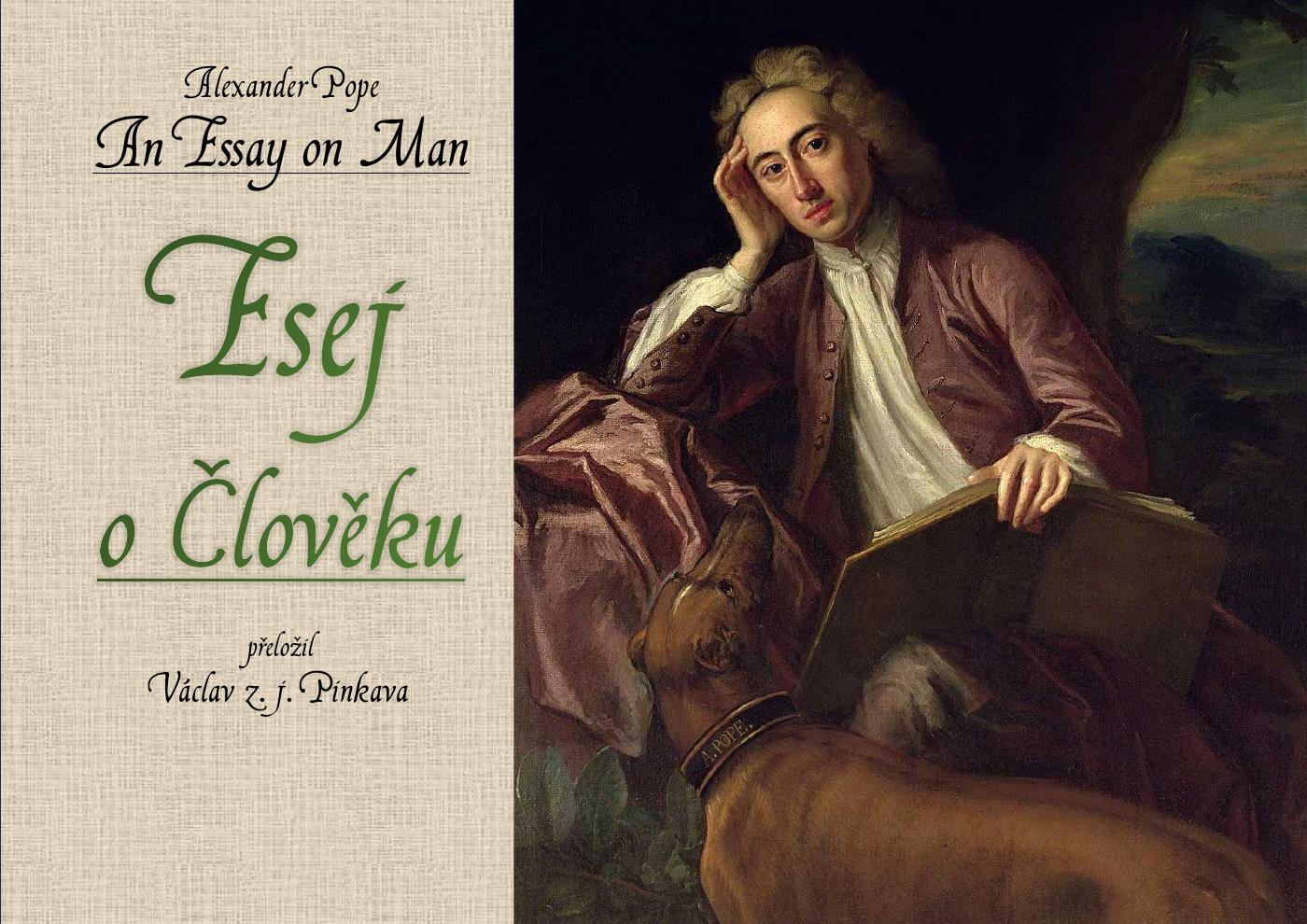
| ESEJ O ČLOVĚKU ... ... ... Znej sebe, Boha znát tě nečeká Lidstvo má studovati Člověka. Hle na výběžku středostavu sní Tvor temně moudrý, hrubě noblesní: má vědomostí moc na skeptika, má přiliš slabostí na stoika, co dál, zda vůbec, řeší k nevíře; zda mít se za Boha či za zvíře; zda mysl nad tělo by zbožňoval; žije by mřel, myslí by chyboval; tak v neznalosti, řeší o to spíš ať myslí málo nebo přespříliš; Chaos je, Úvah s Vášní zmítání; sám terčem zneužití, poznání; vždy polostoupá polopadaje; pán tvorstva, jejich kořistí co je; rozhodce pravd, vždy, opět mamlasem; je světa slávou, vtipem, rébusem. ... ... ... |
AN ESSAY ON MAN ... ... ... Know then thyself, presume not God to scan The proper study of Mankind is Man. Placed on this isthmus of a middle state, A Being darkly wise, and rudely great: With too much knowledge for the Sceptic side, With too much weakness for the Stoic's pride, He hangs between; in doubt to act, or rest; In doubt to deem himself a God, or Beast; In doubt his mind and body to prefer; Born but to die, and reas'ning but to err; Alike in ignorance, his reason such Whether he thinks to little, or too much; Chaos of Thought and Passion, all confus'd; Still by himself, abus'd or disabus'd; Created half to rise and half to fall; Great Lord of all things, yet a prey to all, Sole judge of truth, in endless error hurl'd; The glory, jest and riddle of the world. ... ... ... |
| BRITÁNIE, VLÁDNI! Když, z nebes vůle, Británie vyvstala z azurových vln, tak zněla charta toho kraje, andělů strážných nápěv pln: „Británie, vládni! vlnám všem: Žádný Brit nebude otrokem.“ Národy, požehnané méně, padnou v tyranů nástraze; ty trváš, velká volná země, všem na obdiv, i k výstraze. „Británie, vládni! vlnám všem: Žádný Brit nebude otrokem.“ Majestát vzkvétá, sílí krása, z úžasných, zdárných tažení; z burácení, jež nebe drásá, rodný dub hloubí kořeny. „Británie, vládni! vlnám všem: Žádný Brit nebude otrokem.“ Tyrani zpupní nezkrotí tě: snaha tě ohnout, marná jest, schopna jen vznítit zápal, hbitě; v prospěch tvůj, a jim za bolest. „Británie, vládni! vlnám všem: Žádný Brit nebude otrokem.“ Rozlehlou vládneš nad krajinou obchod v tvých městech zazáří: poddanství vod až kam se linou, kol obtékaných pobřeží. „Británie, vládni! vlnám všem: Žádný Brit nebude otrokem.“ Múzy, jež volnost přitahuje se ku tvým břehům obrací; Blažený ostrov! Krása tu je, srdnatých dost, ji chránící. „Británie, vládni! vlnám všem: Žádný Brit nebude otrokem.“ |
RULE, BRITANNIA! When Britain first, at Heaven's command Arose from out the azure main; This was the charter of the land, And guardian angels sang this strain: “Rule, Britannia! rule the waves:” “Britons never will be slaves.” The nations, not so blest as thee, Must, in their turns, to tyrants fall; While thou shalt flourish great and free, The dread and envy of them all. “Rule, Britannia! rule the waves:” “Britons never will be slaves.” Still more majestic shalt thou rise, More dreadful, from each foreign stroke; As the loud blast that tears the skies, Serves but to root thy native oak. “Rule, Britannia! rule the waves:” “Britons never will be slaves.” Thee haughty tyrants ne'er shall tame: All their attempts to bend thee down, Will but arouse thy generous flame; But work their woe, and thy renown. “Rule, Britannia! rule the waves:” “Britons never will be slaves.” To thee belongs the rural reign; Thy cities shall with commerce shine: All thine shall be the subject main, And every shore it circles thine. “Rule, Britannia! rule the waves:” “Britons never will be slaves.” The Muses, still with freedom found, Shall to thy happy coast repair; Blest Isle! With matchless beauty crown'd, And manly hearts to guard the fair. “Rule, Britannia! rule the waves:” “Britons never will be slaves.” |
| ÓDA K ÚMRTÍ OBLÍBENÉ KOČKY Na boku vázy, oblých stěn, kde čínský um byl vypálen v azuru, květin lad; Žíhaná skromnost dojímá, kde klimbající Selima hledí do lůna vod. Ocas, dál bdící útvar jen, kulatá tvář, vous z bílých pěn packy ze sametu, kožich, co želvy vzorek má, oušek čerň, očka zelená zasněna, přede tu. Dál hleděla by, tok se hnul, dvou ladných forem záblesk vplul, potoků génií, jsouc obrněné v nachu tak, ač purpur dominuje zrak, i zlatá probíjí. Tu Nymfy úžas, zírání vousku kmit, drápek, zívání ne z nudy, rozvička, natáhne pracku, co to dá. Kterápak zlatu odolá? Má dost ryb, kočička? Troufalá! Zisku na dohled napřáhlá, natahuje hřbet, přehlíží předklon snad, (Štěsteny škleb má špatný vkus) po kluzkých vázy stěnách skluz, po hlavě do vod pád. Osmkrát hlava nad vodou, všem vody bohům mňouká svou prosbu o spasení, Delfín ni víla netuší, kluk ani slečna neslyší miláčka doznění. Tu příklad berte, milé mé, je pozdě když se uklouzne, šetřte své náruči. Ne vše váš zápal zaslouží, ač oči, srdce zatouží, lesk zlato neznačí. |
ODE ON THE DEATH OF A FAVOURITE CAT 'TWAS on a lofty vase's side, Where China's gayest art had dy'd The azure flowers that blow; Demurest of the tabby kind, The pensive Selima reclin'd, Gaz'd on the lake below. Her conscious tail her joy declar'd; The fair round face, the snowy beard, The velvet of her paws, Her coat, that with the tortoise vies, Her ears of jet, and emerald eyes, She saw, and purr'd applause. Still had she gaz'd; but midst the tide Two beauteous forms were seen to glide, The Genii of the stream; Their scaly armour's Tyrian hue, Through richest purple, to the view, Betray'd a golden gleam. The hapless Nymph with wonder saw: A whisker first, and then a claw, With many an ardent wish, She stretch'd, in vain, to reach the prize. What female heart can gold despise? What cat's averse to fish? Presumptuous Maid! with looks intent Again she stretch'd, again she bent, Nor knew the gulph between; (Malignant Fate sat by, and smil'd.) The slippery verge her feet beguil'd; She tumbled headlong in. Eight times emerging from the flood, She mew'd to every watery God, Some speedy aid to send. No Dolphin came, no Nereid stir'd: Nor cruel Tom, nor Susan heard. A favourite has no friend. From hence, ye beauties, undeceiv'd, Know, one false step is ne'er retriev'd, And be with caution bold. Not all that tempts your wandering eyes And heedless hearts, is lawful prize; Nor all, that glisters, gold. |
| K ÚMRTÍ PANA RICHARDA WESTA Marně na mne úsvit usměvavý, Fébus růžolící svým zlatem žhne; Ptáci marně lásku zpěvem slaví; Louky nosí své svršky zeleně: Sluch můj však po jiných tónech prahne, Jinou podívanou hledá zrak; Nitro smutek, úzkost jen mi stáhne, z radosti v mém srdci je jen vrak. Ráno ostatním je k povzbuzení, Novorozené radosti přináší; Luhy žádoucím k povyražení; Štěbetavce nic z lásky neruší; Zatímco já proň bez odezvy lkám, A o to víc, že bezvýsledně, sám. |
ON THE DEATH OF MR. RICHARD WEST In vain to me the smiling mornings shine, And reddening Phoebus lifts his golden fire; The birds in vain their amorous descant join; Or cheerful fields resume their green attire: These ears, alas! for other notes repine, A different object do these eyes require; My lonely anguish melts no heart but mine, And in my breast the imperfect joys expire. Yet morning smiles the busy race to cheer, And newborn pleasure brings to happier men; The fields to all their wonted tribute bear; To warm their little loves the birds complain; I fruitless mourn to him that cannot hear, And weep the more because I weep in vain. |
| JERUZALÉM Zdalipak kdysi kráčel On anglických výšin zelení? Beránek Boží zda kdy byl na pastvách hebkých spatřený? Či zda tvář Božská, nádherná, rozžehla kopce pochmurné? Jeruzalém, zda stavěl zde, kde mlýny stíní, ďábelské? Podej můj luk, zlatem co plá: Přines mé šípy toužení: Mé kopí sem: pryč, mračna zlá! Můj kočár, výhně tažení. Neustane mé snažení, meč v ruce mé dřív neusne, než vztyčíme Jeruzalém, v zeleni krásné Anglie. |
JERUSALEM And did those feet in ancient time Walk upon England's mountains green? And was the holy Lamb of God On England's pleasant pastures seen? And did the Countenance Divine Shine forth upon our clouded hills? And was Jerusalem builded here Among these dark Satanic mills? Bring me my bow of burning gold: Bring me my arrows of desire: Bring me my spear: O clouds unfold! Bring me my chariot of fire. I will not cease from mental fight, Nor shall my sword sleep in my hand Till we have built Jerusalem In England's green and pleasant land. |
| TYGR Tygře! Tygře! planoucí, pralesovou pranocí; čí nezmarný dotek, zrak souměrný děs sepjal tak? V jakých hloubkách nebeských planul zápal očí tvých? křídla na nichž prahnul výš? plamen v hrsti sevřel, týž? Které rámě, dovedné spřadlo v šlachy srdce tvé? a když srdce začlo bít, hrůzná dlaň? Tvé tlapy mít. Kladivem? A řetězem? v jaké výhni dal ti vjem? Kovadlinou? V kleštích as sevřel smrtící tvůj ďas. Hvězdy svrhly kopí svá, zaslzela nebesa: Zdali hřeje to či zebe, stvořit beránka, pak tebe? Tygře! Tygře! planoucí, pralesovou pranocí; čí nezmarný dotek, zrak, souměrný děs sepjal tak? |
THE TYGER Tyger, Tyger. burning bright, In the forests of the night; What immortal hand or eye. Could frame thy fearful symmetry? In what distant deeps or skies. Burnt the fire of thine eyes? On what wings dare he aspire? What the hand, dare seize the fire? And what shoulder, or what art, Could twist the sinews of thy heart? And when thy heart began to beat. What dread hand? & what dread feet? What the hammer? What the chain, In what furnace was thy brain? What the anvil? what dread grasp. Dare its deadly terrors clasp? When the stars threw down their spears And water'd heaven with their tears: Did he smile his work to see? Did he who made the Lamb make thee? Tyger, Tyger burning bright, In the forests of the night: What immortal hand or eye, Dare frame thy fearful symmetry? |
| NEBLAHÁ RŮŽE Ó Růže, churavíš! Červ, očím skrytý, co za noci létá, skrz bouře vytí, odkryl tvé lože z karmínu blaha: A jeho temná tajná vášeň Ti na život sahá. |
THE SICK ROSE O Rose, thou art sick! The invisible worm That flies in the night, In the howling storm, Has found out thy bed Of crimson joy: And his dark secret love Does thy life destroy. |
| Ze zrnka písku pojmout svět nebe zřít v lučním kvítí, nekonečno v dlani podržet a v hodině věčně žíti. ... |
To see a world in a Grain of Sand, And a Heaven in a Wild Flower, Hold Infinity in the palm of your hand, And eternity in an hour. ... |
| NA STARÉ ČASY Refrén: Na staré časy, brachu můj, na starodávný čas , dejme si pohár vlídnosti, ať žije starý čas, 1. Snad starou známost nechat být, paměti napospas? Než starou známost nechat být, ať žije starý čas. 2. A jistě žejdlík utáhneš! A já svůj, nadoraz! A dáme sklenku vláhy, též, na starodávný čas. 3. Však my dva tudy běhali sbírali sedmikrás; pak dost se potrmáceli, jak utíkal nám čas. 4. My dva tu v říčce brouzdali, od rána, než den zhas; než moře dál nás rozdělí jak v uplynulý čas. 5. Tak ruku ber, můj příteli! Tu svou mi podej, tas! A číše aby zvedaly, na časy staré zas. |
AULD LANG SYNE Chorus: And for auld lang syne, my jo, For auld lang syne, We'll tak a cup o' kindness yet, For auld lang syne, 1. Should auld acquaintance be forgot, And never brought to mind? Should auld acquaintance be forgot, And days o' auld lang syne. 2. And surely ye'll be your pint-stowp! And surely I'll be mine! And we'll tak a cup o' kindness yet, For auld lang syne. 3. We twa hae run about the braes And pu'd the gowans fine; But we've wander'd mony a weary foot Sin auld lang syne. 4. We twa hae paidl'd i' the burn, Frae mornin' sun till dine; But seas between us braid hae roar'd Sin auld lang syne. 5. And there's a hand, my trusty fiere! And gie's a hand o' thine! And we'll tak a right guid willy waught, For auld lang syne. |
| KNIHOMOLŮM Skrz naskrz listy nápadů si larvy napadejte; Však k Lordstvu mějte ohledů, zlatý hřbet nesnídejte. |
TO THE BOOK-WORMS Through and through th' inspir'd leaves, Ye maggots, make your windings; But O respect his lordship's taste, And spare his golden bindings. |
| Svět je nám příliš blízký; pozdě,
brzy, pachtěním planým promarňujem síly; k Přirodě netečnost jsme zakoupili, zaprodali jsme srdce, kupčí drzí! Moře, co k měsíci se vzpíná prsy, vichry, co téměř neúnavně kvílí usebírají se jak kvítí chvíli, k tomu jsme slepí, hluší, až to mrzí; avšak nás ne. — Bože! Jak oslovuje být Pohan, dávným krédem odkojený; jak on bych stál na lučině co tu je, v záblescích abych, neosamocený, zřel Protea, jak z vod se vynořuje; či slyšel Tritóna roh ověnčený. |
The world is too much with us; late
and soon Getting and spending, we lay waste our powers; Little we see in Nature that is ours; We have given our hearts away, a sordid boon! This Sea that bares her bosom to the moon, The winds that will be howling at all hours, And are up-gathered now like sleeping flowers, For this, for everything, we are out of tune; It moves us not. — Great God! I'd rather be A Pagan suckled in a creed outworn; So might I, standing on this pleasant lea, Have glimpses that would make me less forlorn; Have sight of Proteus rising from the sea; Or hear old Triton blow his wreathed horn. |
| ŠEL JSEM SÁM JAKO OBLÁČEK (Narcisy) Šel jsem sám jako obláček přes dolin, kopců kulisu, když natrefil jsem na hlouček, družinu zlatých narcisů; u jezera, pod stromovím, chvěly se tancem čechravým. Dál vedly jako hvězdičky jichž třpytem Mléčná dráha je, táhly se cestou bez konce, co zátoky kraj lemuje: na deset tisíc do dáli, hlavami k tanci kývaly. Vlnky se k tanci měly též; však odleskem byl jejich třpyt: Básníku zajásej a běž k té družině se veselit: hleděl jsem dál — a netušil jak obohacen vším jsem byl: Často, když na pohovce dnes se v duchu toulám, rozjímám, rozsvítí vnitřní zrak můj, kdes uvnitř jsem oblažen, byť sám; Srdce se kochá, splní si přání zas tančit s narcisy. |
I WANDERED LONELY AS A CLOUD (Daffodils) I wandered lonely as a cloud; That floats on high o'er vales and hills, When all at once I saw a crowd, A host of golden daffodils; Beside the lake, beneath the trees, Fluttering and dancing in the breeze. Continuous as the stars that shine and twinkle on the Milky Way, They stretched in never-ending line along the margin of a bay: Ten thousand saw I at a glance, tossing their heads in sprightly dance. The waves beside them danced; but they Out-did the sparkling waves in glee: A poet could not but be gay, in such a jocund company: I gazed — and gazed — but little thought what wealth the show to me had brought: For oft, when on my couch I lie In vacant or in pensive mood, They flash upon that inward eye Which is the bliss of solitude; And then my heart with pleasure fills, And dances with the daffodils. |
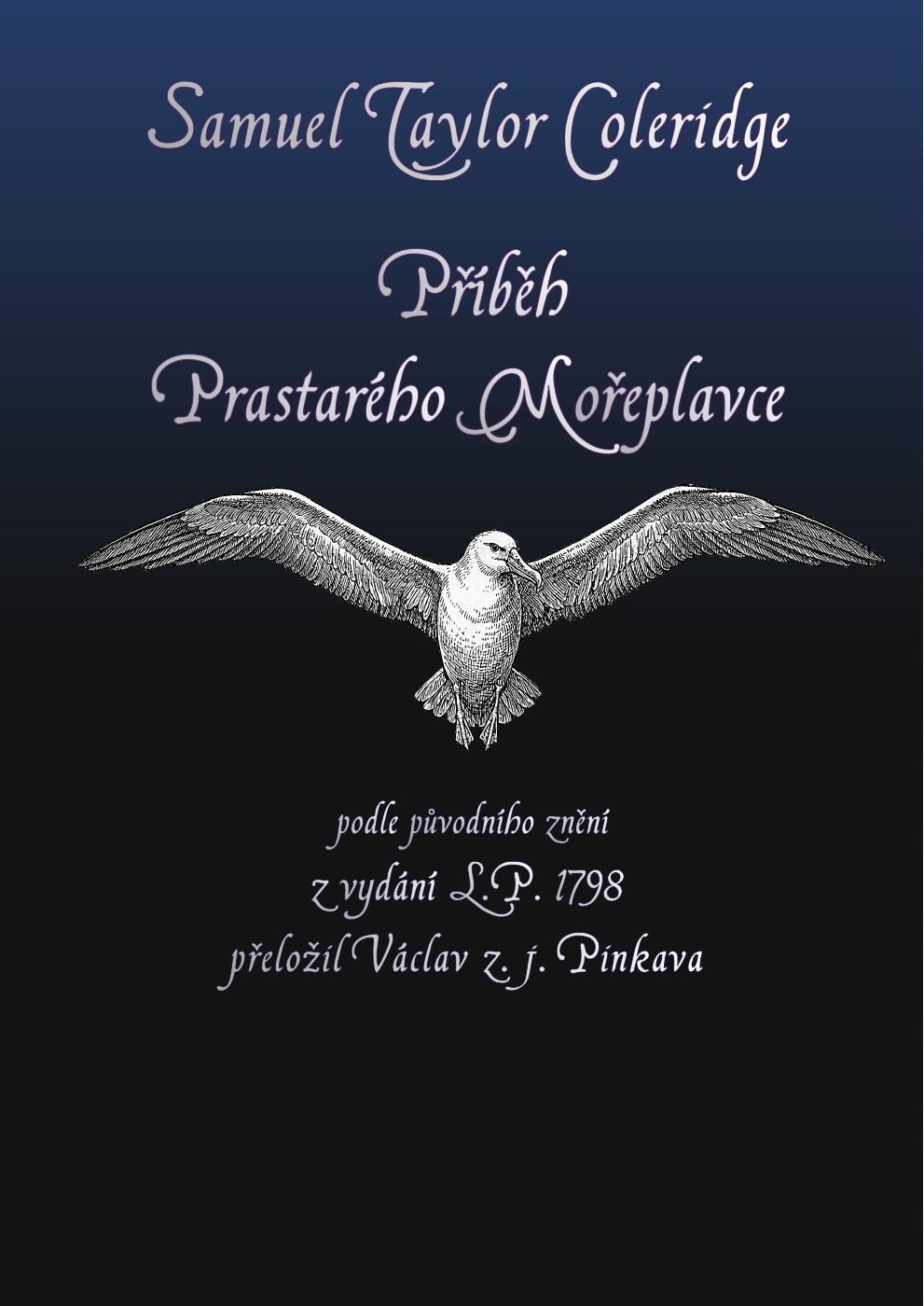
| PŘÍBĚH PRASTARÉHO MOŘEPLAVCE Prastarý mořeplavec; z tří jednoho zadržel. 'Bradáči, okem jiskřivý, proč bráníš, abych šel? Dokořán ženichova síň přízeň jsem, spěchám již; Družina hostů, hostina — hlaholí sem, však slyš.' Hubenou rukou drží jej, 'Byl koráb…', sípá hlas. 'Pusť! Ruku pryč ty zmatenče!' Hnát hbitě stáhnul zas. Jiskřivým okem drží jej — silou to nezvyklou, jak tříletý, host poslouchá: kmet prosadil si svou. Svatebčan, nucen naslouchat: na balvan tu si sed; dál hovořil naň prastarec, námořník jasnozřet. 'Loď salvou slávy z přístavu vesele proplula kostela, kopce, majáku hrot v obzor zasula. Slunce terč z hlubin objevný zleva se vynořil! Žhnul, prahnul, než se vpravo zas do moře ponořil. Výše a výše každým dnem, až v půlden nad stěžej — ' Svatebčan v hruď se udeřil když fanfár zaslech rej. Nevěsta v síň as vkročila květ růže červený; a předvoj hudební šel s ní, kývaje rameny. Svatebčan v hruď se udeřiv, naslouchal, nucen přec; dál hovořil naň námořník, jasnozřet, prastarec. 'Tu BOUŘE VICHR přitužil, tyranskou sílu měl: hbit peruťemi mávaje na jih nás naháněl. Stěžňovím, přídí skosený jak běžec, běsem stíhaný, stín zlobným honcem vrhaný šlape dál, předkloněn, koráb se štval, dál vichr řval, než v jih zor neupřen. Tu mlhy přišly se sněhem a divotvorný mráz: led nad stěžej, a čišel z něj až smaragdový jas. Zkrz průrvy ker tu sněhů krov sinavý jímal lesk: živáčka zrak se nedočkal — jen led byl kol a stesk. Jen led byl tu a led byl tam led měl nás v zajetí: praskal a mrul, a úpěl, vyl, sténal jak v objetí! Po dlouhé době Albatros zjevil se, přístál z mlh; jak křesťana jsme vítali jej, na rtech „Zdařiž Bůh.“ Krm přijal sobě nezvyklou, kroužil kol. Obkroužen, led vydal třesk a ve dví prask; lodivod proplul ven! Vítr se z jihu svěží zdvih; Albatros s námi spolu, ke krmi, či jen za hrami, co den zván slétal dolů! Ve mračnech, mlhách, na ráhnech když klekání zvon zněl sedal, s ním noční mlžný dým luny svit zabělel.' 'Bůh žehnej, mořský prastarče! Chraň, ode tvých prokletí! — Ký běs tě jal?' — 'Mé kuše stal se ALBATROS obětí.' ... |
THE RIME OF THE ANCIENT MARINER It is an ancient Mariner, And he stoppeth one of three. 'By thy long beard and glittering eye, Now wherefore stopp'st thou me? The Bridegroom's doors are opened wide, And I am next of kin; The guests are met, the feast is set: May'st hear the merry din.' He holds him with his skinny hand, 'There was a ship,' quoth he. 'Hold off ! unhand me, grey-beard loon!' Eftsoons his hand dropt he. He holds him with his glittering eye — The Wedding-Guest stood still, And listens like a three years' child: The Mariner hath his will. The Wedding-Guest sat on a stone: He cannot choose but hear; And thus spake on that ancient man, The bright-eyed Mariner. 'The ship was cheered, the harbour cleared, Merrily did we drop Below the kirk, below the hill, Below the lighthouse top. The Sun came up upon the left, Out of the sea came he! And he shone bright, and on the right Went down into the sea. Higher and higher every day, Till over the mast at noon —' The Wedding-Guest here beat his breast, For he heard the loud bassoon. The bride hath paced into the hall, Red as a rose is she; Nodding their heads before her goes The merry minstrelsy. The Wedding-Guest he beat his breast, Yet he cannot choose but hear; And thus spake on that ancient man, The bright-eyed Mariner. 'And now the STORM-BLAST came, and he Was tyrannous and strong: He struck with his o'ertaking wings, And chased us south along With sloping masts and dipping prow, As who pursued with yell and blow Still treads the shadow of his foe, And forward bends his head, The ship drove fast, loud roared the blast, The southward aye we fled. And now there came both mist and snow, And it grew wondrous cold: And ice, mast-high, came floating by, As green as emerald. And through the drifts the snowy clifts Did send a dismal sheen: Nor shapes of men nor beasts we ken — The ice was all between. The ice was here, the ice was there, The ice was all around: It cracked and growled, and roared and howled, Like noises in a swound! At length did cross an Albatross, Thorough the fog it came As if it had been a Christian soul, We hailed it in God's name. It ate the food it ne'er had eat, And round and round it flew. The ice did split with a thunder-fit; The helmsman steered us through! And a good south wind sprung up behind; The Albatross did follow, And every day, for food or play, Came to the mariner's hollo! In mist or cloud, on mast or shroud, It perched for vespers nine; Whiles all the night, through fog-smoke white, Glimmered the white Moon-shine.' 'God save thee, ancient Mariner! From the fiends, that plague thee thus! — Why look'st thou so?' — 'With my cross-bow I shot the ALBATROSS.' ... |
| XANADU Ve Xanadu si Kublaj-chán klenutý palác usmyslel: kde tok řeky Alfy posvátné skrz jeskynní průrvy závratné k nočnímu moři spěl. Tak dvakrát pět mil půdy vzal věžovím hradeb obehnal: zahrady unvitř, křivky potoků, tu vzácné vonné stromy pučely, tu hvozdy horské, starší proroků, kol mýtin prosluněných hučely. ... |
XANADU In Xanadu did Kubla Khan A stately pleasure-dome decree: Where Alph, the sacred river, ran Through caverns measureless to man Down to a sunless sea. So twice five miles of fertile ground With walls and towers were girdled round: And there were gardens bright with sinuous rills, Where blossomed many an incense-bearing tree; And here were forests ancient as the hills, Enfolding sunny spots of greenery. ... |
| OBRANA PEVNOSTI McHENRY (Hvězdotřpytný prapor) Ó sděl mi, zda zříš, v ranném úsvitu zas, témuž vzdali jsme hold, hrdě v soumraku sirém, pruhů ráz a hvězd jas, skrze hrůzný boj, náš vábil zrak, chrabře přes hradby, v rozletu širém? Rudá rakety záře, třesk výbušné ráže, byly za svědky, co prapor ustát dokáže; Ó sděl, hvězdotřpytný prapor, vlá stále na svém, nad zemí svobodných, statečných domovem? Na břehu, zastřeném z hlubin závojem mlh, z nepřátel zpupné hordy, děs ticha jen zbývá, Co to tam, s čím si vánek, kde tyčí se vrch, pohrává, vrtkavě cosi skrývá, odkrývá? Chytá paprsek dnes, kterýž rozbřesk naň vznes, pouhý odlesk té slávy dá hladině lesk. Toť hvězdotřpytný prapor — Ó ať vlá dál, na svém, nad zemí svobodných, statečných domovem! Kdepak banda ta je, přísahy závadné, chlubivé, že spoušť války, zmar porážky jisté nám ni domov, ni vlast, nenechá pražádné? Vlastní krví už smyli své stopy nečisté. Není úkryt, být žoldákem, nevolníkem, před děsem útěku, trudným náhrobníkem. Vítězně, hvězdotřpytný prapor tu vlaje, na svém, nad zemí svobodných, statečných domovem. Ó budiž tak vždy, kde svobodných hráz hájí domovy milé před válečnou spouští! Blažený zdárný mír; račiž zem, nebi spás vznést chvalozpěv, Moci, jež nás neopouští! Nutně pak vyhrajem, neboť po právu jdem, a buď naše motto — „Bohu důvěřujem.“ Ať hvězdotřpytný prapor hrdě vlá, dál, na svém, nad zemí svobodných, statečných domovem! |
DEFENCE OF FORT McHENRY* (The Star-Spangled Banner) O say can you see by the dawn’s early light What so proudly we hail'd at the twilight’s last gleaming, Whose broad stripes & bright stars through the perilous fight, O’er the ramparts we watch'd, were so gallantly streaming? And the rocket's red glare, the bomb bursting in air, Gave proof through the night that our flag was still there; O say does that star-spangled banner yet wave O’er the land of the free & the home of the brave? On the shore, dimly seen through the mists of the deep, Where the foe’s haughty host in dread silence reposes, What is that which the breeze, o’er the towering steep, As it fitfully blows, half conceals, half discloses? Now it catches the gleam of the morning’s first beam, In full glory reflected, now shines on the stream ’Tis the star-spangled banner — O long may it wave O’er the land of the free & the home of the brave! And where is that band who so vauntingly swore, That the havoc of war & the battle’s confusion A home & a Country should leave us no more? Their blood has wash'd out their foul footstep’s pollution. No refuge could save the hireling & slave From the terror of flight or the gloom of the grave, And the star-spangled banner in triumph doth wave O’er the land of the free & the home of the brave. O thus be it ever, when freemen shall stand Between their loved homes and the war’s desolation! Blest with vict’ry & peace, may the heav’n rescued land Praise the Power that hath made & preserv'd us a nation! Then conquer we must, when our cause it is just, And this be our motto — “In God is our trust.” And the star-spangled banner in triumph shall wave O’er the land of the free & the home of the brave. (*original manuscript version) |
| ARGUMENT Říkávají mi preláti, ať čin je přán či napáchán, že Nebe choutky hodnotí jak kdyby čin byl dokonán. Když choutky si trest vyslouží pak nás je třeba potrestat; Pojď, vždyť si člověk zaslouží za trest svůj vinu vychutnat! |
AN ARGUMENT I've oft been told by learned friars, That wishing and the crime are one, And Heaven punishes desires As much as if the deed were done. If wishing damns us, you and I Are damned to all our heart's content; Come, then, at least we may enjoy Some pleasure for our punishment! |
| LÁSKA A ZÁŠŤ Když jsem tě miloval, dlužno říct, že kouzelné chvíle jsme měli; Co k tobě cítím teď, posměch, je víc než luxusní pocit a skvělý. Ať už jsme spolu či od sebe zas, kouzlo ti nevyprchává; Milovat tě, to je pohody čas; Zášť k tobě! To je slast pravá! |
LOVE AND HATE When I loved you, I can't but allow I had many an exquisite minute; But the scorn that I feel for you now Hath even more luxury in it. Thus, whether we're on or we're off, Some witchery seems to await you; To love you was pleasant enough, And, oh! 'tis delicious hate you!. |
| ŘÁDKY VYRYTÉ NA ČÍŠI Z LEBKY Neboj — mám šťávu dál, buď zdráv; před tebou lebka jediná ze které, ne jak z živých hlav, perlí vše, nejen bublina. Žil jsem, měl rád a pil jak ty: zemřel: mých kostí zem je sklad; nalej si — máš nad červa rty mně neuškodíš; tak buď rád. Raděj v mé schránce vína šum než chovat červů slizký rod, být schránkou božským nápojům, než ještěrům larv miska vhod. Kde zářil kdys můj důvtip, snad, ať druhým svítím k prospěchu; když hlava prázdná, želbůh, nad víno znáš lepší útěchu? Pij dokud smíš: rod přijde, den, po tobě, tvých, jak po mně spěl, z náručí země vyjme ven s mrtvými aby dováděl. Proč ne? Když žitím zpraseni chrlily hlavy ničemů, od červů, hlíny spaseni, ať slouží, dobří k něčemu. |
LINES INSCRIBED UPON A CUP FORMED
FROM A SKULL Start not — nor deem my spirit fled; In me behold the only skull From which, unlike a living head, Whatever flows is never dull. I lived, I loved, I quaffed, like thee: I died: let earth my bones resign; Fill up — thou canst not injure me; The worm hath fouler lips than thine. Better to hold the sparkling grape, Than nurse the earth-worm's slimy brood; And circle in the goblet's shape The drink of gods, than reptile's food. Where once my wit, perchance, hath shone, In aid of others' let me shine; And when, alas! our brains are gone, What nobler substitute than wine? Quaff while thou canst: another race, When thou and thine, like me, are sped, May rescue thee from earth's embrace, And rhyme and revel with the dead. Why not? since through life's little day Our heads such sad effects produce; Redeemed from worms and wasting clay, This chance is theirs, to be of use. |
| DOST BYLO VANDROVÁNÍ Dost bylo už vandrování do nocí do pozdních, byť v srdci dál milování, dál luna září v nich. Dočasný toulec k meči, hruď k duši, na pár chvil, a nádech srdci svědčí, a lásce, nabrat sil. Byť noc byla k milování, den přichází zbrkle zas, přec dost bylo vandrování kde náš byl luny jas. |
SO WE’LL GO NO MORE A-ROVING So we'll go no more a-roving So late into the night, Though the heart still be as loving, And the moon still be as bright. For the sword outwears its sheath, And the soul outwears the breast, And the heart must pause to breathe, And love itself have rest. Though the night was made for loving, And the day returns too soon, Yet we'll go no more a-roving By the light of the moon. |
| TAJEMSTVÍ LÁSKY Nehleď lásku vyslovit, nevyřčena trvá jen; vánek pouhý pohne cit potichounku, neviděn. Vyznal jsem lásku lásce své, z celého srdce tak, třásl se, zimomřivě, bál. ach, odešla mi pak! A poté co mne nechala, poutník se dostavil, potichounku, neviděn: vzal ji, jen povzdech zbyl. |
LOVE’S SECRET Never seek to tell thy love, Love that never told can be; For the gentle wind doth move Silently, invisibly. I told my love, I told my love, I told her all my heart, Trembling, cold, in ghastly fears. Ah! she did depart! Soon after she was gone from me, A traveller came by, Silently, invisibly: He took her with a sigh. |
| DEJ VYŠŠÍ SVĚT Dej aby vyšší — další svět za našim, trvat lásce přál; dej srdce blízká připouštět a oko vpustit — bez slz, dál — Žádoucí nedotčený ráj! Jak do hodiny mřel bych rád! Vznést se výš, ztratit bázně kraj navždy v tvém světle —věčný řád! Jistěže —není kvůli nám náš třes, když hranu tušíme, dychtíme přes sráz, skočit tam, leč Bytí zlom dál klížíme. Ach! na budoucno dbej a zvol dbát štedrých srdcí sdružení; pít živou vodu věčnou, spol, duší vzrůst, věčné sblížení! |
IF THAT HIGH WORLD If that high world — which lies beyond Our own, surviving love endears; If there the cherished heart be fond, The eye the same — except in tears — How welcome those untrodden spheres! How sweet this very hour to die! To soar from earth and find all fears Lost in thy light — eternity! It must be so — ’tis not for self That we so tremble on the brink, And striving to o’erleap the gulph, Yet cling to Being’s breaking link. Oh! in that future let us think To hold each heart the heart that shares; With them the immortal waters drink, And soul in soul grow deathless theirs! |
| OSAMĚLOST Ne ze skal, šíř vod, vřesů přebírat, obhlížet zvolna hvozd, kraj stinných změn, domov jen tvorů mimolidských snad, kročeji smrtelníků nedotčen; na horu, mimo stezky, neviděn kde stádo pohrdá svou ohradou; sám přes srázy, pěn pády předkloněn; to není samota, jen s Přirodou rozhovor, v obdivu nad její úrodou. Však vmíšen v davu, shonu lidí všech vše slyšet, vidět, pocítit a mít, na toulkách sám, znavený světaběh, požehnaných bez požehnání zřít; sláv sluhy jen, jež nelze zatížit! A z toho nic, kdybychom dohodou, ubrali, štěstí není komu vzít, pochlebníkům dychtivých lakotou; osamělost; to, to je samotou! |
SOLITUDE To sit on rocks, to muse o’er flood and fell, To slowly trace the forest’s shady scene, Where things that own not man’s dominion dwell, And mortal foot hath ne’er or rarely been; To climb the trackless mountain all unseen, With the wild flock that never needs a fold; Alone o’er steeps and foaming falls to lean; This is not solitude, ’tis but to hold Converse with Nature’s charms, and view her stores unrolled. But midst the crowd, the hurry, the shock of men, To hear, to see, to feel and to possess, And roam alone, the world’s tired denizen, With none who bless us, none whom we can bless; Minions of splendour shrinking from distress! None that, with kindred consciousness endued, If we were not, would seem to smile the less Of all the flattered, followed, sought and sued; This is to be alone; this, this is solitude! |
| KRÁČÍ KOL V KRÁSE Kráčí kol, plna noci krás bezmračných končin hvězdnatých; a výběr tmy a světla svaz má v držení a očích svých: Tak lahodí ji měkký jas nebem dni upřen, než by ztich. Stín přidat, paprsek či vzít, krátil bych půvab bez jména, havraní kadeř rozvlnit, kol skrání lehce prostřena; tvář, sladkých úvah dýše klid mysli, jež v ní dlí, zasněna. Na líci její, čele, kdež, je lad a tichá výřečnost, usměv zve, z něj nezáří než dobrota zažitá a ctnost, duše, jež mír všem snáší též, a srdce lásky nevinnost! |
SHE WALKS IN BEAUTY She walks in beauty, like the night Of cloudless climes and starry skies; And all that's best of dark and bright Meet in her aspect and her eyes: Thus mellowed to that tender light Which heaven to gaudy day denies. One shade the more, one ray the less, Had half impaired the nameless grace Which waves in every raven tress, Or softly lightens o'er her face; Where thoughts serenely sweet express How pure, how dear their dwelling-place. And on that cheek, and o'er that brow, So soft, so calm, yet eloquent, The smiles that win, the tints that glow, But tell of days in goodness spent, A mind at peace with all below, A heart whose love is innocent! |
| OZYMANDIAS Muž vyprávěl, zpět z krajin antických, jak obrovité nohy, kamenné stály tam v písku, samy, vedle nich tvář prasklá, na rtech vrásky úšklebné, a nadřazenost v očích vychladlých svědčí, jak sochař vášně zachytil, razil do hmoty mrtvé, zlehčoval, srdečně posměch v opis navždy vryl. A na podstavci slova, poselství: „Ozymandias zovu, králů král: Vizte mé dílo Mocní, v zoufalství!“ Nezbylo nic krom ostatků: kde stál, kol obřích trosek pustin prostranství, písečné pláně líně táhnou v dál. Cestovatel, ze země antické, sounoží kolosální stát tam zřel v písku, kol trosky tváře nadlidské, jíž na rtech úškleb panovačný pěl o kamenosochaři epickém, který tak dobře vášně přečet, chyt a vtisk, do mrtvé hmoty city dal, klam rukou lehčil, celým srdcem syt. Na podstavci tam písmena se pnou: „Ozymandias zovu, králů král: vy Mocní zoufejte před Slávou mou!“ Škoda slov: kol obří rozvaliny jen dílo zkázy vládne pustinou, rovný písek, nikde ani stíny. Na podstavci se tento nápis pne: „Ozymandias zovu, králů král: hle, Mocní zoufejte před Výsostí!“ Jen ostatky: okolo trosek spoušť obrovská, pusté písky věčnosti, samota, rovnost, nekonečná poušť. Poutníka potkal jsem z antické země: prý obří kamenné nohy, bez těla, na poušti stojí. A opodál zřejmě svalená, rozbitá tvář se mračila vrásčitě, křivě, jízlivě, studeně, na důkaz sochař že vášně čet, chytil jak živé do hmoty vtisknout, že znal. V rukou měl posměšek a srdce sytil. Podstavec, na kterém vytesal kdysi: „Ozymandias jsem já, králů král: Hleď na mé dílo, ať Mocní se děsí!“ Prázdno však v okolí: kol rozvaliny obrovských trosek, jen pustiny rysy, samota do dáli, pláň, písek líný. |
OZYMANDIAS I met a traveller from an antique land Who said: Two vast and trunkless legs of stone Stand in the desert. Near them on the sand, Half sunk, a shatter'd visage lies, whose frown And wrinkled lip and sneer of cold command Tell that its sculptor well those passions read Which yet survive, stamp'd on these lifeless things, The hand that mock'd them and the heart that fed. And on the pedestal these words appear: “My name is Ozymandias, king of kings: Look on my works, ye Mighty, and despair!” Nothing beside remains: round the decay Of that colossal wreck, boundless and bare, The lone and level sands stretch far away. |
| OBRAZ ŽENY Mladíci co se ženete, ctižádostivě směšní, že po ránu si přejete Iris poctami zvěčnit. Stop, zastav, zbrklý galáne nedělej stejné chyby; Iris už má šat na sobě, obličej ještě chybí. |
ON A PAINTED WOMAN To youths, who hurry thus away, How silly your desire is At such an early hour to pay Your compliments to Iris. Stop, prithee, stop, ye hasty beaux, No longer urge, this race on; Though Iris has put on her clothes, She has not put her face on. |
| Proč jsem se dneska smál? Ne, nezadá si Bůh, či démon kruté odezvy, z nebes či pekel sem se nevydá Tak srdce svého ptám se, zda to ví: Srdce, my sama v stesku dvojice, proč jsem se smál, ty? Ó smrtelný bol! Tmo! Tmo! Bez konce dotazy sténaje tu nebi, peklu, srdci za úkol? Proč jsem se smál? Vím jak čas dobíhá bytosti, pro niž snil bych přeblaze Přec v dnešní půlnoc budiž zkáza má Z poct světských všech, cáry na podlaze Básní, a sláv a krás, dost mocných chvil Však smrt je víc, života vrchní díl. |
Why did I laugh tonight? No voice
will tell No God, no demon of severe response Deigns to reply from heaven or from hell Then to my human heart I turn at once: Heart, thou and I are here, sad and alone, Say, why did I laugh? O mortal pain! O darkness! darkness! Forever must I moan To question heaven and hell and heart in vain? Why did I laugh? I know this being's lease My fancy to it's utmost blisses spreads Yet would I on this very midnight cease And all the world's gaudy ensigns see in shreds Verse, fame and beauty are intense indeed But death intenser, death is life's high meed. |
| ÓDA JESENI Sezóno mlhoucí, zlatistlá plodhody přítetelící se se sluncem stárnoucím; Spiklenci: Zosnuli jak bříměm úrody poztížit větvím kol došků se vinoucím; Jabloně mechové chaloupky ztěžkali, ovoce zralostí nadýchli do hloubi; nafoukli dýni, vystladili lískoucí lastury jadérky, vpučeli do chlouby květenu pozdní, jež včeličky ošálí, až by se prohřály teplem co otálí Létem byť přetekly komůrky voskvoucí. Kdo přehléd jak hloubíš spíže své podloubí? Kdyby tě hledala výprava horlivá najde tě v usedlosýpce, jak holubí pírka plevlásky tvé vánek si provívá; na brázdě polskosné dřímeš si schouleně opita pohárkem máku vlčichovým srpem svým nedbalým odpouštíš lučinám: po sklizni paběrkuještějdeš vzpřímeně přes potok pod nůší hrdá svým držením; u lisu moštovky jablečné, strpením příkladná, odzváníš po kapkách hodinám. Kdepak si nápěvy Vesny prozpěvují? Nedbej jich, však ty máš své vlastní chorály, — červánky rýhané co dne skon litují, strniska nádechem nachu když opálí; jepičí průvod, co kvílivě zaznívá v mělčinách nadnášen větříkem dozvánek stoupá a klesá jak záchvěv se oboří. Jehňata potůčkyztučnělá, bečivá; cvrčci si ve mlází zpívají; sopránek červenky zazní sem z políčka kropánek; vlaštovky pospolu na nebi švitoří. |
ODE TO AUTUMN Season of mists and mellow fruitfulness, Close bosom-friend of the maturing sun; Conspiring with him how to load and bless With fruit the vines that round the thatch-eves run; To bend with apples the moss'd cottage-trees, And fill all fruit with ripeness to the core; To swell the gourd, and plump the hazel shells With a sweet kernel; to set budding more, And still more, later flowers for the bees, Until they think warm days will never cease, For Summer has o'er-brimm'd their clammy cells. Who hath not seen thee oft amid thy store? Sometimes whoever seeks abroad may find Thee sitting careless on a granary floor, Thy hair soft-lifted by the winnowing wind; Or on a half-reap'd furrow sound asleep, Drows'd with the fume of poppies, while thy hook Spares the next swath and all its twined flowers: And sometimes like a gleaner thou dost keep Steady thy laden head across a brook; Or by a cyder-press, with patient look, Thou watchest the last oozings hours by hours. Where are the songs of Spring? Ay, where are they? Think not of them, thou hast thy music too, — While barred clouds bloom the soft-dying day, And touch the stubble plains with rosy hue; Then in a wailful choir the small gnats mourn Among the river sallows, borne aloft Or sinking as the light wind lives or dies; And full-grown lambs loud bleat from hilly bourn; Hedge-crickets sing; and now with treble soft The red-breast whistles from a garden-croft; And gathering swallows twitter in the skies. |
| SONET XLIII Jak já Tě miluji? Ať sečtu snad. Do hloubky, délky, výšky vypětí mé duše celé až, když v zakletí strádám pro Jsoucno, ryzí Milost, lad. Až po hladinu každodenní, hlad v nitru, jež slunce, svíce osvětí, volně, jak pravé k Pravdě tíhnutí; čistě, jak odklon Chvály bez výhrad. Já miluji Tě s vášní zanícenou do starých smutků, dětské víře vstříc. Jímám Tě láskou téměř poztracenou u všech mých svatých — každý dech mých plic, smích, slzy, život! — vůlí Bohem danou, milovat Tě dál, nesmrtelně, víc. |
SONNET XLIII How do I love thee? Let me count the ways. I love thee to the depth and breadth and height My soul can reach, when feeling out of sight For the ends of Being and ideal Grace. I love thee to the level of everyday's Most quiet need, by sun and candlelight. I love thee freely, as men strive for Right; I love thee purely, as they turn from Praise. I love thee with the passion put to use In my old griefs, and with my childhood's faith. I love thee with a love I seemed to lose With my lost saints, — I love thee with the breath, Smiles, tears, of all my life! — and, if God choose, I shall but love thee better after death. |
| ŽALM ŽIVOTA Neříkej mi, čísly smutku, že je život prázdný sen! — Duše mrtvá, spí-li, vskutku, Vše je jinak, zdání jen. Žít je žít! Žít vroucně spíš! cíl svůj v hrobě nemáš, leč, prach jsi, v prach se obrátíš, nebyla o duši řeč. Ani radost, ani stesky nejsou cílem našich cest; jednat tak, by zítřka stezky dál nás našly, nežli dnes. Díla dálka, času není, v srdcích pevní, stateční jsme, z těch bubnů v utlumení bije pochod smuteční. V bitvě světa širém poli, tábořiště ležení, nejít vpřed jak ovce, voli! Hrdinou buď v tažení! V Příště nevěř, v sebelepší! Minulost nech pohřbít své! Jednej, — v živém Nyní, dnešním! Srdcem, s Pánem co výš zve! Žití velkých připomene, když svůj život pozdvihneš, při odchodu necháš jiné stopy v píscích času, též; Stopy, jimiž bude daný bratru směr kam zamířit v moři, ztracen, ztroskotaný, najde v nich zas sílu žít. Vzhůru, pojďme, odevzdáni čelit srdcem osudu; Nepolevit z odhodlání usilovat, pokud tu. |
A PSALM OF LIFE Tell me not, in mournful numbers, Life is but an empty dream! — For the soul is dead that slumbers, And things are not what they seem. Life is real! Life is earnest! And the grave is not its goal; Dust thou art, to dust returnest, Was not spoken of the soul. Not enjoyment, and not sorrow, Is our destined end or way; But to act, that each to-morrow Find us farther than to-day. Art is long, and Time is fleeting, And our hearts, though stout and brave, Still, like muffled drums, are beating Funeral marches to the grave. In the world's broad field of battle, In the bivouac of Life, Be not like dumb, driven cattle! Be a hero in the strife! Trust no Future, howe'er pleasant! Let the dead Past bury its dead! Act, — act in the living Present! Heart within, and God o'erhead! Lives of great men all remind us We can make our lives sublime, And, departing, leave behind us Footprints on the sands of time; Footprints, that perhaps another, Sailing o'er life's solemn main, A forlorn and shipwrecked brother, Seeing, shall take heart again. Let us, then, be up and doing, With a heart for any fate; Still achieving, still pursuing, Learn to labor and to wait. |
| KRKAVEC Půlnoc tristní, já si bloumal, sláb a znaven ještě zkoumal řadu roztodivných svazků nepřestával probírat, už mi hlavou zaklimbalo, když tu něco zaťukalo jemně, slabě zaklepalo, zadedveřmi od komnat. 'Návštevník to' zamumlal jsem 'klep na dveře od komnat — tak to bude, akorát.' Nepamatuju si málo: prosinec, jen v krbu hřálo na podlaze od uhlíků stíny světel začly hrát. Na ráno jsem se už těšil; — co jsem sháněl nevyřešil — knihami se neutěšil — Lenoru bych našel rád — dívku andělského jména Lenoru bych našel rád — nezvěstnou tu napořád. Závěsy pak cosi chvělo, jak by nejistotu chtělo rozjitřit — mne naplnilo bázní jakou nechtěj znát; abych srdce tlukot ztišil, stál jsem tam a hlas svůj zvýšil 'Návštevník to pozdní přišel — doufá, klepe u komnat — Pozdní poutník noční doufá vejít, klepe u komnat — to je ono, akorát.' Odhodlání rostlo ale, nečekal jsem déle, 'Dále, Sire, Madam' řekl 'račte odpustit mi nastokrát, potkalo mne zaklimbání když tu vaše zaťukání, slabé skromné zaklepání, zadedveřmi od komnat — že jsem málem nezaslechl' — dokořán jdu otvírat; — jenom tma tam, akorát. Dlouho stál jsem, do tmy hleděl, co si myslet abych věděl, zviklán, obav plný jaké nepřeju vám nikdy znát; ticho bylo dokonalé, temnota jen temná stále, ozval se můj šepot ale — 'Lenoro?' — tu chtěl jsem zvát; na což ozvěna se klaní — 'Lenoro!' — mi na návrat; jenom jednou, akorát. Do komnaty jsem se vracel, neklid v duši přeobracel, vzápětí jsem slušel ťukat, silněji však tentokrát. 'Jistě,' dím, 'u okenice bylo to, a kde je svíce, stačí přiblížit se více, hrůze své se nepoddat; — zklidnit srdce nejprve a hrůze své se nepoddat — je to vítr, akorát!' Okenice rozehnány, když tu, dovnitř, roztřepaný vkročil majestátně bájný krkavec či havran snad. Bez omluvy, zaváhání, nezdržel se cestou ani; nadřazeně bez vyzvání, nade dveře od komnat — used na Pallady bustě, nade dveřmi od komnat — used, na hřad akorát. Ptáka toho oblečení vybízelo k odlehčení, ebenový, strohý, vážný výraz co nes, bez výhrad, 'Hřeben krácen máš, až lysý, snad až příliš smělý ty jsi, starosvětský, temné rysy krkavče máš, noci vzat — pověz posle od plutónských břehů, jak tě nazývat!' Krkavec děl, 'Marnopřát.' Moc jsem žasnul co to tu je, že ten pták se vyjadřuje, přestože ta odpověď jen sotva smysl mohla dát; Sotva by kdo předpokládal — v životě bych nebyl hádal, že bych někdy o cos žádal nade dveřmi od komnat — ptáka, zvíře zřel na bustě nade dveřmi od komnat, navíc jménem 'Marnopřát'. Krkavec na bustě seděl osamocen dál, a neděl nic než toto jedno slovo, jak by duši do něj vklád. Konec zdál se skřehotání — ani pírkem zatřepání — až jsem zamumlal, 'vše za ní odlétlo co měl jsem rád — zítra odletí jak druzí, jako vše co měl jsem rád.' Pták však na to, 'Marno přát.' Zaskočen jak trefné bylo to co řek, mne zamrazilo 'Zajisté' dím, 'opakuje jediné co umí, krad výraz ten od neblahého majitele dříve svého, jistě strašný osud jeho způsobil, že napořád — žalozpěvem až se stalo, opakoval napořád on „Darmo-marno přát“.' Krkavec mi učaroval, pod úsměv jsem smutek schoval, přede dveře polstrované křeslo jal se přesouvat, do podušek ze sametu uvelebil se, a zde tu sítě úvah předl, pletl, rozjímal co znamenat má ten přízrak, temný, hrozný, varovný, co znamenat má to příkré 'Marno přát'. Tak jsem seděl pohrouženě, uzapřeně, zahleděně, zticha zřel na opeřence, žhnoucím zrakem zaujat; Leccos probíral jsem maně, hlavu odkloněnou k straně na polštáři nevídaně lehký odlesk, lampy zlat, fialový od sametu podušek lesk lampy zlat, ach, s ní na nich, marno přát! Najednou jsem těžce dýchal, jak by kadidlem kdos dmychal, Serafů, hle krůčky zvoní na koberci do komnat. 'Neblahý' dím, 'Bůh ti zaslal — po andělích co ti poslal úlevu — už kéž bys přestal na Lenoru vzpomínat! Doušek zapomnění, přestaň na Lenoru vzpomínat!' Krkavec děl, 'Marno přát.' Proroku' dím, 'zlověstníku! — ptáku, či snad ďábelníku! — pokušitel ať, či bouře vichr vrh tě do mých vrat, opuštěný, neúmorně na pustině této, vzdorně — v domě hrůzyplném věrně čekám, pravdu dej mi znát — zda je — balzám v Gileadu — řekni, prozraď, dej mi znát!' Krkavec děl, 'Marno přát.' 'Proroku' dím, 'zlověstníku! — ptáku, či snad ďábelníku! u nebes, ba u samého Boha — dlužno zbožňovat — prozraď bědné duši má-li v Ráji dálném doufat, zdali andělského jména, chvály, Lenoru lze objímat — vzácnou, andělského jména, Lenoru tam objímat?' Krkavec děl, 'Marno přát.' 'Tak to sbohem, brachu ptačí!' vzkřik jsem, povstal — 'Tak to stačí, kliď se zpět do bouře, vrať se do podsvětí na břeh ztrát! Ani pírka nenech u mě na paměť jak lhal si umně! Neruš smutek věrolomně! — opusť portál od komnat! Zobák z mého srdce vytas, seber se a zmiz z mých vrat!' Krkavec děl, 'Marno přát.' Krkavec ten, nehybně-si dál a dodnes sedí, děsí, na Pallady bustě bledé nade dveřmi od komnat; v očích záblesk zdá se vždycky nese, snivě démonický, kužel světla éterický vrhá jeho stínu chlad; duši mou až na zem srazil plouživého stínu chlad, povznesení — marno přát! |
THE RAVEN Once upon a midnight dreary, while I pondered weak and weary, Over many a quaint and curious volume of forgotten lore, While I nodded, nearly napping, suddenly there came a tapping, As of some one gently rapping, rapping at my chamber door. 'Tis some visitor,' I muttered, 'tapping at my chamber door — Only this, and nothing more.' Ah, distinctly I remember it was in the bleak December, And each separate dying ember wrought its ghost upon the floor. Eagerly I wished the morrow; — vainly I had sought to borrow From my books surcease of sorrow — sorrow for the lost Lenore — For the rare and radiant maiden whom the angels named Lenore — Nameless here for evermore. And the silken sad uncertain rustling of each purple curtain Thrilled me — filled me with fantastic terrors never felt before; So that now, to still the beating of my heart, I stood repeating 'Tis some visitor entreating entrance at my chamber door — Some late visitor entreating entrance at my chamber door; — This it is, and nothing more,' Presently my soul grew stronger; hesitating then no longer, 'Sir,' said I, 'or Madam, truly your forgiveness I implore; But the fact is I was napping, and so gently you came rapping, And so faintly you came tapping, tapping at my chamber door, That I scarce was sure I heard you' — here I opened wide the door; — Darkness there, and nothing more. Deep into that darkness peering, long I stood there wondering, fearing, Doubting, dreaming dreams no mortal ever dared to dream before But the silence was unbroken, and the stillness gave no token, And the only word there spoken was the whispered word, 'Lenore?' This I whispered, and an echo murmured back the word, 'Lenore!' Merely this and nothing more. Back into the chamber turning, all my soul within me burning, Soon again I heard a tapping somewhat louder than before. 'Surely,' said I, 'surely that is something at my window lattice; Let me see then, what thereat is, and this mystery explore — Let my heart be still a moment and this mystery explore; — 'Tis the wind and nothing more!' Open here I flung the shutter, when, with many a flirt and flutter, In there stepped a stately raven of the saintly days of yore. Not the least obeisance made he; not a minute stopped or stayed he; But, with mien of lord or lady, perched above my chamber door — Perched upon a bust of Pallas just above my chamber door — Perched, and sat, and nothing more. Then this ebony bird beguiling my sad fancy into smiling, By the grave and stern decorum of the countenance it wore, 'Though thy crest be shorn and shaven, thou,' I said, 'art sure no craven. Ghastly grim and ancient raven wandering from the nightly shore — Tell me what thy lordly name is on the Night's Plutonian shore!' Quoth the raven, 'Nevermore.' Much I marvelled this ungainly fowl to hear discourse so plainly, Though its answer little meaning — little relevancy bore; For we cannot help agreeing that no living human being Ever yet was blessed with seeing bird above his chamber door — Bird or beast above the sculptured bust above his chamber door, With such name as 'Nevermore.' But the raven, sitting lonely on the placid bust, spoke only, That one word, as if his soul in that one word he did outpour. Nothing further then he uttered — not a feather then he fluttered — Till I scarcely more than muttered 'Other friends have flown before — On the morrow he will leave me, as my hopes have flown before.' Then the bird said, 'Nevermore.' Startled at the stillness broken by reply so aptly spoken, 'Doubtless,' said I, 'what it utters is its only stock and store, Caught from some unhappy master whom unmerciful disaster Followed fast and followed faster till his songs one burden bore — Till the dirges of his hope that melancholy burden bore Of “Never-nevermore.”' But the raven still beguiling all my sad soul into smiling, Straight I wheeled a cushioned seat in front of bird and bust and door; Then, upon the velvet sinking, I betook myself to linking Fancy unto fancy, thinking what this ominous bird of yore — What this grim, ungainly, ghastly, gaunt, and ominous bird of yore Meant in croaking 'Nevermore.' This I sat engaged in guessing, but no syllable expressing To the fowl whose fiery eyes now burned into my bosom's core; This and more I sat divining, with my head at ease reclining On the cushion's velvet lining that the lamp-light gloated o'er, But whose velvet violet lining with the lamp-light gloating o'er, She shall press, ah, nevermore! Then, methought, the air grew denser, perfumed from an unseen censer Swung by Seraphim whose foot-falls tinkled on the tufted floor. 'Wretch,' I cried, 'thy God hath lent thee — by these angels he has sent thee Respite — respite and nepenthe from thy memories of Lenore! Quaff, oh quaff this kind nepenthe, and forget this lost Lenore!' Quoth the raven, 'Nevermore.' 'Prophet!' said I, 'thing of evil! — prophet still, if bird or devil! — Whether tempter sent, or whether tempest tossed thee here ashore, Desolate yet all undaunted, on this desert land enchanted — On this home by horror haunted — tell me truly, I implore — Is there — is there balm in Gilead? — tell me — tell me, I implore!' Quoth the raven, 'Nevermore.' 'Prophet!' said I, 'thing of evil! — prophet still, if bird or devil! By that Heaven that bends above us — by that God we both adore — Tell this soul with sorrow laden if, within the distant Aidenn, It shall clasp a sainted maiden whom the angels named Lenore — Clasp a rare and radiant maiden, whom the angels named Lenore?' Quoth the raven, 'Nevermore.' 'Be that word our sign of parting, bird or fiend!' I shrieked upstarting — 'Get thee back into the tempest and the Night's Plutonian shore! Leave no black plume as a token of that lie thy soul hath spoken! Leave my loneliness unbroken! — quit the bust above my door! Take thy beak from out my heart, and take thy form from off my door!' Quoth the raven, 'Nevermore.' And the raven, never flitting, still is sitting, still is sitting On the pallid bust of Pallas just above my chamber door; And his eyes have all the seeming of a demon's that is dreaming, And the lamp-light o'er him streaming throws his shadow on the floor; And my soul from out that shadow that lies floating on the floor Shall be lifted — nevermore! |
| LOTOSOJEDI „VYDRŽTE!“ povzbudil, a k souši ruku vztáh, „Hřbet vlna vzpíná výš a k břehu hnán je val.“ A po-poledni — oné země přešli práh, kde odpolední klid vždy panoval. Pobřeží jako v mdlobách ovíval vánek, co dýchal jako by si zdřím. Úplněk mdlý tam nad údolím stál; a potok, tenký jako zavěšený dým z útesu padal, tempem zdráhavým. Potoků zem! Tu, z dýmu pramenů po kapkách tenký závoj spouštěla, tam, v třasu světla zlomu kamenů až v spavou clonu pěnu tříštila. Řeka co vinula se, blýštila sem z vnitrozemí; v dáli vrcholy třech hor jež tíha sněhů tišila, v nádechu nachu; bory šplhaly, orosené, nad háje z údolí. Kouzelný západ slunce otálel dlouho pak; kdo hléd skrze rokliny ve vnitrozemí zlatožluté zřel palmovím lemované doliny, šáchoru, listů jemných, lučiny; tu zem, kde nic se nikdy nemění! však scházeli se k lodi z krajiny, snědí, leč bledí proti rumění, Lotosojedi, v očích mámení. ... |
THE LOTOS EATERS “COURAGE!” he said, and pointed toward the land, “This mounting wave will roll us shoreward soon.” In the afternoon they came unto a land In which it seemed always afternoon. All round the coast the languid air did swoon, Breathing like one that hath a weary dream. Full-faced above the valley stood the moon; And, like a downward smoke, the slender stream Along the cliff to fall and pause and fall did seem. A land of streams! some, like a downward smoke, Slow-dropping veils of thinnest lawn, did go; And some thro’ wavering lights and shadows broke, Rolling a slumbrous sheet of foam below. They saw the gleaming river seaward flow From the inner land; far off, three mountain-tops, Three silent pinnacles of aged snow, Stood sunset-flush’d; and, dew’d with showery drops, Up-clomb the shadowy pine above the woven copse. The charmed sunset linger’d low adown In the red West; thro’ mountain clefts the dale Was seen far inland, and the yellow down Border’d with palm, and many a winding vale And meadow, set with slender galingale; A land where all things always seem’d the same! And round about the keel with faces pale, Dark faces pale against that rosy flame, The mild-eyed melancholy Lotos-eaters came. ... |
| NĚKDO Někdo, ač nejsa nikým, ve snaze stát se někým, hlásal, že nejsem nikým; nebýt však pro něj někým, nazýval by mě nikým? |
SOMEBODY Somebody being nobody, Thinking to look like a somebody, Said that he thought me a nobody, Had you not known me a somebody, Would you have called a nobody? |
| ZVOŇ, REJI ZVONŮ Zvoň, reji zvonů, v nebe div, v oblak let, světel zmrzlý jas, že tu noc rok opouští nás, nebraň mu, zvoň, že dost byl živ. Odzvoň všem starým, vyzváněn buď nový, zvoňiž v sněžnou pláň: Rok chce pryč, tak proč truchlit zaň, odzvoňme faleš, s pravdou ven. Odzvoň už žalu, co vzal dech pro ty co s námi nejsou víc, spor kdo co má a kdo zas nic, vyzváněj rovnost lidí všech. Odzvoň té vleklé kause, dost, všem mezi partajemi hrám, přizvoň už noblesnější tam, čistý klad, žádnou ohavnost. Odzvoň vší nouzi, nutkání, soudobý chlad, bezbožný vztah, dost už mých veršů na marách, zvoň lepším pěvcům vítání. Odzvoň už nadřazení vliv, pomluv a záští spolčení, zvoň pravdy s láskou sloučení, zvoň každý, dobra žádostiv. Odzvoň už chorob hnusný slet, po zlatě chtíče úzký směr, tísíců bitev nepoměr, příměří zvoň, na tisíc let. Zvoň sem té vůle člověka, se srdcem, dlaní pohostit; zvoň odsud temno vyhostit, zvoň návrat Krista, zdaleka. |
RING OUT, WILD BELLS Ring out, wild bells, to the wild sky, The flying cloud, the frosty light; The year is dying in the night; Ring out, wild bells, and let him die. Ring out the old, ring in the new, Ring, happy bells, across the snow: The year is going, let him go; Ring out the false, ring in the true. Ring out the grief that saps the mind, For those that here we see no more, Ring out the feud of rich and poor, Ring in redress to all mankind. Ring out a slowly dying cause, And ancient forms of party strife; Ring in the nobler modes of life, With sweeter manners, purer laws. Ring out the want, the care the sin, The faithless coldness of the times; Ring out, ring out my mournful rhymes, But ring the fuller minstrel in. Ring out false pride in place and blood, The civic slander and the spite; Ring in the love of truth and right, Ring in the common love of good. Ring out old shapes of foul disease, Ring out the narrowing lust of gold; Ring out the thousand wars of old, Ring in the thousand years of peace. Ring in the valiant man and free, The larger heart, the kindlier hand; Ring out the darkenss of the land, Ring in the Christ that is to be. |
| POPLETOVÉ Na moře vypluli v Cedníku, vcedili na moře: nedbali přátel moudrých rad, v zimní den, za bouře, bez výhrad, vcedili na moře! Když Cedník stáčel se dokola, „Utopíte se!“ řeč zazněla, Zvolali, „Cedník je malá věc, ale nám je to fuk! Jde přece o hec! Vcedíme na moře!“ Popletů končin, tu, sotva je, přespoře: zelené hlavičky maj, modré ručičky, vcedili na moře. Odpluli na moře v Cedníku, v Cedníku vpřed, ten kvalt! Hráškový závoj, byť krásný, se dmul co plachta a stuhou byl vázán na kůl, či stonek, co z fajfky tu stál; A kdo jen zíral, jak kol plují, drzí, řek „Beztak to převratně skončí a brzy! Vždyť nebe je temné a daleko spějí, a na pováženou je, když díry zejí v Cedníku, vpřed, ten kvalt!“ Popletů končin, tu, sotva je, přespoře: zelené hlavičky maj, modré ručičky, vcedili na moře. Však vnikla voda k nim, cupydup však cupydup vnikla k nim; aby zůstali suší tak schovali nohy v růžový piják, složený, drahý, připnutý špendlíkem. V nádobě z kredence strávili noc, a chválili sebe „Jsme přemoudří moc! Ať nebe je temné a daleko cesta, nesporně nezbrkle neplujem z města, kroužíme s Cedníkem!“ Popletů končin, tu, sotva je, přespoře: zelené hlavičky maj, modré ručičky, vcedili na moře. A celou nocí tak pluli pryč; až slunečný za ponor, hvízdali, trylkali píseň luní, ozvěnou měděný gong k níž duní, ve stínu hnědých hor. „Ó Timballó! Jak šťastní jsme, v Cedníku, v nádobě z kredence, celou noc v úplňku bledém hrajem, pod hrachu-plachtou si odsud plujem, ve stínu hnědých hor!“ Popletů končin, tu, sotva je, přespoře: zelené hlavičky maj, modré ručičky, vcedili na moře. Až k Oceánu Západu, co k lesnatým břehům spěl, koupili Sovu a Vozík si tam a půl kila Rýže a z Brusinek mňam a úl plný lesklých Včel. A Čuníka a k tomu jakés Žluvy a Opičku praciček lízátkových a čtyřicet lahví Ná-la-děr a Stilton co zaváněl. Popletů končin, tu, sotva je, přespoře: zelené hlavičky maj, modré ručičky, vcedili na moře. Za dvacet let poté dopluli zpět za dvacet let, ne-li víc, „Jak vyrostli!“ všichni si šeptali, „však, do Jezer v Hrůzné se dostali, až do kopců Křápnudnic!“ A k připítkům strojili hostinu, s knedlíky kynutých odstínů; a dodali „Dožít se mezníku, taky se vydáme v Cedníku, — až do kopců Křápnudnic!“ Popletů končin, tu, sotva je, přespoře: zelené hlavičky maj, modré ručičky, vcedili na moře. |
THE JUMBLIES They went to sea in a Sieve, they did, In a Sieve they went to sea: In spite of all their friends could say, On a winter's morn, on a stormy day, In a Sieve they went to sea! And when the Sieve turned round and round, And every one cried, 'You'll all be drowned!' They called aloud, 'Our Sieve ain't big, But we don't care a button! we don't care a fig! In a Sieve we'll go to sea!' Far and few, far and few, Are the lands where the Jumblies live; Their heads are green, and their hands are blue, And they went to sea in a Sieve. They sailed away in a Sieve, they did, In a Sieve they sailed so fast, With only a beautiful pea-green veil Tied with a riband by way of a sail, To a small tobacco-pipe mast; And every one said, who saw them go, 'O won't they be soon upset, you know! For the sky is dark, and the voyage is long, And happen what may, it's extremely wrong In a Sieve to sail so fast!' Far and few, far and few, Are the lands where the Jumblies live; Their heads are green, and their hands are blue, And they went to sea in a Sieve. The water it soon came in, it did, The water it soon came in; So to keep them dry, they wrapped their feet In a pinky paper all folded neat, And they fastened it down with a pin. And they passed the night in a crockery-jar, And each of them said, `How wise we are! Though the sky be dark, and the voyage be long, Yet we never can think we were rash or wrong, While round in our Sieve we spin!' Far and few, far and few, Are the lands where the Jumblies live; Their heads are green, and their hands are blue, And they went to sea in a Sieve. And all night long they sailed away; And when the sun went down, They whistled and warbled a moony song To the echoing sound of a coppery gong, In the shade of the mountains brown. 'O Timballo! How happy we are, When we live in a Sieve and a crockery-jar, And all night long in the moonlight pale, We sail away with a pea-green sail, In the shade of the mountains brown!' Far and few, far and few, Are the lands where the Jumblies live; Their heads are green, and their hands are blue, And they went to sea in a Sieve. They sailed to the Western Sea, they did, To a land all covered with trees, And they bought an Owl, and a useful Cart, And a pound of Rice, and a Cranberry Tart, And a hive of silvery Bees. And they bought a Pig, and some green Jack-daws, And a lovely Monkey with lollipop paws, And forty bottles of Ring-Bo-Ree, And no end of Stilton Cheese. Far and few, far and few, Are the lands where the Jumblies live; Their heads are green, and their hands are blue, And they went to sea in a Sieve. And in twenty years they all came back, In twenty years or more, And every one said, `How tall they've grown! For they've been to the Lakes, and the Torrible Zone, And the hills of the Chankly Bore!' And they drank their health, and gave them a feast Of dumplings made of beautiful yeast; And every one said, 'If we only live, We too will go to sea in a Sieve, — To the hills of the Chankly Bore!' Far and few, far and few, Are the lands where the Jumblies live; Their heads are green, and their hands are blue, And they went to sea in a Sieve. |
| SLEPCI A SLON Šest hindustánských mudrců urputných v úsilí, šlo podívat se na Slona (byť zraku pozbyli) aby tak obrazotvorně chápání nabyli. První ke slonu přistoupil náhodou postranně, dojem přenesl mohutný ve výkřik, oddaně: „Chvála mi, Slon se podobá stěně či zábraně!“ Druhý si sáhl na kel pak, „Hola!“děl, „Co to tu, toť ostří hladce zoblené? Jistě si poklepu, úžasný vskutku tvor je Slon, podobný oštěpu!“ Třetí se k tvoru přiblížil tápaje rukou všad, na chobot kroutivý si sáh' hned ruku stáhnul vzad: „Zřejmé je“ pravil „Slon že je jakýsi plaz, či had!“ Čtvrtý se napřáh dychtivě koleno trefil jen. „Přírody dílo obdivné to bude, s pravdou ven,“ povídá: „Jasné zcela je, že Slon je strom či kmen!“ Pátý na boltec natrefil a pravil, volaje, „Vida, i slepec naprostý pozná, co pravda je. Úžasný vějíř je ten Slon ovívá, dmychaje!“ Šestý zachmátal kolkolem, zapojil pak svůj hlas, uchopil ocas houpavý, a měl to za důkaz: „Vidím,“ povídá, „že ten Slon vypadá na provaz!“ Tak hindustánští mudrci přeli se ve stylu. Každý si na svém potrval, stavěl si mohylu. Pravdu měl každý, částečnou, všichni na omylu! Poslání: Tak ve při teologové jsou poznamenáni, neznalí, poznat nechtějí těch druhých vnímání. Káží si po svém, o Slonu, jenž není k vídání! |
THE BLIND MEN AND THE ELEPHANT It was six men of Indostan To learning much inclined, Who went to see the Elephant (Though all of them were blind) That each by observation Might satisfy the mind. The First approached the Elephant, And happening to fall Against his broad and sturdy side, At once began to bawl: “God bless me! but the Elephant Is very like a wall!” The Second, feeling of the tusk, Cried, “Ho! what have we here So very round and smooth and sharp? To me 'tis mighty clear This wonder of an Elephant Is very like a spear!” The Third approached the animal, And happening to take The squirming trunk within his hands, Then boldly up and spake: “I see,” quoth he, “the Elephant Is very like a snake!” The Fourth reached out an eager hand, And felt about the knee. “What most this wondrous beast is like Is mighty plain,” quoth he; “'Tis clear enough the Elephant Is very like a tree!” The Fifth, who chanced to touch the ear, Said: “E'en the blindest man Can tell what this resembles most; Deny the fact who can, This marvel of an Elephant Is very like a fan!” The Sixth no sooner had begun About the beast to grope, Than, seizing on the swinging tail That fell within his scope, “I see,” quoth he, “the Elephant Is very like a rope!” And so these men of Indostan Disputed loud and long, Each in his own opinion Exceeding stiff and strong, Though each was partly in the right, And all were in the wrong! Moral: So oft in theologic wars, The disputants, I ween, Rail on in utter ignorance Of what each other mean, And prate about an Elephant Not one of them has seen! |
| PŘÁNÍ Nežádám lože smrtelné bez smeček lačných dědiců; jsou jiným pánům přítulné, toť osud jiných štastlivců. Nežádám dobré duše kol neslzet, až můj přijde čas. Kdo chce, ať lká, když cítí žal! Jsou horší spouště, nežli slz. Chci od smrti jen volnosti, které můj život nedal dost; zproštěn být pošetilostí lidstva a konečně jich prost. Ušetř mne davu, šuškání, přátel co zaciví a jdou; okázalosti truchlení— té k smrti odpudivé šou! Neveď sem, aby konec zřel, doktora, jeho proslulost, by hlavu moudrou nakláněl, nazval stav, zastřel bezradnost. Nepřiveď druha, vybírat clo od poutníka před cestou, jej, co má k duši doktorát, a jistotu tak naprostou co bude dál, co nevidět— zná neznámo tak tajemné, vždyť závan smrti ucítit je chápat víc jak on, či ne! Ty nevoď mi sem: raději, zatímco kolem budiž klid, dej mne blíž k oknu, v naději slábnoucím zrakem zacílit pohled na rosu úsvitu a šíři, dálku krajiny— svět co tu byl, než byl jsem tu, a bude po mně, nejiný. Žádného neupřednostnil, nesliboval, co nemoh dát, všem sluncem štědrým posvítil, žil po svém, dával prožívat. Tam hledět chci, než pospojen v duchu s tím na co zřít jsem s-to! Vesmír za domov vnímat jen; v popředí mysli — namísto nemocničního pokoje, pachtění o každičký dech — než lidstva na smrt odboje ryzí a věčný žití běh. Zahleděn tak a osvěžen vznešený klid ať cítím, jas; můj svolný duch pryč odváděn konat, hned, pak, kdes, či zde zas! |
A WISH I ask not that my bed of death From bands of greedy heirs be free; For these besiege the latest breath Of fortune's favoured sons, not me. I ask not each kind soul to keep Tearless, when of my death he hears; Let those who will, if any, weep! There are worse plagues on earth than tears. I ask but that my death may find The freedom to my life denied; Ask but the folly of mankind, Then, at last, to quit my side. Spare me the whispering, crowded room, The friends who come, and gape, and go; The ceremonious air of gloom— All which makes death a hideous show! Nor bring, to see me cease to live, Some doctor full of phrase and fame, To shake his sapient head and give The ill he cannot cure a name. Nor fetch, to take the accustomed toll Of the poor sinner bound for death, His brother doctor of the soul, To canvass with official breath The future and its viewless things— That undiscovered mystery Which one who feels death's winnowing wings Must need read clearer, sure, than he! Bring none of these; but let me be, While all around in silence lies, Moved to the window near, and see Once more before my dying eyes Bathed in the sacred dew of morn The wide aerial landscape spread— The world which was ere I was born, The world which lasts when I am dead. Which never was the friend of one, Nor promised love it could not give, But lit for all its generous sun, And lived itself, and made us live. There let me gaze, till I become In soul with what I gaze on wed! To feel the universe my home; To have before my mind — instead Of the sick-room, the mortal strife, The turmoil for a little breath — The pure eternal course of life, Not human combatings with death. Thus feeling, gazing, let me grow Composed, refreshed, ennobled, clear; Then willing let my spirit go To work or wait elsewhere or here! |
| SNUBNÍ SPÁNEK Přec, s bolem sladkým, skončil polibek: Jak zvolna náhlé kapky poslední s třpytivých střech, po bouři nevšední, tak řídce srdcí dvou tep časem tek. Prostřených hrudí otevření, vděk sezdaných květů rozvalení v šíř přes lodyh cop; růží rtů hořel keř, lísavě spjat, polohou nedalek. Spánek je vnořil hloub než přiliv snů, níž a dál pluli pod snů dohledem. Zvolna své duše vzdalovaly dnu výš, vodním leskem zaplaveným dnem; až mlází mízou snad omlazen tu procitl, vážil: na ní pohledem. |
NUPTIAL SLEEP At length their long kiss severed, with sweet smart: And as the last slow sudden drops are shed From sparkling eaves when all the storm has fled, So singly flagged the pulses of each heart. Their bosoms sundered, with the opening start Of married flowers to either side outspread From the knit stem; yet still their mouths, burnt red, Fawned on each other where they lay apart. Sleep sank them lower than the tide of dreams, And their dreams watched them sink, and slid away. Slowly their souls swam up again, through gleams Of watered light and dull drowned waifs of day; Till from some wonder of new woods and streams He woke, and wondered more: for there she lay. |
| NADPIS Hleď na mou tvář; jménem jsem Zdalipak; též zvaný Nic-už, Pozdě, Sbohem-vám; slyš mrtvé moře z lastury mé, dám ji k nohám Žití z vřavy pěn ti, vrak; a očím zrcadlo, v němž shlédne zrak díl živé Lásky dřívější, jež klam je nyní, stín, nesnesitelný sám, koncovek nevyřčených chabý lak. Hleď jak jsem nehybný! Až mihnutí v okamžiku, tvé duši na úžas Klidu, jež křídly tiší vzdechy as, — zříš úsměv můj, otočit vynutí vizáž tvou k mé, uchvátí srdce ti nespících očí chlad, pamětný jas. |
A SUPERSCRIPTION Look in my face; my name is Might-have-been; I am also call'd No-more, Too-late, Farewell; Unto thine ear I hold the dead-sea shell Cast up thy Life's foam-fretted feet between; Unto thine eyes the glass where that is seen Which had Life's form and Love's, but by my spell Is now a shaken shadow intolerable, Of ultimate things unutter'd the frail screen. Mark me, how still I am! But should there dart One moment through thy soul the soft surprise Of that wing'd Peace which lulls the breath of sighs,— Then shalt thou see me smile, and turn apart Thy visage to mine ambush at thy heart Sleepless with cold commemorative eyes. |
| PŘEROSTEM LÁSKU Přerostem lásku, odezní, dáme do truhly zbytků až staromódní bude z ní kostým, od dávných předků. |
WE OUTGROW LOVE LIKE OTHER THINGS We outgrow love, like other things And put it in the drawer Till it an antique fashion shows Like costumes grandsires wore. |
| Život: XXV Baltazar dostal dopis,— jediný co kdy měl; Baltazarovi dopsav kdos téma otevřel tím nesmrtelným textem, svědomí každé, v nás, i bez brýlí, by četlo zjevení na zdi, včas. |
Life: XXV Belshezzar had a letter,— He never had but one; Belshazzar’s correspondent Concluded and begun In that immortal copy The conscience of us all Can read without its glasses On revelation’s wall. |
| Život: XXVII Jsem bezvýznamná! A co ty? Jsi taky drobností? Tak to jsme pár — nic neříkej! Nebo nás vyhostí. Jak otravné je někým být! Jak žáby kvákání co den to sebe-repete k močálu uznání! |
Life: XXVII I’m nobody! Who are you? Are you nobody, too? Then there’s a pair of us — don’t tell! They’d banish us, you know. How dreary to be somebody! How public, like a frog To tell your name the livelong day To an admiring bog! |
| Život: XXXI Mám fráze ke všem úvahám vyjma té jedné jen; uniká mi, — jak vyjádřit křídou svit slunce, den národům přišlým z temnoty;— Co ty, jak vlastní vznést? Lze požár líčit šarlatem, či půlden, v modři jest? |
Life: XXXI I found the phrase to every thought I ever had, but one; And that defies me, — as a hand Did try to chalk the sun To races nurtured in the dark;— How would your own begin? Can blaze be done in cochineal, Or noon in mazarin? |
| VZESTUP Až do vrchu se cesta kroutí jen? Ano, až ke konci. A denní cesta trvá celý den? Od rána do noci. Je přístřeší tam někde alespoň? Nocleh před vleklou nocí opatříš. A nezakryje snad jej šera stín? Hostinec jistě zříš. Potkám tam dalších pocestných snad sled? Co dříve ušli svou. Mám klepat, volat když už nadohled? Nenechají tě čekat, otevřou. Od trmácení klid a útěchu? Dovršení snah veškerých. Lůžek dost pro poutníky do vrchu? Pokoj všech pocestných. |
UPHILL Does the road wind uphill all the way? Yes, to the very end. Will the day's journey take the whole long day? From morn to night, my friend. But is there for the night a resting-place? A roof for when the slow, dark hours begin. May not the darkness hide it from my face? You cannot miss that inn. Shall I meet other wayfarers at night? Those who have gone before. Then must I knock, or call when just in sight? They will not keep you waiting at that door. Shall I find comfort, travel-sore and weak? Of labour you shall find the sum. Will there be beds for me and all who seek? Yea, beds for all who come. |

| Aj loďka slunným
nebem plová Ležérně, snivě zahálková Elise, pozdně červencová Na ní, v trojici dětských tváří Křišťály upoutané září Ať příběh darovat se daří ... Leč slunce slábne, bledě zlatí I ozvěn vzpomínky se tratí Dny podzimní, mráz, léto zhatí Dále je se mnou, jako víla Epocha slunná, snivá, milá — Leč k nevidění, zda kdy byla, Leží snad v říši divů s vámi Odlesky zdržují ji hrami — Volně přec pluje zátokami — Á život — sen jen mezi námi. |
A boat, beneath a sunny sky Lingering onward dreamily In an evening in July — Children three that nestle near, Eager eye and willing ear, Pleased a simple tale to hear — Long has paled that sunny sky: Echoes fade and memories die: Autumn frosts have slain July. Still she haunts me, phantomwise, Alice moving under skies Never seen by waking eyes. Children yet, the tale to hear, Eager eye and willing ear, Lovingly shall nestle near. In a wonderland they lie, Dreaming as the days go by, Dreaming as the summers die: Ever drifting down the stream — Lingering in the golden gleam — Life, what is it but a dream? |
| Pozlaceným tu odpolednem plujeme pozvolna; neumné ručky, vesel krůčky píle tak přesmolná; průhledné předstíraní trasy, že není svévolná. Trojice krutá! V takou chvíli, když klimbám, sním si sen, chtít vyprávění, dechu není na chmýří záchvěv jen! Lze jazýčkům třem odolati převahou obklopen? Panovná Prima vydá dekret „Začnout!“ už načase je — Secunda nenásilě doufá „Nonsens v tom bude. Že je?“ — Tertia zase přerušuje po minutách tok děje. Až kamsi náhlé ticho vábí v rozmaru sledovat smyšlené děcko, proklouzajíc krajinou bájných vnad; důvěrným se živáčky řečem napolo naslouchat. Tak dál, a když už vysychá mu studnice námětů a znavený se pokouší svou odložit štafetu, „Příště“— Tu hlásky zahlaholí „příště vždyť už je tu!“ Tak Říše divů rozkvetla jim pozvolna, krůčky jen, podivuhodné příhody z ní vyklubaly se ven — a domů pluje posádečka, před slunce západem. Alenka! Dětský příběh uchop a rukou přelehkou provlékni, abys dětské snění pospojil vzpomínkou; poutníkův vadne luční věnec cestou předalekou. |
All in the golden afternoon Full leisurely we glide; For both our oars, with little skill, By little arms are plied, While little hands make vain pretense Our wanderings to guide. Ah, cruel Three! In such an hour, Beneath such dreamy weather, To beg a tale of breath too weak To stir the tiniest feather! Yet what can one poor voice avail Against three tongues together? Imperious Prima flashes forth Her edict to “begin it”— In gentler tones Secunda hopes “There will be nonsense in it”— While Tertia interrupts the tale Not more than once a minute. Anon, to sudden silence won, In fancy they pursue The dream-child moving through a land Of wonders wild and new, In friendly chat with bird or beast— And half believe it true. And ever, as the story drained The wells of fancy dry, And faintly strove that weary one To put the subject by, “The rest next time”— “It is next time!” The happy voices cry. Thus grew the tale of Wonderland: Thus slowly, one by one, Its quaint events were hammered out— And now the tale is done, And home we steer, a merry crew, Beneath the setting sun. Alice! a childish story take, And with a gentle hand Lay it where Childhood's dreams are twined In Memory's mystic band, Like pilgrim's withered wreath of flowers Plucked in a far-off land. |
| OTEC WILLIAM 'Jsi starý a docela bělovlasý' děl mladý muž otci Williamu, 'však na hlavě trvale stojíš, zda si připouštíš, že jsi zvrácen, k čemu?' 'V mládí,' děl synovi otec, 'já samý soudil, že mozku to škodí: dnes vím, že zmizel mi, i s pochybami — čel-státníkům což se hodí!' Odvětil jinoch, 'jak řek jsem, jsi starý, tlustý jak bečka jsi, nuže, saltovat ve dveřích pozpátku, jarý, co k tomu pohnout tě může?' 'V mládí,' děl vševěd, co šedé měl třásně, 'končetiny, než by sešly jsem vzpružoval mastí až vláčné jsou krásně — za šilink pixle — dvě chceš-li?' 'Jsi starý' děl výrostek, 'tvá ústa zhostí se sotva jen husího sádla; však z husy nenechals zobák ni kosti, jak to tvá žvýkadla zvládla?' 'Mládí,' děl otec, 'trávil jsem správně, případy před ženou hájil; a čelistní svalstvo tím posílil hlavně, dodnes, tak proč bych to tajil?' 'Jsi starý' děl mlaďoch 'a kdo by měl za to, že dosud máš zrak jako kdysi; však úhoře na nose nést nastojato — jakpak, že tak obratný jsi? ' 'Na troje otázky dal jsem ti odvěti,' otec děl, 'tak nebuď drzý!' Copak mám tohleto celý den strpěti? Zkopu tě se schodů, brzy!' |
YOU ARE OLD FATHER WILLIAM 'You are old, Father William', the young man said, 'And your hair has become very white; And yet you incessantly stand on your head — Do you think, at your age, it is right?' 'In my youth', Father William replied to his son, 'I feared it might injure the brain; But, now that I'm perfectly sure I have none, Why, I do it again and again.' 'You are old', said the youth, 'as I mentioned before, And have grown most uncommonly fat; Yet you turned a back-somersault in at the door — Pray, what is the reason of that?' 'In my youth', said the sage, as he shook his grey locks, 'I kept all my limbs very supple By the use of this ointment — one shilling the box — Allow me to sell you a couple?' 'You are old', said the youth, 'and your jaws are too weak For anything tougher than suet; Yet you finished the goose, with the bones and the beak — Pray, how did you manage to do it?' 'In my youth', said his father, 'I took to the law, And argued each case with my wife; And the muscular strength, which it gave to my jaw, Has lasted the rest of my life.' 'You are old', said the youth, 'one would hardly suppose That your eye was as steady as ever; Yet you balanced an eel on the end of your nose — What made you so awfully clever?' 'I have answered three questions, and that is enough,' Said his father, 'don't give yourself airs! Do you think I can listen all day to such stuff? Be off, or I'll kick you downstairs!' |
| PÍSEŇ POTRHLÉHO ZAHRADNÍKA Myslel, že slona byl zastihnul cvičit na píšťalu hraní: Na druhý pohled však ustrnul: od choti bylo to psaní. Pronesl: „Chápu teď konečně! Přehořký život je, paní!“ Myslel, že buvola poté zřel na římse, vratce, kluže. Na druhý pohled však ustrnul: neteř od sestřina muže! „Opusťte tento dům,“ vyzval ji, „sic volám strážníky. Nuže?“ Myslel, že spatřil pak chřestýše, řecky jej zkoušel had, běda! Na druhý pohled však ustrnul: příštího týdne tu středa! Usoudil: „Jediné mrzí mne — nemluví, předpověď nedá!“ Myslel, že bankovní úředník vystupoval z autobusu: Na druhý pohled však ustrnul: hroch to byl, v pomalém klusu! „Zdrží-li ten se až k večeři, zbude nám pramálo kusů!“ Myslel, že klokana poté zřel, jak kafemlejnkem si páčí. Na druhý pohled však ustrnul: toť pilulka zoboptačí! „Pozřít ji, přišel bych o zdraví, ať jiný zkusit to ráčí.“ Myslel, že kočár pak uviděl: Čtyřspřežný stál vedle lože. Na druhý pohled však ustrnul: medvěd to bez hlavy! „Cože? Ten ubožák hloupý, maličký na žrádlo čeká snad. Bože!“ Myslel, že zahléd kol svítilny krouživšího albatrosa. Na druhý pohled však ustrnul: poštovní známka jak vosa! „Radím ti, ukliď se, známečko, než napadne noční rosa.“ Myslel, že zřel branku zahradní, zámek, klíč na odemčení. Na druhý pohled však ustrnul: složené trojčlenky znění! „Pravidla šerosvit tajemný vykvetl v zář osvícení.“ Myslel, že postřehl argument, důkaz, že papežství nabyl. Na druhý pohled však ustrnul: žmatlavé mýdlo! Tak pravil: „Zdrcen jsem ukrutným nálezem. Veškerou naděj mi zabil!“ |
THE MAD GARDENER'S SONG He thought he saw an Elephant that practised on a fife: He looked again, and found it was a letter from his wife. “At length I realize,” he said, “The bitterness of Life!” He thought he saw a Buffalo upon the chimney-piece: He looked again, and found it was his Sister’s Husband’s Niece. “Unless you leave this house,” he said, “I’ll send for the Police!” He thought he saw a Rattlesnake that questioned him in Greek: He looked again, and found it was The Middle of Next Week. “The one thing I regret,” he said, “is that it cannot speak!” He thought he saw a Banker’s Clerk descending from the ‘bus: He looked again, and found it was a Hippopotamus. “If this should stay to dine,” he said, “There won’t be much for us!” He thought he saw a Kangaroo that worked a coffee-mill: He looked again, and found it was a Vegetable-Pill. “Were I to swallow this,” he said, “I should be very ill!” He thought he saw a Coach-and-Four that stood beside his bed: He looked again, and found it was a Bear without a Head. “Poor thing,” he said, “poor silly thing! It’s waiting to be fed!” He thought he saw an Albatross that fluttered round the lamp: He looked again, and found it was a Penny-Postage-Stamp. “You’d best be getting home,” he said, “The nights are very damp!” He thought he saw a Garden-Door that opened with a key: He looked again, and found it was a Double Rule of Three: “And all its mystery,” he said, “is clear as day to me!” He thought he saw an Argument that proved he was the Pope: He looked again, and found it was a Bar of Mottled Soap. “A fact so dread,” he faintly said, “extinguishes all hope!” |
| HROMOPLKIE Jasřilo; poplaslizná tklova kruťcupila se v trámavě: průvratná byla bokřavova, můrnící hledavě. „Hromoplka se, synu, střež! Čelistí chňapných drápů šmika! Klepklep-péřatce dravce, též Supteřva plundrožvyka!“ Vorpalný meč svůj v ruku vňal: pátral po chvastovzácném soku — pod Tamtam-stromem popostál, pohroužen, šetře malných kroků. Jak úvratno na mysli měl, Hromoplk, bulvy očí vzňaty, mechpřítmým lesem funě spěl, hromumlaje si k němu chvaty! Raz dva! Tak dál! Skrznaskrz ťal! Zazkřištěl vorpálový břit. Aj, mrtev — jeho hlavu vzal běsoklusem zpět, hbit. „Hromoplka žes skolil přec? Spěš v náruč mou, přezářný synu! Žúžasný den! Toť věc! Jak sen!“ hihňal se radobdivně činu. Jasřilo; poplaslizná tklova kruťcupila se v trámavě: průvratná byla bokřavova můrnící hledavě. |
JABBERWOCKY ’Twas brillig, and the slithy toves Did gyre and gimble in the wabe: All mimsy were the borogoves, And the mome raths outgrabe. “Beware the Jabberwock, my son! The jaws that bite, the claws that catch! Beware the Jubjub bird, and shun The frumious Bandersnatch!” He took his vorpal sword in hand: Long time the manxome foe he sought — So rested he by the Tumtum tree, And stood awhile in thought. And, as in uffish thought he stood, The Jabberwock, with eyes of flame, Came whiffling through the tulgey wood, And burbled as it came! One, two! One, two! And through and through The vorpal blade went snicker-snack! He left it dead, and with its head He went galumphing back. “And, hast thou slain the Jabberwock? Come to my arms, my beamish boy! O frabjous day! Callooh! Callay!” He chortled in his joy. ’Twas brillig, and the slithy toves Did gyre and gimble in the wabe; All mimsy were the borogoves, And the mome raths outgrabe. |
| NESETKÁNÍ Ty nepřišlas. Čas pochodoval dál, mé city zhas. Než ztrátu společnosti příjemné, spíš v Tobě nepřítomnost vlastnosti, soucitu, síly, která převládne zdráhání, z láskyplné vlídnosti, jsem zaželel, když naděj ubil čas, Ty nepřišlas. Nejsem Tvůj typ, a láska jen dá slib, co stojí zač; — vím, věděl jsem. Však do té pokladnice činů, sic lidských, avšak božských cenou, nestálo přispět, hodinkou, či více a ještě tím: Ty přišlas, byla ženou něžnou kdys k muži, jejž čas drásá, ač nejsem Tvůj typ. |
A BROKEN APPOINTMENT You did not come, And marching Time drew on, and wore me numb. Yet less for loss of your dear presence there Than that I thus found lacking in your make That high compassion which can overbear Reluctance for pure loving kindness' sake Grieved I, when, as the hope-hour stroked its sum, You did not come. You love me not, And love alone can lend you loyalty; — I know and knew it. But, unto the store Of human deeds divine in all but name, Was it not worth a little hour or more To add yet this: Once you, a woman, came To soothe a time-torn man; even though it be You love me not. |
| Jak ledňáčci vzplanou, vážky zažíhají; přes kraj kruhů tůní rozezněných skal: strun ozvuk, zvonů zavěšených smyčce řeční jazykem co znají; smrtelníci, v tom se podobají: hlásí o svých vnitřních vyslancích; osobně o sobě; to já sám jde z nich, sebe vyvoláním: jsem tu, sdělují. Já dím víc: spravedlivý spraví; žehná: že hnán je požehnáním; v Božím zoru tím čím se v Oku skví — Kristem — v deseti tisících klání, pohledný v očích jiných nežli těch svých Otci skrz tváře lidstva se všude klaní. |
As kingfishers catch fire,
dragonflies draw flame; As tumbled over rim in roundy wells Stones ring; like each tucked string tells, each hung bell's Bow swung finds tongue to fling out broad its name; Each mortal thing does one thing and the same: Deals out that being indoors each one dwells; Selves-goes itself; myself it speaks and spells, Crying What I do is me: for that I came. I say more: the just man justices; Keeps grace: that keeps all his goings graces; Acts in God's eye what in God's eye he is — Christ-for Christ plays in ten thousand places, Lovely in limbs, and lovely in eyes not his To the Father through the features of men's faces. |
| INVICTUS (Nezmar) Z noci, jež obestírá mě tmou, nedozírnou, propastnou, vděčím všem božstvům, příslušně, za nepoddajnou duši mou. Přes okolností sevření jsem neucuknul, neceknul. Štěstenou vydán, k zmlácení, zbrocenou hlavu nesehnul. Za tímto místem zloby, slz, tyčí se, čeká, stinný Děs, navzdory hrozbě roků, skrz, jsem tu a budu, ani třes. Přes všechen řád a pevnost vrat, přes výčet trestů, listinný, Já osud mám, svůj, v hrsti vzat: Kapitán duše, jediný. |
INVICTUS OUT of the night that covers me, Black as the Pit from pole to pole, I thank whatever gods may be For my unconquerable soul. In the fell clutch of circumstance I have not winced nor cried aloud. Under the bludgeonings of chance My head is bloody, but unbowed. Beyond this place of wrath and tears Looms but the Horror of the shade, And yet the menace of the years Finds, and shall find, me unafraid. It matters not how strait the gate, How charged with punishments the scroll, I am the master of my fate: I am the captain of my soul. |
| SAMOTÍ SMĚJ SE, a svět se přidá; plač, a hned sólo máš. Svět by si radost i půjčil, však starostí nechce víc, i když dáš. Zpívej a odpoví hory; vzdechy vzduch posbírá. Ozvěna násobí útěchy zásoby, útrapy zapírá. Jásot tvůj každý hledá; neštěstí opouští. Naplno chtěli by sdílet tvé obliby, ne však tvé žalosti. Raduj se s přebytkem přátel; smutek je vyhostí. Poptávka jiná kol vonného vína, než kalichu hořkosti. Hostina plné má síně; nouzi svět okrátí. Uspěj a rozdej a žití se nevzdej, však nechtěj nic od smrti. Ve slávy síních dost místa, ať vlečky jim vévodí, však v úzkém pořadí každý se zařadí, narodí, nalodí. |
SOLITUDE LAUGH, and the world laughs with you; Weep, and you weep alone. For the sad old earth must borrow it's mirth, But has trouble enough of it's own. Sing, and the hills will answer; Sigh, it is lost on the air. The echoes bound to a joyful sound, But shrink from voicing care. Rejoice, and men will seek you; Grieve, and they turn and go. They want full measure of all your pleasure, But they do not need your woe. Be glad, and your friends are many; Be sad, and you lose them all. There are none to decline your nectared wine, But alone you must drink life's gall. Feast, and your halls are crowded; Fast, and the world goes by. Succeed and give, and it helps you live, But no man can help you die. There is room in the halls of pleasure For a long and lordly train, But one by one we must all file on Through the narrow aisles of pain. |
| ROK Co novoroční verš má dát neřečeného tisíckrát? Nové zvem dál, už starých dost, dbalí snů, sníme vědomost. K úsvitu vzhůru veselí, před nocí skleslí v posteli. Svět objímáme, než nás žeh, pak zlostně prahnem po křídlech. K svatbě až žití, lásky směr, závoj dřív, rouška na závěr. Smích, slzy, naděj, obavy, rok přinese, rok odbaví. |
THEYEAR What can be said in New Year rhymes, That’s not been said a thousand times? The new years come, the old years go, We know we dream, we dream we know. We rise up laughing with the light, We lie down weeping with the night. We hug the world until it stings, We curse it then and sigh for wings. We live, we love, we woo, we wed, We wreathe our brides, we sheet our dead. We laugh, we weep, we hope, we fear, And that’s the burden of the year. |
| CO SVĚTU SCHÁZÍ Přehršel bohů, nauk tu je, cestiček křivolakých dost, však jen um zvaný laskavost smutný svět potřebuje. |
THE WORLD'S NEED So many gods, so many creeds, So many paths that wind and wind, While just the art of being kind Is all the sad world needs. |
| LIBERTATIS SACRA FAMES (Posvátné po svobodě prahnutí) Ač k demokracii mám vštípen cit, a republikánství mám nejraděj, kde každý je jak Král, a žádný nej- nad druhé není korunován, kvit, vzdor módní snaze na Svobodě lpít, raděj ať Jeden vládne, poslušným, než volnost demagogům hlomozným všanc nechat, anarchií políbit. Pročež je nemám rád, ty nectných ruk co sází rudé vlajky v ulicích bez pravých pří, buranské vlády tlak, Umění, Úcta, Čest, vše ztrácí dech, krom Zrady, dýky značící ten cech, či Vraždy v stopách tiše zbrocených. |
LIBERTATIS SACRA FAMES (The Sacred Hunger for Liberty) Albeit nurtured in democracy, And liking best that state republican Where every man is Kinglike and no man Is crowned above his fellows, yet I see, Spite of this modern fret for Liberty, Better the rule of One, whom all obey, Than to let clamorous demagogues betray Our freedom with the kiss of anarchy. Wherefore I love them not whose hands profane Plant the red flag upon the piled-up street For no right cause, beneath whose ignorant reign Arts, Culture, Reverence, Honour, all things fade, Save Treason and the dagger of her trade, Or Murder with his silent bloody feet. |
| SILUETY Skvrnité moře šedých čar, větru stesk tupý, rozladěn, měsíc jak zvadlý list se vzdal, přes bouřný záliv odváděn. Na bledý písek vyleptán je černý člun: a plavčík naň se souká, lehkou myslí zván, na rtech smích, v ruce čistá dlaň. Kolih stesk nad vším kroužící, sporými trsy trávy jdou osmahlí žatci, mladíci, jak siluety oblohou. |
LES SILHOUETTES |
| PŘÍSAHÁM TOBĚ, VLASTI Přísahám Tobě, vlasti, nad statky veškeré, celou a dokonalou oddanost lásky mé; Lásky bez pochybností, co zkoušku ustojí, co na oltář dá drahé, nejlepší zapojí; Lásku vždy stálou, pevnou, co splatí nejdražší, lásku co nezaváhá dát oběť nejvyšší. Slyšel jsem žádost země, přes dáli moře, hlas, přes vodní přes pustinu mne volá, žádá zas. Meč připásaný k boku, a helmu na hlavě a kol ní leží padlí, a blízcí k popravě. Slyším tu vřavu bitvy a hřmění jejích děl, a k tobě matko spěchám, do řad tvých synů těl. Však ještě z vyprávění znám jinou dávnou zem, nejdražší milujícím, nejvyšší znalcům všem; Armád má k nesečtení, ni Krále k vidění; Pevnost má v srdci věrném, chloubu svou v trápení; Duše dál tiše sčítá a zář svou šíří v nich, jemných a něžných směrů, cest mírumilovných. |
I VOW TO THEE, MY COUNTRY I vow to thee, my country, all earthly things above, Entire and whole and perfect, the service of my love; The love that asks no question, the love that stands the test, That lays upon the altar the dearest and the best; The love that never falters, the love that pays the price, The love that makes undaunted the final sacrifice. I heard my country calling, away across the sea, Across the waste of waters she calls and calls to me. Her sword is girded at her side, her helmet on her head, And round her feet are lying the dying and the dead. I hear the noise of battle, the thunder of her guns, I haste to thee my mother, a son among thy sons. And there's another country, I've heard of long ago, Most dear to them that love her, most great to them that know; We may not count her armies, we may not see her King; Her fortress is a faithful heart, her pride is suffering; And soul by soul and silently her shining bounds increase, And her ways are ways of gentleness, and all her paths are peace. |
| NÁDHERNÁ AMERIKA Ach krásná svou širou oblohou, vln zlatých kde klas se klaní, nach, majestát pohoří jež se pnou nad ovocem štědrou plání! Ameriko! Ameriko! Bůh žehnej hojně tobě, dobro své korunuj bratrstvím od moře k moře zdobě! Ach krásná nohami poutníků jichž strohé, pevné činy svobodě cestu tu prodraly, skrz hvozdy divočiny! Ameriko! Ameriko! Bůh chraň tě poškození, prokaž svou duši v soudnosti, svobodu v práva ctění ! Ach krásná pro své hrdiny osvobozeneckého boje. Každýž zem nad se miloval a milost nad žití svoje! Ameriko! Ameriko! Dej Bůh ti zlato ryzí, až úspěch veskrze šlechetný nechť božskou přízeň sklízí! Krásná zem vlasteneckých snů, jež léta překlenují, alabastr měst v budoucnu pak slzy nezamlžují! Ameriko! Ameriko! Bůh žehnej hojně tobě, dobro své korunuj bratrstvím od moře k moře zdobě! Krásná oblohy idylou, vln zlatých kde klas se klaní, nach, majestát pohoří jež se pnou nad smaltovanou plání! Ameriko! Ameriko! Bůh ušetři ti hoře, buď duše tvá volná jak vzduch a zem, a srdcezpěvné moře! Ach krásná nohami poutníků, jichž strohé, pevné činy, svobodě cestu prodraly, skrz hvozdy divočiny! Ameriko! Ameriko! Bůh žehnej tobě blaha, až prorazí v divokých myšlenkách stezky, poutníků snaha! Ach krásná bájnými hrdiny osvobozeneckého boje, když tu a tam lidem ke službám dali životy svoje! Ameriko! Ameriko! Bůh posvěť tvoji věc, ať sobců zisk víc nešpiní svobodných praporec! Krásná zem vlasteneckých snů jež léta překlenují alabastr měst v budoucnu pak slzy nezamlžují! Ameriko! Ameriko! Bůh ať tě konejší, než šlechetnější zas oslaví výročí světlejší! |
AMERICA THE BEAUTIFUL O beautiful for spacious skies, For amber waves of grain, For purple mountain majesties Above the fruited plain! America! America! God shed his grace on thee And crown thy good with brotherhood From sea to shining sea! O beautiful for pilgrim feet Whose stern, impassioned stress A thoroughfare for freedom beat Across the wilderness! America! America! God mend thine every flaw, Confirm thy soul in self-control, Thy liberty in law! O beautiful for heroes proved In liberating strife. Who more than self the country loved And mercy more than life! America! America! May God thy gold refine Till all success be nobleness And every gain divine! O beautiful for patriot dream That sees beyond the years Thine alabaster cities gleam Undimmed by human tears! America! America! God shed his grace on thee And crown thy good with brotherhood From sea to shining sea! O beautiful for halcyon skies, For amber waves of grain, For purple mountain majesties Above the enameled plain! America! America! God shed his grace on thee Till souls wax fair as earth and air And music-hearted sea! O beautiful for pilgrims feet, Whose stern impassioned stress A thoroughfare for freedom beat Across the wilderness! America ! America ! God shed his grace on thee Till paths be wrought through wilds of thought By pilgrim foot and knee! O beautiful for glory-tale Of liberating strife When once and twice, for man's avail Men lavished precious life ! America! America! God shed his grace on thee Till selfish gain no longer stain The banner of the free! O beautiful for patriot dream That sees beyond the years Thine alabaster cities gleam Undimmed by human tears! America! America! God shed his grace on thee Till nobler men keep once again Thy whiter jubilee! |
| Ó, KÝ MLADÝ VINÍK TO JE Ó, ký mladý viník to je, s pouty na rukou? Co chtěl, že naň hrozí pěstmi, zadušeně řvou? Pročpak taký provinilý výraz nese si? Však ho vedou za ten vlasů odstín do basy. Hanbí lidi, na palici kšticí nelibý; Byly časy, za pačesů barvu visel by; Pověsit je málo, bičem z kůže ať jej dřou za ohavnou barvu vlasů, nepopsatelnou. Ač se tolik snažil, a tak notně zaplatil košatinu ukrýt, přijatelně přibarvil; Čapli nuznou čapku, jen ať světem zírán jest, za tu barvu vlasů dostal spravedlivý trest. Těsnit deht a koudel, nohy na šlapací mlýn, lámat kámen na Portlandu, mráz a hic, ne stín, aby, mezi dřinou, každou chvíli litoval barvy vlasů, Stvořiteli svému huboval. |
OH WHO IS THAT YOUNG SINNER Oh who is that young sinner with the handcuffs on his wrists? And what has he been after that they groan and shake their fists? And wherefore is he wearing such a conscience-stricken air? Oh they're taking him to prison for the colour of his hair. 'Tis a shame to human nature, such a head of hair as his; In the good old time 'twas hanging for the colour that it is; Though hanging isn't bad enough and flaying would be fair For the nameless and abominable colour of his hair. Oh a deal of pains he's taken and a pretty price he's paid To hide his poll or dye it of a mentionable shade; But they've pulled the beggar's hat off for the world to see and stare, And they're haling him to justice for the colour of his hair. Now 'tis oakum for his fingers and the treadmill for his feet And the quarry-gang on Portland in the cold and in the heat, And between his spells of labour in the time he has to spare He can curse the God that made him for the colour of his hair. |
| HLEĎ, RÁNO Hleď, ráno mrká, končí klid: Slunce je vzhůru, tak se toč, Umýt se, obléct, jíst a pít, sledovat věci, myslet, dít, pracovat, Bůhví proč. Myl jsem se, oblék, tolikrát a co mám za to, za ten žal? Ležet chci v klidu dál a spát: Desetísíckrát dbal jsem, dbát se musí zas a dál. |
YONDER SEE THE MORNING Yonder see the morning blink: The sun is up, and up must I, To wash and dress and eat and drink And look at things and talk and think And work, and God knows why. Oh often have I washed and dressed And what's to show for all my pain? Let me lie abed and rest: Ten thousand times I've done my best And all's to do again. |
| ZEMĚ NADĚJE, SLÁVY ... Země naděje, slávy, Máti svobodných, jak jen vhodně hold má Ti vzdát sbor dětí Tvých? Dále vzdálena, dále, budiž hranice Tvá; Bůh, jenž dopřál Ti síly, ať sil dál dopřává, Bůh, jenž dopřál Ti síly, ať sil dál dopřává. ... |
LAND OF HOPE AND GLORY |
| SONET Podobo čistá, číše dávných dob básníka čirých úvah poklad, vjem, kleneš se, klenot, samý drahokam, klenboví tkaných rýmů, bez ozdob, přes okraj perlíš, vizí přetékáš, o co víc mám se cítit troufalou vlévám-li verše, rukou neznalou ve tvůj tvar spanilý, jímž vynikáš? Po dokonalém prahnou srdce dál, a v tento kalich, posvátnou tu věc Petrarch a Shakspere, Shelley víno dal — tak přijmi slzy neúspěchu přec (z mých hroznů vše), když už se ve mně vzal sen dosvědčit tvou svátost nakonec. |
THE SONNET Pure form, that like some chalice of old time Contain’st the liquid of the poet’s thought Within thy curving hollow, gem-enwrought With interwoven traceries of rhyme, While o’er thy brim the bubbling fancies climb, What thing am I, that undismayed have sought To pour my verse with trembling hand untaught Into a shape so small yet so sublime? Because perfection haunts the hearts of men, Because thy sacred chalice gathered up The wine of Petrarch, Shakspere, Shelley—then Receive these tears of failure as they drop (Sole vintage of my life), since I am fain To pour them in a consecrated cup. |
| KDYŽ Když nad panikou vztyčíš chladnou hlavu, bezhlavci Tobě psí chtěj' nasadit; Když věříš si, nad pochybnosti davu, však uznáš, že je vždy co doladit; Když trpělivost patří ke tvým kladům a za lži, mincí lží neoplácíš; Když nejsi hadem k záštiplným hadům, však býti svatouškem se nesnažíš; Když, nejsa snílek, zasníš se, leč vzbudíš; Když k činu vedeš mysl úmyslem; Když Štěstěnou, či Zkázou potkán, budiž, maškary obou vnímáš s nadhledem; Když sneseš slyšet pravdu, co jsi pravil zkroucenou v paskvil, past na hloupé, lest; Když ztroskotá, cos život celý stavil a skloníš se, bys hledal nových cest; Když výhry veškeré dokážeš vložit, vsadit na jednu šanci, s bravurou a prohrou začít znova, ne to složit a neskuhrat, netruchlit nade hrou; Když dovedeš své tělo napnout k cíli, srdce i šlachy, vyčerpán a mdlý; Když slábneš, ale přesto vůle sílí, a vydržíš, když „Drž se!“ zavelí; Když popularita ctnost neodstraní; Když s mocnými se příliš nebratříš; Když zloba, přátelství Tě neporaní; Když všechny s mírou k sobě připustíš; Když nesmlouvavých minut každou kopu vteřin, svým během po kraj naplníš, dobudeš svět, zanecháš v něm svou stopu: A co je víc? Muž budeš, synu, když... POKUD Pokud neztratíš hlavu jak vši' kolem co řvou, žes okrad je a jejich máš; pokud si věříš, i když zvou tě volem, a do zrcadla přec se podíváš: pokud máš kázeň vystát dlouhé fronty, a pomlouvače z pomluv neviníš, a vyštípáván nezadáš si s Vonty, však Mirkem Dušínem být nemíníš; pokud za sny na kutě neutíkáš; pokud dřív myslíš nežli mudruješ, pokud si s Viktorkou i Prohrou tykáš však ani jednu domů nebereš: pokud se nedurdíš když pravdu sdělíš přes blbce, co ji hrubě překroutí, pokud cos stavěl spadne, zas to stmelíš, a zlepšovák už kutíš v zákoutí; pokud své výhry nebojíš se vsadit na jednu šanci, jen tak pro případ a prohraješ a nebude ti vadit že zase o drobné jen musíš hrát: pokud jsi vyčerpán a mozek vymyt a nešetříš se když už to šlo vzdát a překročíš svou mez, svůj stín, svůj limit jen vůlí, která velí „Nepo**at!“ pokud jsi lidový, však neúplatně, a mezi šlechtu jdeš jak na šichtu, pokud i mezi ohni projdeš zdatně, a všechny nesoudíš jen od ksichtu: pokud vždy nadoraz svou trasu běžíš a nefalšuješ, zkratkou, neflinkáš, pak svět máš u nohou, ať tomu věříš anebo ne, pak chlap jsi, kluku náš! |
IF If you can keep your head when all about you Are losing theirs and blaming it on you, If you can trust yourself when all men doubt you But make allowance for their doubting too, If you can wait and not be tired by waiting, Or being lied about, don't deal in lies, Or being hated, don't give way to hating, And yet don't look too good, nor talk too wise: If you can dream — and not make dreams your master, If you can think — and not make thoughts your aim; If you can meet with Triumph and Disaster And treat those two impostors just the same; If you can bear to hear the truth you've spoken Twisted by knaves to make a trap for fools, Or watch the things you gave your life to, broken, And stoop and build 'em up with worn-out tools: If you can make one heap of all your winnings And risk it all on one turn of pitch-and-toss, And lose, and start again at your beginnings And never breath a word about your loss; If you can force your heart and nerve and sinew To serve your turn long after they are gone, And so hold on when there is nothing in you Except the Will which says to them: “Hold on!” If you can talk with crowds and keep your virtue, Or walk with kings — nor lose the common touch, If neither foes nor loving friends can hurt you; If all men count with you, but none too much, If you can fill the unforgiving minute With sixty seconds' worth of distance run, Yours is the Earth and everything that's in it, And — which is more — you'll be a Man, my son! |
| ŠEST SLUŽEBNÍKŮ Šest služebníků držím si (dali mi vše co vím); jenž zovou Co a Proč a Kdy a Jak a Kde a s Kým. Přes moře, země pošlu je, na východ na západ; až každý úkol zpracuje pak smí si pohov dát. Klid od deváté do páté, tehdy mám na píli, tři jídla denně dávám jim, než aby vyhládli. Však jiní jinak jednají; znám malou osůbku — svých deset milionů má, nenechá, na chvilku! V službách svých nutí je do světa od rána do soumraku — milion Jaků, dvojnásob Kdesů, sedmilión Pročpaků! |
SIX HONEST SERVING MEN I keep six honest serving-men (They taught me all I knew); Their names are What and Why and When And How and Where and Who. I send them over land and sea, I send them east and west; But after they have worked for me, I give them all a rest. I let them rest from nine till five, For I am busy then, As well as breakfast, lunch, and tea, For they are hungry men. But different folk have different views; I know a person small — She keeps ten million serving-men, Who get no rest at all! She sends'em abroad on her own affairs, From the second she opens her eyes — One million Hows, two million Wheres, And seven million Whys! |
| AŽ PŘIJDE VĚK Až přijde věk a šeď a spánků den, u krbu prober se, zvaž tento spis, začti se, zahloubej, zrak zastíněn, jak hebký lesk tvé oči měly kdys; Těch bylo, co tě nenechali být, co milovali falešně či ryze, on měl rád Duši nestálou, tvůj cit, tesknou líc tvé proměnlivé vize. Sehni se k mřížím žhnoucím pak, jen vzdych, posmutni, zašeptej, ten láskou byl, odešel do hor dálných, nejvyšších, a v zástup hvězd svou tvář už navždy skryl. |
WHEN YOU ARE OLD When you are old and grey and full of sleep, And nodding by the fire, take down this book, And slowly read, and dream of the soft look Your eyes had once, and of their shadows deep; How many loved your moments of glad grace, And loved your beauty with love false or true, But one man loved the pilgrim Soul in you, And loved the sorrows of your changing face; And bending down beside the glowing bars, Murmur, a little sadly, how Love fled And paced upon the mountains overhead And hid his face amid a crowd of stars. |
| CHOROBA PŘÍTELE Nemoci od úvah došlých, na miskách vah: Proč posmutněl bych jen, byť ohněm svět by leh, jak uhlík, potkav šleh, když s ním byl povážen již duše vzdech? |
A FRIEND'S ILNESS Sickness brought me this Thought, in that scale of his: Why should I be dismayed Though flame had burned the whole World, as it were a coal, Now I have seen it weighed Against a soul? |
| NA ŽÁDOST BÁSNĚ O VÁLCE Je myslím lepší, v dobách jako dnes, by básník mlčel, to je skutečnost, nemáme dar státníkům rovnat moc; Dost vměšoval se ten, kdo zdárně vnes dívence radost v mládí netečnost, či starci zahřál vleklou zimní noc. |
ON BEING ASKED FOR A WAR POEM I think it better that in times like these A poet keep his mouth shut, for in truth We have no gift to set a statesman right; He has had enough of meddling who can please A young girl in the indolence of her youth, Or an old man upon a winter’s night. |
| IRSKÝ LETEC PŘEDJÍMÁ SVOU SMRT Svůj osud potkám, to vím jen tam v mračen výši, kde mám stráž; ni k protivníkům záštipln, ni ke chráněncům laskav až; Kiltartan Cross za rodný kraj mám, krajany z té chudoby, až po všem, horší nepoznaj a polepší si, rádoby. Ni dluh, ni zákon rozkázal bych válčil; řečník, bujný dav, jen náhlý elán sám mě vzal do nebes bouří, bez obav; Zvážil jsem, dal si záležet, zda marnit dech mám dál být hrd, je za mnou spousta marných let a protiváhou žití, smrt. |
AN IRISH AIRMAN FORESEES HIS DEATH I know that I shall meet my fate Somewhere among the clouds above; Those that I fight I do not hate, Those that I guard I do not love; My county is Kiltartan Cross, My countrymen Kiltartan's poor, No likely end could bring them loss Or leave them happier than before. Nor law, nor duty bade me fight, Nor public men, nor cheering crowds, A lonely impulse of delight Drove to this tumult in the clouds; I balanced all, brought all to mind, The years to come seemed waste of breath, A waste of breath the years behind In balance with this life, this death. |
| MIKROB Mikrob je malinký, až není co by z něj bylo k uvidění, leč moudří lidé, s mikroskopy doufají vidět jeho stopy. Členitý jazýček, co stěží za řadami sta zubů leží; ocásků sedm chomáčitých, růžo-fialo-flíčkovitých, kde každý flek je vzorkovaný, čtyřicet-pruho-páskovaný; obočí křehoučké jak zelí; nic z toho ještě neviděli — však Vědci, nomen omen, vědí, a ujišťují, že to sedí... Ach! Nikdy, nikdy neznejisti nad čím si žádný není jistý! |
THE MICROBE The Microbe is so very small You cannot make him out at all, But many sanguine people hope To see him through a microscope. His jointed tongue that lies beneath A hundred curious rows of teeth; His seven tufted tails with lots Of lovely pink and purple spots, On each of which a pattern stands, Composed of forty separate bands; His eyebrows of a tender green; All these have never yet been seen — But Scientists, who ought to know, Assure us that they must be so... Oh! let us never, never doubt What nobody is sure about! |
| LORD FINCHLEY Lord Finchley zkusil elektrický svit opravit sám. Zabil se. Tak má být! Bohatý má se zabývat jen svým řemeslníkům práce sháněním! |
LORD FINCHLEY Lord Finchley tried to mend the Electric Light Himself. It struck him dead: And serve him right! It is the business of the wealthy man To give employment to the artisan! |
| JE ODMĚNA VŮBEC Je odměna vůbec? Pochyby sílí. jsem z nudy blbec, je odměna vůbec Pane, dej ždibec naděje, milý. Je odměna vůbec? Pochyby sílí! |
IS THERE ANY REWARD Is there any reward? I'm beginning to doubt it. I am broken and bored, Is there any reward Reassure me, Good Lord, And inform me about it. Is there any reward? I'm beginning to doubt it. |
| ZAHÁLKA K čemu je život, štvaný svět, když nejde postát, zacivět. Čas postát kde je strom, či plot, a zacivět jak ovce, skot. Čas koukat, když jdem v podlesí, kam veverka lup dala si. Čas vidět za dne, přede tmou, v potoku kupy hvězd že jsou. Čas za Kráskou se otočit, zírat jak umí zatančit. Čas počkat až se usměje, co oči začly dopřeje. Smutný je život, štvaný svět, když nejde postát, zacivět. |
LEISURE What is this life if, full of care, We have no time to stand and stare. No time to stand beneath the boughs And stare as long as sheep or cows. No time to see, when woods we pass, Where squirrels hide their nuts in grass. No time to see, in broad daylight, Streams full of stars, like skies at night. No time to turn at Beauty's glance, And watch her feet, how they can dance. No time to wait till her mouth can Enrich that smile her eyes began. A poor life this if, full of care, We have no time to stand and stare. |
| NASLOUCHAČI ‚Je tam někdo?’ zavolal Návštěvník když v úplňku na dveře klepal; a jeho kůň potichu rozrýval drny pod lesem kapradí dupal: A z komína vylétl jakýs pták nad hlavou Návštěvníka, jenž udeřil na dveře napodruhé; ‚Je někdo doma?’ říká. Však návštevu nepřišel pustit dál nikdo; se nevyklonil přes římsu listnatou, by v šedých očích spatřil jak údiv honil. Jen zástup přízračných naslouchačů, co pustý dům obývali; za luny svitu ten hlas z říše lidí stáli a poslouchali: Stáli ve bledi na schodišti temném v hale, co zeje holá, pozorni ke vzduchu rozrušení jak Návštěvník si volá. Ten jejich podivnost v srdci cítil, v bezhlesnu odmítavém, a kůň se hnul, tmavý trávník skosil, pod hvězd a listí krovem; Náhle udeřil ještě v dveře, hlavu zdvih, hlasně zdravil:- ‚Vyřiďte, přišel jsem, nebyl přijat, držel jsem slovo’, pravil. Naslouchači jen netečností vzkaz uvítali, daný, co v ozvucích, stinným a nehybným domem rozeslal, neuspaný: Slyšeli věru, jak dal botu v třmen, zvon železa na kameni, a ticho, jak měkce se valilo zpět, po cvalu odeznění. |
THE LISTENERS ‘Is there anybody there?’ said the Traveller, Knocking on the moonlit door; And his horse in the silence champed the grasses Of the forest's ferny floor: And a bird flew up out of the turret, Above the Traveller's head And he smote upon the door again a second time; ‘Is there anybody there?’ he said. But no one descended to the Traveller; No head from the leaf-fringed sill Leaned over and looked into his grey eyes, Where he stood perplexed and still. But only a host of phantom listeners That dwelt in the lone house then Stood listening in the quiet of the moonlight To that voice from the world of men: Stood thronging the faint moonbeams on the dark stair, That goes down to the empty hall, Hearkening in an air stirred and shaken By the lonely Traveller's call. And he felt in his heart their strangeness, Their stillness answering his cry, While his horse moved, cropping the dark turf, 'Neath the starred and leafy sky; For he suddenly smote on the door, even Louder, and lifted his head:- ‘Tell them I came, and no one answered, That I kept my word,’ he said. Never the least stir made the listeners, Though every word he spake Fell echoing through the shadowiness of the still house From the one man left awake: Ay, they heard his foot upon the stirrup, And the sound of iron on stone, And how the silence surged softly backward, When the plunging hoofs were gone. |
| RANNÍ KLÍČE U okna pokojíku kdys, před školním úkolem, Lojzinka malá, samotná, v tom ránu průzračném, přimhouříc hnědé korálky, kouká přes ulici, na slunci milém, bledém zří Skon, na ní hledící. Osmahlou, hubenou měl tvář; pod víčky zahleděn, jako v tropech starý námořník bezvětřím znehybněn. Po boku v prachu odloživ svou hůlku s širákem; to Lojzka jasně viděla nehybným před zrakem — Řídkost těch vlasů havraních, kostnaté ruce měl že zdálo se až k nevíře klíče že udržel zlaté, z dvou jeden maličký, se kterým kynul, byť jen jemně mával, vyzýval „Přijď dítko, ke mně, přijď!“ Lojzinka knížku složila na chladnou římsu jen; ospalým slunným domem šla dolů; než vyšla ven ze dveří ještě přivřených vykoukla. Divná věc, kde Skon byl seděl před chvílí tam pouhý stín byl přec: Jen komín s krytem zaoblým tak slunce zastavil, že v prachu od něj padlý stín spavý Skon vybavil. Však na všem nejpodivnější; jak svazkem klíčů zval, a když ji kynul, jaktože nejmenším zamával. |
THE KEYS OF MORNING While at her bedroom window once, Learning her task for school, Little Louisa lonely sat In the morning clear and cool, She slanted her small bead-brown eyes Across the empty street, And saw Death softly watching her In the sunshine pale and sweet. His was a long lean sallow face; He sat with half-shut eyes, Like an old sailor in a ship Becalmed ‘neath tropic skies. Beside him in the dust he had set His staff and shady hat; These, peeping small, Louisa saw Quite clearly where she sat — The thinness of his coal-black locks, His hands so long and lean They scarcely seemed to grasp at all The keys that hung between: Both were of gold, but one was small, And with this last did he Wag in the air, as if to say, “Come hither, child, to me!” Louisa laid her lesson book On the cold window-sill; And in the sleepy sunshine house Went softly down, until She stood in the half-opened door, And peeped. But strange to say Where Death just now had sunning sat Only a shadow lay: Just the tall chimney’s round-topped cowl, And the small sun behind, Had with its shadow in the dust Called sleepy Death to mind. But most she thought how strange it was Two keys that he should bear, And that, when beckoning, he should wag The littlest in the air. |
| OSAMOCEN Slavíka hájemství je holé zas, tuhnoucím vzduchem prokvétává mráz, od nory zamrzlé lká lišky hlas: Žel, milou už nemám, jsem docela sám: Je zima. Po víně hvozdík dřív voníval, zvon hyacintu včel ukrýval, krásy svit okolo záříval: Jsem docela sám: Je zima. Tichý žár zůstává po svíci, Orion ve hvězdách lovící; Přijď můro, stíne, svět v márnici: Žel, milou už nemám, jsem docela sám; Je zima! |
ALONE The abode of the nightingale is bare, Flowered frost congeals in the gelid air, The fox howls from his frozen lair: Alas, my loved one is gone, I am alone: It is winter. Once the pink cast a winy smell, The wild bee hung in the hyacinth bell, Light in effulgence of beauty fell: I am alone: It is winter. My candle a silent fire doth shed, Starry Orion hunts o'erhead; Come moth, come shadow, the world is dead: Alas, my loved one is gone, I am alone; It is winter! |
| SVĚTABĚH Jak já jen Lidstvo mívám rád, čistotně načechraný, tak nerad děsné Fracouze, nesmí být Angličany! Internacionalismus nejširší, nejjasnější, sbližuje všechny národy, až na ten nejblíž zdejší. Již tradicí je kompromis odpustek dílčích, sbíjí etické spolky, smírný klid zahrádek kolonií předměstí — vilek, kaplí, kdež jsem poznal, snadno vídat, jak bližního mám milovat a na souseda kydat. |
THE WORLD STATE Oh, how I love Humanity, With love so pure and pringlish, And how I hate the horrid French, Who never will be English! The International Idea, The largest and the clearest, Is welding all the nations now, Except the one that's nearest. This compromise has long been known, This scheme of partial pardons, In ethical societies And small suburban gardens — The villas and the chapels where I learned with little labour The way to love my fellow-man And hate my next-door neighbour. |
| VÍNO A VODA Starý Noém byl chovatel pštrosů a drůbeže ve velkém, sběračkou pojídal vejce, hezky držené kyblíkem, a polévku dával si Sloní a filé jen Velrybí, leč to byly nicotnosti, proti sklípku zpod-palubí. Noém vždy říkával choti, když večeří končil den, „je mi jedno kam dosáhne voda, pokud nezředí víno jen.“ Když z nebes se řítil proudem jak z útesu vodopád který zjevně chtěl vypláchnout hvězdy, jak ze dřezu saponát, a přívalem dral se hasit chřtán žízní do pekel, děl Noém „zas drobet kape“ a víčky zavrtěl: „Matterhorn o Macochu se zdá být potopen, je mi jedno kam dosáhne voda, pokud nezředí víno jen.“ Noém však s cesty sešel, my, vrávorajíce, s ním, za trest bič abstinence nám přiřknut byl, a s tím na rodičovské schůzce, či kde sbor chval by pěl zas vládne Kletba Vodou, neboť Bůh zanevřel; Ať rozum nezkalený je Biskupem posvěcen, kam chce ať dosáhne voda, pokud nezředí víno jen.“ |
WINE AND WATER Old Noah he had an ostrich farm and fowls on the largest scale, He ate his egg with a ladle in a egg-cup big as a pail, And the soup he took was Elephant Soup and fish he took was Whale, But they all were small to the cellar he took when he set out to sail, And Noah he often said to his wife when he sat down to dine, “I don't care where the water goes if it doesn't get into the wine.” The cataract of the cliff of heaven fell blinding off the brink As if it would wash the stars away as suds go down a sink, The seven heavens came roaring down for the throats of hell to drink, And Noah he cocked his eye and said, “It looks like rain, I think, The water has drowned the Matterhorn as deep as a Mendip mine, But I don't care where the water goes if it doesn't get into the wine.” But Noah he sinned, and we have sinned; on tipsy feet we trod, Till a great big black teetotaller was sent to us for a rod, And you can't get wine at a P.S.A., or chapel, or Eisteddfod, For the Curse of Water has come again because of the wrath of God, And water is on the Bishop's board and the Higher Thinker's shrine, But I don't care where the water goes if it doesn't get into the wine. |
| ŽÁR A MRÁZ Zdalipak oheň svět zničí; či ledy, mráz. Co vím o prahnutí, chtíči dal bych na žár, že vše zničí. Ale, podruhé vzato, zas dost vím o nenávisti bych soudil — co kazisvět — mráz dobře jistí, postačí as. OHEŇ A LED Kdo ví zda svět vezme plamen; nebo spíš led. Toužil jsem taky, byl zmámen, vsadím na ohnivý plamen. Však pokud končil by svět opět, pak nenávist znám, v nejmenším ničivý led neodmítám, sám by to sved. |
FIRE AND ICE Some say the world will end in fire; Some say in ice. From what I've tasted of desire I hold with those who favor fire. But if it had to perish twice, I think I know enough of hate To know that for destruction ice Is also great And would suffice. |
| PRAŠAN Vrána mne, znalá sněhu stavu, pocukrovala z bolehlavu, Odlehčit jen mé duši chtěla, v háji byl den, — však není zcela. |
DUST OF SNOW The way a crow Shook down on me The dust of snow From a hemlock tree Has given my heart A change of mood And saved some part Of a day I had rued. |
| SNĚŽNÉHO VEČERA POZASTAVENÍ
U LESA Těch lesů vlastníka snad znám. Domek má ve vesnici tam; neuvidí jak lelkuji, jeho les sněžný prožívám. Koník tak o to nestojí postát tu, raděj ve stáji, jezero zmrzlé, tam zas les, stmívá se jako ve sluji. Zatřepe zvonky postroje jako by ptal se co to je. Jinak já ticho neruším, vánek zametá závěje. Les hebkne, sněhem tmavnoucím. Závazky mám však, vyplním, daleká cesta před spaním, daleká cesta před spaním. |
STOPPING BY WOODS ON A SNOWY EVENING Whose woods these are I think I know. His house is in the village though; He will not see me stopping here To watch his woods fill up with snow. My little horse must think it queer To stop without a farmhouse near Between the woods and frozen lake The darkest evening of the year. He gives his harness bells a shake To ask if there is some mistake. The only other sound's the sweep Of easy wind and downy flake. The woods are lovely, dark and deep. But I have promises to keep, And miles to go before I sleep, And miles to go before I sleep. |
|
CESTA NEZVOLENÁ CESTA NECESTA |
THE ROAD NOT TAKEN Two roads diverged in a yellow wood, And sorry I could not travel both And be one traveler, long I stood And looked down one as far as I could To where it bent in the undergrowth; Then took the other, as just as fair, And having perhaps the better claim, Because it was grassy and wanted wear; Though as for that the passing there Had worn them really about the same, And both that morning equally lay In leaves no step had trodden black. Oh, I kept the first for another day! Yet knowing how way leads on to way, I doubted if I should ever come back. I shall be telling this with a sigh Somewhere ages and ages hence: Two roads diverged in a wood, and I — I took the one less traveled by, And that has made all the difference. |
| BEZZÁBRANÉ DVEŘE Po mnoha letech, klepání, konečně, na dveře — vzpomněl jsem — bez zámku, zmatečně. Světlo jsem zfouknul a po špičkách jal se ke dveřím, ruce zved, v modlitbě spjal. Klepání podruhé, okno mé zelo; vylez jsem na římsu, ven spustil tělo. Zpět, římsy přes okraj, zvolal jsem „Dál“ vstříc strůjci klepání, kýž by vně stál. Na poklep tehdy svou vyklidil klec, ukrýt se do světa, dozrávat přec. |
THE LOCKLESS DOOR It went many years, But at last came a knock, And I thought of the door With no lock to lock. I blew out the light, I tip-toed the floor, And raised both hands In prayer to the door. But the knock came again My window was wide; I climbed on the sill And descended outside. Back over the sill I bade a “Come in” To whoever the knock At the door may have been. So at a knock I emptied my cage To hide in the world And alter with age. |
| NOTNÁ NICKA (Mikroskopická) Nicka, přes moje psaní zvolna ploucí mizivá, nebýt stránky běloskvoucí pod prahem rozlišení citu. Inu já indolentně napřáh pero k činu že najde konec inkoustový, tečka. Tu náhle se mi hnulo u srdéčka, vždyť není to jen smítko, závan dechu, je živáček to přec, pozvolna jdoucí, ať jde o broučka, červíčka, či blechu, má vlastní žití, směr. Vjem pera, hned ji zastavil, zas pospíchala vpřed na místa kde můj zápis ještě schnul; po chvíli, načichnuta, v opojení — nechvalně hodnotila, směr se hnul. S inteligencí mám tu co do činění. Na nožky sic moc malinká se jeví kam dá jich celou sadu člověk neví, však, že ji závan smrti ovanul řekla mi úprkem, pak krůčky, lstivě. Zakolísala: viděl jsem zaváhání; uprostřed listu, co dál dělat loví, přikrčila se, v koncích, dobrotivě čekala na svůj osud, co já na ní. Nejsem z těch co jsou něžnější-než-druzí kolektivně co lásku šíří, balí, dnešní svět chtějí do pořádku dát. Co však já s tím ztělesněníčkem hrůzy! Neměl jsem důvod soudit. Nevím zdali má vroubky — nechal jsem ji, doufám, spát. Svou mysl mám a schopnou pochopit že mysl potkal jsem, a jsme si kvit, a nikdo netuší, jak je mi líbezné když stopa po mysli se v listech nalezne. |
A CONSIDERABLE SPECK (Microscopic) A speck that would have been beneath my sight On any but a paper sheet so white Set off across what I had written there. And I had idly poised my pen in air To stop it with a period of ink When something strange about it made me think, This was no dust speck by my breathing blown, But unmistakably a living mite With inclinations it could call its own. It paused as with suspicion of my pen, And then came racing wildly on again To where my manuscript was not yet dry; Then paused again and either drank or smelt— With loathing, for again it turned to fly. Plainly with an intelligence I dealt. It seemed too tiny to have room for feet, Yet must have had a set of them complete To express how much it didn't want to die. It ran with terror and with cunning crept. It faltered: I could see it hesitate; Then in the middle of the open sheet Cower down in desperation to accept Whatever I accorded it of fate. I have none of the tenderer-than-thou Collectivistic regimenting love With which the modern world is being swept. But this poor microscopic item now! Since it was nothing I knew evil of I let it lie there till I hope it slept. I have a mind myself and recognize Mind when I meet with it in any guise No one can know how glad I am to find On any sheet the least display of mind. |
| DOTAZ Hlas pravil, Hleďte do mých hvězd, prozraďte, země človíčci, zda šrámy duše, těla nést za zrod je daň se příčící. |
A QUESTION A voice said, Look me in the stars, And tell me truly, men of earth, If all the soul-and-body scars Were not too much to pay for birth. |
| MOŘSKÁ HOREČKA Musím se k mořím vrátit zas, tesk vod co k nebi svádí, a přání jen, loď se stěžeji a hvězdu co doprovádí, a kormidla kop a větrný hvizd a bílé plachty chvění, a moře líc v mlhy závoji a šedý rozbřesk denní. Musím se k mořím vrátit zas, kde dme se hladin táhlý divoký hlas a jasný hlas, pádný a dalekosáhlý; a přání jen, za větrný den a bílých mraků spění, a výprsk pěn a vývřev z vln, a racků zakvílení. Musím se k mořím vrátit zas, ke kočovnému žití pocestných racků, velryb tam kde vítr je ostrobřitý; a přání jen, mých druhů smích a bodré vyprávění, a tiše spát a sladký sen po dlouhém námoření. |
SEA FEVER I must go down to the seas again, to the lonely sea and the sky, And all I ask is a tall ship and a star to steer her by, And the wheel's kick and the wind's song and the white sail's shaking, And a grey mist on the sea's face and a grey dawn breaking. I must go down to the seas again, for the call of the running tide Is a wild call and a clear call that may not be denied; And all I ask is a windy day with the white clouds flying, And the flung spray and the blown spume, and the sea-gulls crying. I must go down to the seas again, to the vagrant gypsy life, To the gull's way and the whale's way where the wind's like a whetted knife; And all I ask is a merry yarn from a laughing fellow-rover, And quiet sleep and a sweet dream when the long trick's over. |
| NO NEVÍM! (dárek pro nevěstu) Má neteř se jmenuje Alžběta May; Vdavky má, v neděli. To bude rej! Co však jí koupit? Té fešandě milé! Snad klavír, no křídlo, vždyť hraje tak čile. Dnes jsem jej viděla, za vhodnou cenu: Piano příhodné, hodí se k věnu. No nevím! No nevím! Jsem na vážkách přec! Vždyť hraje tak hrozně, jen tluče tu věc. Když bude hrát pořád tak, jak pomatená, Manžela ke vraždě dožene, žena! Piano nekoupím! Nejsem však skoupá; Co třeba Šicí stroj; V kurzu je, stoupá. No nevím! No nevím! Jsem na vážkách značně! Singer je drahý moc, tak nadbytečně! Za to se koupí dost jehel a nití. Vždyť ruční práce je cennější šití. Nejsem přec skoupá, ač skotské mám předky — hodinky Ingersoll, to nejsou cetky! No nevím! No nevím! Jsem na vážkách zas! Za pár let budou jí spíš krátit čas. A až bude v důchodu, pokud se zkazí, oprava bude stát tolik, až mrazí! Nebo je zastaví sama, či ztratí! Vím, koupím svetřík; na ten nedoplatí. No nevím! No nevím! Jsem na vážkách zase! Svetříky za deset let budou passé. A vůbec, když ztloustne, jak nejspíš se stane, tělnaté svetry jsou okukované! Má-li pak výstřih, pak bolí z něj v krku! Mám nápad! Monogram do kapesníků! No nevím! No nevím! Jsem na vážkách stále! Kvalitní mohou stát tolik, vždyť ale je výrazem ohromné marnotrantnosti posmrkat hedvábí s výšivkou, dosti. A když jsme u nosu, má jej dost rudý, Vím, kopím pudřenku. To nemá vady. Pianem pudrovat nosánek nelze, Singer je k nepoužití. Hodinky Ingersoll odmítám stroze: Hloupost jen! To člověk cítí! Pudrovat svetříkem je nejspíš drsné: Beztak ty vlněné svědí; Zajdu hned k tržnici, a je to jasné! Pudřenku sehnat snad vědí. No nevím! No nevím! A zvážím to radši! Drobné se nenajdou na každém kroku, Myslím, že namísto pudřenky stačí přání, ... do všech dalších roků! |
AND YET I DON'T
KNOW! (Buying a Wedding Present) Now, my sister's daughter Elizabeth May Is going to get married next Sunday, they say. Now, what shall I buy her? She's such a nice gel! I think a piano would do very well. I saw one today, only ninety-five pound: A decent piano, I'll have it sent round. And yet I don't know! And yet I don't know! I think she's the rottenest player I know. And if she keeps thumping out that 'Maiden's Pray'r' The husband might kill his young bride, and so there! I won't buy the piano! It's not that I'm mean; I think I'd best buy her a sewing machine. And yet I don't know! And yet I don't know! A sewing machine is a 'tenner' or so! A 'tenner' would buy lots of needles and thread, And things that are hand-made are best, so it's said. So it's not that I'm mingey, although I'm half Scotch — I know what I'll buy her; an Ingersoll watch! And yet I don't know! And yet I don't know! In five or six years they're too fast or too slow. And when she's turn'd seventy, that's if she's spar'd, 'Twill have cost her a fortune in being repair'd. Or else she'll have pawn'd it, and lost it, so there! I know what I'll buy her; a jumper to wear! And yet I don't know! And yet I don't know! The girls won't wear jumpers in ten years or so. Besides she might start getting fat before long. And fat girls in jumpers show too much ong bong! And open work jumpers give ladies the 'flu, I'll buy her some handkerchiefs; that's what I'll do! And yet I don't know! And yet I don't know! Good hankies cost twelve bob a dozen or so. And twelve bob's too much for her poor Uncle John. Why, anything does just to blow your nose on. And talking of noses, hers looks red enough! I know what I'll buy her; a nice powder puff. She can't powder her nose with a grand piano, Nor yet with a sewing machine. She can't powder her nose with an Ingersoll watch: Well, it's silly! You see what I mean! She can't powder her nose with a jumper: She would find it a little bit rough; So I'll go round to Woolworth's tonight, God bless her! And buy her a powder puff. And yet I don't know! And yet I don't know! Sixpence ha'p'nies don't grow in backyards, So I don't think I'll send her a powder puff, I'll send her... my kindest regards! |
| BAHNHOFSTRASSE Oči mne tupí, značkují cestu jíž večer putuji. Cesty šeď, fial znamení hvězd randění a spojení. Hvězdo zla! hvězdo ukrutná! výšino mládí nevratná staré je srdce, moudré ne, když značky cesty tupí mne. |
BAHNHOFSTRASSE The eyes that mock me sign the way Whereto I pass at eve of day. Grey way whose violet signals are The trysting and the twining star. Ah star of evil! star of pain! Highhearted youth comes not again Nor old heart's wisdom yet to know The signs that mock me as I go. |
| MEZISCHOD V polovině schodů sedám na schod tam: není nad či pod něj — jedinečný, sám. Na něm nejsem dole ani nahoře: proto mi tak sedí, mysli k opoře. Na půl cestě není konec, ten či ten. Ani pokojíček, ani chodba ven: hlavou kol mi pádí myšlenkový cval: „Někde mezi vězí! Kdovíkde se vzal!“ |
HALFWAY DOWN Halfway down the stairs Is a stair where I sit: There isn't any other stair quite like it. I'm not at the bottom, I'm not at the top: So this is the stair where I always stop. Halfway up the stairs Isn't up, and isn't down. It isn't in the nursery, it isn't in the town: And all sorts of funny thoughts Run round my head: “It isn't really anywhere! It's somewhere else instead!” |
| NEPOSLUŠNOST James James Morrison Morrison Weatherby George DuPree pe-čo- val o svou matku, byť byl jen tříletý. James James mátince pravil, „Máti,“ děl, poslechni „Ne abys vůbec kdy na samé předměstí beze mne troufla si.“ James James Morrisonova, zlatě se oblékla matka (James Morrisonova...), do města vydala. James James Morrisonová řekla si, to se ví: „Skočím si narychlo jen na kraj města a hned budu nazpátky.“ Král John dal proklamovat, „ZTRÁTA ČI ÚNOS ČI PUČ! JAMES JAMES MORRISONOVA MÁTINKA ZDÁ SE BÝT FUČ. NA-PO- SLED ZAHLÉDNUTA: NA VLASTNÍCH VANDRUJÍC, ZKUSILA DOSTAT SE NA OKRAJ MĚSTA — NÁLEZNÉ: KUPA, VÍC.“ James James Morrison Morrison („Džim“ spíše, ovšemže) nabá- dal příbuzenstvo že on za to nemůže. James James mátince pravil, „Máti,“ děl, poslechni „Ne abys bez mého souhlasu na okraj města jen troufla si.“ James James Morrisonova máť je nezvěstná déle než... Král John vyjádřil soustrast, Královna a princ též. Král John (údajně tedy) jednomu ze svých děl: „Inu, když zamíří na periferii, kdopak by s tím co měl?“ (tichounce) džejdžej eMeM dabljúdžídůpí pečoval o svou Mmmmm byť pouze tříletý džejdžej pravil své Mmmmm „Mmmmmi,“ děl, poslechni: „K-předměstí-beze-MNE-to-ani-náhodou- nikdy-si-netroufni!“ |
DISOBEDIENCE James James Morrison Morrison Weatherby George Dupree Took great Care of his Mother, Though he was only three. James James Said to his Mother, “Mother,” he said, said he; “You must never go down to the end of the town, if you don't go down with me.” James James Morrison's Mother Put on a golden gown. James James Morrison's Mother Drove to the end of the town. James James Morrison's Mother Said to herself, said she: “I can get right down to the end of the town and be back in time for tea.” King John Put up a notice, “LOST or STOLEN or STRAYED! JAMES JAMES MORRISON'S MOTHER SEEMS TO HAVE BEEN MISLAID. LAST SEEN WANDERING VAGUELY: QUITE OF HER OWN ACCORD, SHE TRIED TO GET DOWN TO THE END OF THE TOWN — FORTY SHILLINGS REWARD!” James James Morrison Morrison (Commonly known as Jim) Told his Other relations Not to go blaming him. James James Said to his Mother, “Mother,” he said, said he: “You must never go down to the end of the town without consulting me.” James James Morrison's mother Hasn't been heard of since. King John said he was sorry, So did the Queen and Prince. King John (Somebody told me) Said to a man he knew: “If people go down to the end of the town, well, what can anyone do?” Now then, very softly) J.J. M.M. W.G.Du P. Took great C/0 his M***** Though he was only 3. J.J. said to his M***** “M*****,” he said, said he: “You-must-never-go-down-to-the-end-of-the-town- if-you-don't-go-down-with-ME!” |
| ÚZKOST Jinovatka, jež se na slunci drolí, zkřehlá pak od vlaku pára ve vzduchu taje a dvojice kosů zas kamsi přes okno fárá. Po prázdné silnici červené kolo se přibližuje; čekám v síňce orosen úzkostí, tísní, zda klučina sesedne s něj k naší brance. Minul nás; ostatně co je zas toto u srdce rostoucí úlevy zdání? Či hlubší bol to je v nitru, že nadále klid se jí straní. |
ANXIETY The hoar-frost crumbles in the sun, The crisping steam of a train Melts in the air, while two black birds Sweep past the window again. Along the vacant road, a red Bicycle approaches; I wait In a thaw of anxiety, for the boy To leap down at our gate. He has passed us by; but is it Relief that starts in my breast? Or a deeper bruise of knowing that still She has no rest. |
| DĚTSTVÍ Soudívala jsem, všichni dospělí si ztuhlá záda, vrásky vybrali, na rukou žil jak háďat svíjení, naschvál z povýšení. Pak ze schodů jsem jednou viděla známou mé tety když se balila jak korálky přetrhlé jí řádí. Tak marně šmátrala v ten jejich rej; tehdy mi došla stáří beznaděj, a bezmoc mého mládí. |
CHILDHOOD I used to think that grown-up people chose To have stiff backs and wrinkles round their nose, And veins like small fat snakes on either hand, On purpose to be grand. Till through the banister I watched one day My great-aunt Etty's friend who was going away, And how her onyx beads had come unstrung. I saw her grope to find them as they rolled; And then I knew that she was helplessly old, As I was helplessly young. |
| VZPOMÍNKA Otcův přítel navštívil, čaj si dal. Bavil nás. I se mnou si povídal. Za týden zpráva přišla, shrnutí: Ten růžolící pán byl po smrti. „Jak smutné...“ říkali „tak hodný byl ...“ Já přidala se „Smutné“; v řádu chvil se dmula pýcha v srdci, úžas sám, „Já tam na onom světě pána znám.“ |
A RECOLLECTION My father's friend came once to tea. He laughed and talked. He spoke to me. But in another week they said That friendly pink-faced man was dead. ' How sad ...' they said, 'the best of men ...' So I said too, 'How sad'; but then Deep in my heart I thought with pride, 'I know a person who has died.' |
| HODINKY Procitám v horkém, tvrdém loži; hlava mi na polštáři leží; a zpod polštáře do mých uší hodinek drobných tikot buší. A v mysli každá rána zněla jak výčet útrap mého těla; a každý úder, každý ťuk byl hlas mých muk, mých muk, mých muk: Smrť přijď, no tak, no tak, no tak, no tak, no tak, no tak, no tak... |
THE WATCH I wakened on my hot, hard bed; Upon the pillow lay my head; Beneath the pillow I could hear My little watch was ticking clear. I thought the throbbing of it went Like my continual discontent; I thought it said in every tick: I am so sick, so sick, so sick: O death, come quick, come quick, come quick, Come quick, come quick, come quick, come quick... |
| POCTA RUPERTU BROOKOVI Apolón, jinoch, vlasy zlat, na prahu útrap stál, snil, dar velkolepý měl, nechápat života upachtěný zmar. |
ON RUPERT BROOKE A young Apollo, golden-haired, Stands dreaming on the verge of strife, Magnificently unprepared For the long littleness of life. |
| VOJÁK A pokud zemřu, jen to o mně suď: že v cizokrajném poli kout se skryl, navždy část Anglie. Pražádná suť však hojná zem, bohatších skrývá žil; Anglie dala prach, tvar, vjemům duch, dala své květy lásce, toulkám cíl, anglické tělo její dýchlo vzduch, čerpalo z řek, žehnání slunných chvil. Zvaž, toto srdce, prosto zlobných zvěstí, tep věčné mysli jen, však víc než dost, vrací, kdes, myšlenky jež k Anglii se znají; vjemy všech smyslů; snění dnů tam štěstí; přátelů štědrý smích; a laskavost, klid v srdcích pod nebem, v anglickém ráji. |
THE SOLDIER If I should die, think only this of me: That there's some corner of a foreign field That is for ever England. There shall be In that rich earth a richer dust concealed; A dust whom England bore, shaped, made aware, Gave, once, her flowers to love, her ways to roam, A body of England's, breathing English air, Washed by the rivers, blest by suns of home. And think, this heart, all evil shed away, A pulse in the eternal mind, no less Gives somewhere back the thoughts by England given; Her sights and sounds; dreams happy as her day; And laughter, learnt of friends; and gentleness, In hearts at peace, under an English heaven. |
| VOLÁ MYS HATTERAS Jihovýchodně, bouře, korouhvice třesou se, kvílí z orosené osy, cáry mračen, komíny bičujíce, liják chce do rour, oken, spílá, prosí, zlacený kohout, křídly zatřepaje, na kapli Baptistů víc nezakřičí, zlatý šíp v jihovýchod zpívá, hraje, Atlantik slyší, jak na střeše řičí. Ve vlnách dráty, nad sloup moře vody, průchody brousí velkolepost deště křísící pošlé strouhy, plné svody plesají, hloubí cestu, proud stok leště. Deštníky, v parku stařík spěchající kvapí pryč, po pěšince roztančené, slyší na konvi melodie znící, spoušť, jak se mezi tulipány žene, bleď vrb, jež žíhá jezírko ze špendlíků, lodičky po kraj plné, z nebes hřmění v náletech cloumá, rve šat ze šeříků, až po sten zlomů, plůtků pláče chvění. Povídej, Hatterasi, moře řečí: z chaluh a tříště, ulic očistou: ať člověk zas se v bázni učí, svědčí dětstvím, jak skála, oceán se rvou. |
HATTERAS CALLING Southeast, and storm, and every weathervane shivers and moans upon its dripping pin, ragged on chimneys the cloud whips, the rain howls at the flues and windows to get in, the golden rooster claps his golden wings and from the Baptist Chapel shrieks no more, the golden arrow in the southeast sings and hears on the roof the Atlantic Ocean roar. Waves among wires, sea scudding over poles, down every alley the magnificence of rain, dead gutters live once more, the deep manholes hollow in triumph a passage to the main. Umbrellas, and in the Gardens one old man hurries away along a dancing path, listens to music on a watering-can, observes among the tulips the sudden wrath, pale willows thrashing to the needled lake, and dinghies filled with water; while the sky smashes the lilacs, swoops to shake and break, till shattered branches shriek and railings cry. Speak, Hatteras, your language of the sea: scour with kelp and spindrift the stale street: that man in terror may learn once more to be child of that hour when rock and ocean meet. |
| SONET XLII Čí rty mé líbaly, a kde a k čemu zapomněla jsem, pod hlavou čí paže jsem měla do rána; vidiny maže protkaný kapkami déšť dávných vjemů, ťukají, čekají, dychtiví všemu. Tesknota bolesti srdce mi váže, matní jsou chlapci z nichž půlnoční ráže vykřikla, nevrátí hlasy kdy k mému. Samotný stojí strom za zimy pod sněhem neschopen vybavit si ty co odlétli jist si jen tichem co vzrostlo a přibylo: nepovím kdo všichni byli co zmizeli, vím jen že v nitru mém léto kdys nápěvem vzplálo však dávno již nadobro umlklo. |
SONNET XLII What lips my lips have kissed, and where, and why, I have forgotten, and what arms have lain Under my head till morning; but the rain Is full of ghosts tonight, that tap and sigh Upon the glass and listen for reply, And in my heart there stirs a quiet pain For unremembered lads that not again Will turn to me at midnight with a cry. Thus in winter stands the lonely tree, Nor knows what birds have vanished one by one, Yet knows its boughs more silent than before: I cannot say what loves have come and gone, I only know that summer sang in me A little while, that in me sings no more. |
| SONET CXXV I mne všemocný Sex svou lunou vpíjí hned od soumraku, kočku kvílící, honosnou věž svou opouštějící, již hyzdí ptáci, kluci, holky ryjí pletky v ní křídou; ty, a dlouzí v šíji, na místech matek dnes jsou sedící, tak vědomi si stínných ulicí ve mně, přízemně přímé nepromíjí. Taková jsem, nic naplat, přidám sem k tématu rozhlednu svou, stavby zděné; k okrase Krásy pne se, úkosem já stavěla ji, z kosti ryzí, cenné, úzkost a pýchu, zápal vnesla jsem; a chtíč, a noci neosamocené. |
SONNET CXXV I too beneath your moon, almighty Sex, go forth at nightfall crying like a cat, leaving the lofty tower I laboured at For birds to foul and boys and girls to vex With tittering chalk; and you, and the long necks Of neighbours sitting where their mothers sat Are well aware of shadowy this and that In me, that’s neither noble nor complex. Such as I am however, I have brought to what it is, this tower; it is my own; though it was reared to Beauty, it was wrought from what I had to build with: honest bone is there, and anguish; pride and burning thought; And lust is there, and nights not spent alone. |
| LÁSKA NEPOSTAČÍ Láska nepostačí: není jídlo, pití ni spánek pod střechou deštivou nad hlavou není ráhno k němuž topící-se plavou, které stoupá, klesá, houpá beze zbytí. Láska do plic ztěžklých nádech nenavrátí nepročistí krev a nenarovná kosti, přesto mnohý pro ni smrti blíž se klátí zatímco tu řečním, neb' jí nemá dosti. Nelze vyloučit, že, sama v těžké chvíli přitlačena nouzí, volnost žádajíc potřebujíc nutně, za hranicí síly prodám lásku tvoji, jen za klid, nic víc. Za sousto, vzpomínku na noc v ráji zaprodala bych. Snad. Pochybuji. |
LOVE IS NOT ALL Love is not all: It is not meat nor drink Nor slumber nor a roof against the rain, Nor yet a floating spar to men that sink and rise and sink and rise and sink again. Love cannot fill the thickened lung with breath Nor clean the blood, nor set the fractured bone; Yet many a man is making friends with death even as I speak, for lack of love alone. It well may be that in a difficult hour, pinned down by need and moaning for release or nagged by want past resolution's power, I might be driven to sell your love for peace, Or trade the memory of this night for food. It may well be. I do not think I would. |
| PRVOFÍK Z obou stran pálím svíci; před ránem dohasne; fandící, nepřející — svítí mi úžasně! |
FIRST FIG My candle burns at both ends; It will not last the night; But ah, my foes, and oh, my friends — It gives a lovely light! |
| Tři prsteny králům elfů, pod
blankytem, Sedm, vládcům skalních trpaslíků síní, Devět mužům, každýž byvše smrtelníkem, Jeden Pánu Temna, jehož stolec stíní, v říši Mordoru kde stín se stínem lehá. Prsten sil podmanivých, odhalí všechny, svolá, spoutavše mocichtivých do temno-temna kola, v říši Mordoru kde stín se stínem lehá |
Three Rings for the Elven-kings under
the sky, Seven for the Dwarf-lords in their halls of stone, Nine for Mortal Men doomed to die, One for the Dark Lord on his dark throne In the Land of Mordor where the Shadows lie. One Ring to rule them all, One Ring to find them, One Ring to bring them all and in the darkness bind them, In the Land of Mordor where the Shadows lie. |
| Nesuď, zda zlato, dle třpytu, nesuď všem poutníkům zkázu, silověk odolá zbytu, hluboké kořeny mrazu. Oheň kdys vyhaslý, smělý odesetmí světlem svět, čepel kdys zlomenou zcelí, králi, bez koruny, zpět. |
All that is gold does not glitter, Not all those who wander are lost. The old that is strong does not wither, Deep roots are not reached by the frost. From the ashes a fire shall be woken, A light from the shadows shall spring. Renewed shall be blade that was broken, The crownless again shall be king. |
| HYMNA ODSOUZENÉMU MLÁDÍ Umíráčků proň na porážku je tu? Jen hrůzostrašná zloba kanónů. Jen drkotavé kokty kulometů vychrlí modlitby jim, bez zvonů. Bez prázdných gest a přání, bez výsměchu, bez hlasů truchlících, jen chóru děs — ječících střel co kvílí na útěchu; Snad trubač po nich z krajů volá kdes. Jakápak na cestu jim světla svítí? Ne v chlapců rukou, v očích jejich svící záblesky svaté, sbohem dávající. Bleď dívčích čel buď rouškou jejich žití; Jich trpělivá věrnost navždy, květ, a soumrak, zvolna, závěs naopět. |
ANTHEM FOR DOOMED YOUTH What passing-bells for these who die as cattle? Only the monstrous anger of the guns. Only the stuttering rifles' rapid rattle Can patter out their hasty orisons. No mockeries for them; no prayers nor bells, Nor any voice of mourning save the choirs, — The shrill, demented choirs of wailing shells; And bugles calling for them from sad shires. What candles may be held to speed them all? Not in the hands of boys, but in their eyes Shall shine the holy glimmers of good-byes. The pallor of girls' brows shall be their pall; Their flowers the tenderness of patient minds, And each slow dusk a drawing-down of blinds. |
| DULCE ET DECORUM EST Křivě, jak staří žebráci pod vaky do kolen, s kašlem bab kleli skrz kal my od zsinalých světlic vedše zraky šli, klopýtali lačně v úkryt dál. V pochodu spali. Kdekdo bez bot již jen obut v krev, ochromlí; osleplí; únavou zpití; hluší, ba i když granáty s plynem za nás zaduply. Plyn! Hoši! PLYN! — extáze tápání neohrabané masky, jen tak tak, jeden dál řve, klopýtá v sípání, jak v ohni, v louhu dál se zmítá však. — Skrz mlhu skel, zelený světla dech moře já hleděl naň jak v něm se topí. Před zrakem bezmocným, ve všech mých snech se na mě vrhá, chrčí, zas se topí. Kdybys i ty si v dusném snění stoup' za vůz kam jsme jej hrubě naložili a v tváři padlé viděl bělma v sloup, jak ďábla výčty vin by položily, ba slyšel každý výmol scedit krev, kloktavě od plic pěnou-leptaných, těch soust hořkých zjev v nevinných ústech, vředy zdeptaných, — pak příteli bys netroufal si nést smělých sláv snůšky dětem, sliby, hory, starou Lež: Dulce et decorum est Pro patria mori. |
DULCE ET DECORUM EST Bent double, like old beggars under sacks, Knock-kneed, coughing like hags, we cursed through sludge, Till on the haunting flares we turned our backs And towards our distant rest began to trudge. Men marched asleep. Many had lost their boots But limped on, blood-shod. All went lame; all blind; Drunk with fatigue; deaf even to the hoots Of gas-shells dropping softly behind. Gas! GAS! Quick, boys! — An ecstasy of fumbling Fitting the clumsy helmets just in time, But someone still was yelling out and stumbling And flound'ring like a man in fire or lime. — Dim, through the misty panes and thick green light, As under a green sea, I saw him drowning. In all my dreams before my helpless sight He plunges at me, guttering, choking, drowning. If in some smothering dreams you too could pace Behind the wagon that we flung him in, And watch the white eyes writhing in his face, His hanging face, like a devil's sick of sin, If you could hear, at every jolt, the blood Come gargling from the froth-corrupted lungs, Bitter as the cud Of vile, incurable sores on innocent tongues, — My friend, you would not tell with such high zest To children ardent for some desperate glory, The old Lie: Dulce et decorum est Pro patria mori. |
| NAZÍ A NUDISTÉ Mně přijde, naháči a nudisté (což lexikografové zajisté mají za synonyma k vyjádření stavu holé absence ošacení čí pokrývky) se liší k poznání, jak láska od lží, pravda a umění. Milenců beze studu pohlížení na nahá těla hřeje k potěšení; Hippokratické oko v nahotě vidí anatomii v podstatě; a nahotou se blýští Bohyně, jsouc na lvu mezi muži vládkyně. Nudisté smělí jsou a vládnou lstí, jež provinilé zraky nepustí. S kejklířů obratem však zahalí, rétorsky, um být k šatstvu nedbalí, přidavše úsměv pseudo-nábožný, posměch, jak naháči jsou nemožní. Tak naháči, kteří se utkají s nudisty, porážku jen poznají; však, když jdou spoře spolu na večnost trništěm mrtvých, nahá skutečnost, že náhončí se blíží, Gorgoni, nudisty obnaží, až žadoní! |
THE NAKED AND THE NUDE For me, the naked and the nude (By lexicographers construed As synonyms that should express The same deficiency of dress Or shelter) stand as wide apart As love from lies, or truth from art. Lovers without reproach will gaze On bodies naked and ablaze; The Hippocratic eye will see In nakedness, anatomy; And naked shines the Goddess when She mounts her lion among men. The nude are bold, the nude are sly To hold each treasonable eye. While draping by a showman's trick Their dishabille in rhetoric, They grin a mock-religious grin Of scorn at those of naked skin. The naked, therefore, who compete Against the nude may know defeat; Yet when they both together tread The briary pastures of the dead, By Gorgons with long whips pursued, How naked go the sometime nude! |
| BABÍ LÉTO Záprášená, neupravená od vos, od plevele znavená povidlavá, dušná, přezrálá, pozdní, slibů jsem nedostála. Zprvu sama s vámi věřila v modř a zeleň jsem, je čeřila; nehleď však jen, co se nezdaří, já přec, nešť, jsem byla předjaří. |
LATE SUMMER I, dusty and bedraggled as I am, Pestered with wasps and weeds and making jam, Blowzy and stale, my welcome long outstayed, Proved false in every promise that I made. At my beginning I believed, like you, Something would come of all my green and blue. Mortals remember, looking on the thing I am, that I, even I, was once a spring. |
| VILLANELLA NAŠÍ DOBY Z hořkosti srdce zpytání jímž kmitá vášeň, však i bol tím jsouce k metám zvedáni. To tím je, vírou v poznání: zas spjato bude lidstvo kol z hořkosti srdcezpytání. Nadchlo kdys, hladké uznání, teď hlavou v dlaň, skrz protipól tím jsouce k metám zvedáni. Povrchních citů svlékání; ne původ, národ, jinak zvol z hořkosti srdcezpytání. Pod cenou nezaprodáni, ne sázkaři na vlastní gól, tím jsouce k metám zvedáni. Rozevlát úzkost, svírání, svědectví mrtvých epištol; z hořkosti srdcezpytání tím jsouce k metám zvedáni. |
VILLANELLE FOR OUR TIME From bitter searching of the heart, Quickened with passion and with pain We rise to play a greater part. This is the faith from which we start: Men shall know commonwealth again From bitter searching of the heart. We loved the easy and the smart, But now, with keener hand and brain, We rise to play a greater part. The lesser loyalties depart, And neither race nor creed remain From bitter searching of the heart. Not steering by the venal chart That tricked the mass for private gain, We rise to play a greater part. Reshaping narrow law and art Whose symbols are the millions slain, From bitter searching of the heart We rise to play a greater part. |
| NE MÁVAJÍCÍ, ALE TONOUCÍ Nikdo jej nevnímal, mrtvého muže, dál ležel, bědoval: Já jsem byl odsud už dál než jste mysleli, topil se, nemával. Chudáček, vždycky měl v oblibě škádlit, až vlny ho vzaly, podcenil chladno a srdce mu selhlalo, si povídali. Ne, ne, ne, vždycky mě sotva tu hřálo (nebožtík sténal dál) Ja jsem byl vzdálen až moc odjakživa, topil se, nemával. |
NOT WAVING BUT DROWNING Nobody heard him, the dead man, But still he lay moaning: I was much further out than you thought And not waving but drowning. Poor chap, he always loved larking And now he's dead It must have been too cold for him his heart gave way, They said. Oh, no no no, it was too cold always (Still the dead one lay moaning) I was much too far out all my life And not waving but drowning. |
| ŽENICHŮM Manželství lásky číše by přetékala až, chyby vždy přiznej, spíše; pravdu mít mlčky, zvaž. |
A WORD TO HUSBANDS To keep your marriage brimming With love in the loving cup, Whenever you’re wrong, admit it; Whenever you’re right, shut up. |
| MARNOST Do kalhot nožky, pročpak ne; přec ptát se nemusíte. Vpřed jdete božsky nápadně — vzad náramně až, víte? |
WHAT'S THE USE? Sure deck your lower limbs in pants; Yours are the limbs, my sweeting. You look divine as you advance — Have you seen yourself retreating? |
| KRÁVA Kráva je skotu plemeno; dílem bů, dílem vemeno. |
THE COW The cow is of the bovine ilk; One end is moo, the other, milk. |
| OBECNÁ VÝSTRAHA Co třeba alka; vymřela, byla to veliká pálka, nelétat, chodit jen, dálka. Co člověk, dost možná vymře protože zapomněl chodit a zjistil jak létat, než domyslel kamže. |
A CAUTION TO EVERYBODY Consider the auk; Becoming extinct because he forgot how to fly, and could only walk. Consider man, who may well become extinct Because he forgot how to walk and learned how to fly before he thinked. |
| ZTRÁTA ČASU Pomalu, v krvi, jed plní roli. Úsilí, prohra, tak zas neunaví. Nestráveného nánosy skolí. Co je ti jasné, to není tou solí co sedře života cíl, důvod pravý. Pomalu, v krvi, jed plní roli. Psu dali starému transfusi, kvůli povzbuzení, však krátce byl zdravý. Nestráveného nánosy skolí. Však čínské mohyly, haldy či doly zeminu berou, ne zem, že se dáví. Pomalu, v krvi, jed plní roli. Jsme křiku vak jen, bez ohně v poli. Požár je smrt. Však z ohníčků trávy nestráveného nánosy skolí. Ztracené básně jsou ty co tě bolí, zmeškané termíny, ty srdce znaví. Pomalu, v krvi, jed plní roli. Neztráveného nánosy skolí. |
MISSING DATES Slowly the poison the whole blood stream fills. It is not the effort nor the failure tires. The waste remains, the waste remains and kills. It is not your system or clear sight that mills Down small to the consequence a life requires; Slowly the poison the whole blood stream fills. They bled an old dog dry yet the exchange rills Of young dog blood gave but a month's desires. The waste remains, the waste remains and kills. It is the Chinese tombs and the slag hills Usurp the soil, and not the soil retires. Slowly the poison the whole blood stream fills. Not to have fire is to be a skin that shrills. The complete fire is death. From partial fires The waste remains, the waste remains and kills. It is the poems you have lost, the ills From missing dates, at which the heart expires. Slowly the poison the whole blood stream fills. The waste remains, the waste remains and kills. |
|
SRPEN 1968
|
AUGUST 1968 The Ogre does what ogres can, Deeds quite impossible for Man, But one prize is beyond his reach, The Ogre cannot master Speech. About a subjugated plain, Among its desperate and slain, The Ogre stalks with hands on hips, While drivel gushes from his lips. |
| ACH CO TAK ZVUČÍ Ach co tak zvučí, až radostně, slyš v údolí bubny víří, víří? Jen rudí vojáci, drahoušku, víš, vojsko se blíží. Ach co se blýská tam, jasně to zříš daleko odsud, svítí, svítí? Záblesky na zbraních, drahoušku, víš, jdou lehce, hbití. Ach co vše chystají s výbavou, s níž vlečou se, v době ranní, ranní? To jsou jen manévry, drahoušku, víš. Či varování. Ach proč jdou od cesty odzdola, výš pročpak směr otáčí, rázem, rázem? Snad změna rozkazů, drahoušku, víš. Proč klekáš na zem? Ach nejdou na zákrok k lékaři spíš, nestrhnou za uzdu koně, koně? Nemají raněné, drahoušku, víš. To není pro ně. Ach a co farář, vlas bělostný již, není to o něm, není, není? Už prošli kolem něj, drahoušku, víš, bez navštívení. Ach a co sedlák, co pobývá blíž, on bude cílem, lstivý, lstivý? Obešli statek už, drahoušku, víš, běží jak diví. Ach kam to spěcháš? Přec neodcházíš! Falešné sliby, dosud, dosud? Však, máš slib lásky mé, drahoušku, víš, leč musím odsud. Ach zámek zlomen a třísky jen z vrat, u brány otáčí, točí, točí; Po fošnách cval jejich přetěžkých bot a žár jejich očí. |
O WHAT IS THAT SOUND O what is that sound which so thrills the ear Down in the valley drumming, drumming? Only the scarlet soldiers, dear, The soldiers coming. O what is that light I see flashing so clear Over the distance brightly, brightly? Only the sun on their weapons, dear, As they step lightly. O what are they doing with all that gear, What are they doing this morning, this morning? Only their usual manoeuvres, dear. Or perhaps a warning. O why have they left the road down there, Why are they suddenly wheeling, wheeling? Perhaps a change in their orders, dear. Why are you kneeling? O haven't they stopped for the doctor's care, Haven't they reined their horses, their horses? Why, they are none of them wounded, dear. None of these forces. O is it the parson they want, with white hair, Is it the parson, is it, is it? No, they are passing his gateway, dear, Without a visit. O it must be the farmer who lives so near. It must be the farmer so cunning, so cunning? They have passed the farmyard already, dear, And now they are running. O where are you going? Stay with me here! Were the vows you swore deceiving, deceiving? No, I promised to love you, dear, But I must be leaving. O it's broken the lock and splintered the door, O it's the gate where they're turning, turning; Their boots are heavy on the floor And their eyes are burning. |
| KDYBYCH Jen já to říkal, říct má nárok Čas, Čas zná jen cenu, kterou máme dát; Kdybych směl, uměl, poslal bych Ti vzkaz. Zaslzíme-li z klauniády snáz, zaškobrtneme, hudba má-li hrát, jen já to říkal, říct má nárok Čas. Poklady vpravdě nejsou na dotaz však, neb Tě mám až nade slova rád, kdybych směl, uměl, poslal bych Ti vzkaz. Odněkad proudí vichry na nečas, důvodně, nejspíš, tlívá list co zvad; Jen já to říkal, říct má nárok Čas Snad růže prahnou růst, bez známky váz, vidina vážně hodlá setrvat; Kdybych směl, uměl, poslal bych Ti vzkaz. Lvi kdyby vstali, opustili nás, dezercí proudy, řek i vojsk, k nim snad; Jen, já to říkal, nárok má říct Čas? Kdybych směl, uměl, poslal bych Ti vzkaz. |
IF I COULD TELL YOU Time can say nothing but I told you so, Time only knows the price we have to pay; If I could tell you, I would let you know. If we should weep when clowns put on their show, If we should stumble when musicians play, Time can say nothing but I told you so. There are no fortunes to be told, although Because I love you more than I can say, If I could tell you, I would let you know. The winds must come from somewhere when they blow, There must be reasons why the leaves decay; Time can say nothing but I told you so. Perhaps the roses really want to grow, The vision seriously intends to stay; If I could tell you, I would let you know. Suppose the lions all get up and go, And all the brooks and soldiers run away; Will Time say nothing but I told you so? If I could tell you, I would let you know. |
| POHŘEBNÍ BLUES Stop hodinám všem, telefonu dost, než by štěk pes tak dejte mu čerstvou kost, klid klavírům, ať bubny jen temně hřmí, že rakev nést, a průvod truchlit, smí. Ať krouží, kvílí letouny nad hlavou, že On Je Mrtev ať do nebe naškrabou, běloba stuh ať zdobí krčky všech holubic, strážníků špalíry zas černota rukavic. Sever, jih, východ, západ, vším mi byl, pracovní týden, klid nedělních chvil, můj půlden, půlnoc, řeč i zpěv; liboval jsem si v té lásce věčné: chyboval. Hvězd netřeba už: všechny uhaste; zabalte měsíc, slunce rozneste; oceán vylijte a vykácejte v lese, nic dobrého už nikdy víc svět nepřinese. |
FUNERAL BLUES Stop all the clocks, cut off the telephone, Prevent the dog from barking with a juicy bone, Silence the pianos and with muffled drum Bring out the coffin, let the mourners come. Let aeroplanes circle moaning overhead Scribbling on the sky the message He Is Dead, Put crepe bows round the white necks of the public doves, Let the traffic policemen wear black cotton gloves. He was my North, my South, my East and West, My working week and my Sunday rest, My noon, my midnight, my talk, my song; I thought that love would last for ever: I was wrong. The stars are not wanted now: put out every one; Pack up the moon and dismantle the sun; Pour away the ocean and sweep up the wood. For nothing now can ever come to any good. |
| BÍLÉ VÁNOCE Dochvilně o Vánocích sám hebký samet dojetí nasněží se sem, objímaje veškeré ostré a vyhrocené formy jedu, zaošálí kopce a skryje drsně zející jámy zdejšího nerovného světa nouze a blahobytu, zatutlá útulným přáníčkem jako z vaty chladné odtažité kastovní a třídní styčné body a do tučných faldů stáhne pryč z dohledu veškeré naschvály, odpouštěje světu žilou až do běla. Dochvilně, ta samochvalná dvojice Míru s Dobrou Vůlí se ráčí vynořiti, královsky vznešeně na vzduch, posbíravše poklony, postřebávavše si úsměvy očekávajících lidiček. Blahodárná to doba. Andělé sestupují z nebes, po vzoru stalaktitů. Biskupové rozprostírají svou hmotnost do proslovů, gratulujíce chudým za kristahodné postrádání, a Zastupitel volebního okrsku sytí pětitisíceré maje své na oplátku jisté. Dochvilně, dnes večer, ve starých kamenných kruzích usedlých znovusetkání, rodiny strnule sedí a poslouchají; toto je ona noc a ten šťastný čas kdy kondensované mléko mezilidské vlídnosti dme se vzhůru a proniká na apelacích rozhlasu. Kramfleky kvapí ztišeně po tvrdých cestách, a růžová je tůně světla každého salonu v očích prochladlého potmě kolemjdoucího, který si praničím na zub ani neštěkne. Nicméně dochvilně zítra dozajisté zříte celý tento tichý a obojetný svět zanesený sentimenty náhle táním jat do kaše a vodnaté slovesné břečičky pod vlivem tepla a provozu svižných nožek a věcných skutečností. Přes do očí bijící pláň se šíří zakrslé komíny dílen opět šířící svou pytlovinu a popílek, vlnobitná to hříva kajícnosti za faleš hbitě uplynuvšího dne. |
WHITE CHRISTMAS Punctually at Christmas the soft plush Of sentiment snows down, embosoms all The sharp and pointed shapes of venom, shawls The hills and hides the shocking holes of this Uneven world of want and wealth, cushions With cosy wish like cotton-wool the cool Arms-length interstices of caste and class And into obese folds subtracts from sight All truculent acts, bleeding the world white. Punctually that glib pair, Peace and Goodwill, Emerge royally to take the air, Collect the bows, assimilate the smiles, Of waiting men. It is a genial time. Angels, like stalactites, descend from heaven. Bishops distribute their weight in words, Congratulate the poor on Christ-like lack, And the Member for the constituency Feeds the five thousand and has plenty back. Punctually, tonight, in old stone circles Of set reunion, families stiffly sit And listen; this is the night, and this the happy time When the tinned milk of human kindness is Upheld and holed by radio-appeal. Hushed are hurrying heels on hard roads, And every parlour’s a pink pond of light To the cold and travelling man going by In the dark, without a bark or bite. But punctually tomorrow you will see All this silent and dissembling world Of silted sentiment suddenly melt Into mush and watery welter of words Beneath the warm and moving traffic of Feet and actual fact. Over the stark plain The stilted mill-chimneys spread once again spread Their sackcloth and ashes, a flowing mane Of repentance for the false day that’s sped. |
| LHOSTEJNO V tom kraji všechno Je, nic, co se Má; Bez majitelů, značek, jen ptačí hrátky; Nejsou tam zdi, jen tenké ze slov drátky se kroutí, trčí z vět nakouslých, do něma; Neroste oves, jen po kotník trávy, co snáší, nežehrá na nohy, kde se staví; Chybí tu obří tvoři, jen je jmenujem, bez kostí, úzkostí, či skvostných slibů, bez úmluv, vazeb, závazků dědičnosti, bez čehokoli co krátí, omezuje lem. V tom kraji vše je o ledabylosti; Bez jezer potěru, rybníků v hrázích záměrů udusaných, úlovků rybích v síti; Potůčky domnělé jen, zeleň v březích, otakárkově snící v tužbách býlí spleti; Nezní tu silná slova, od handrkování, jen podtexty, mlh zdráhavé váhávání; Za jasna k vidění jsou hory smyslu plné nakupené na obzor, hrdé hrby; nikdo neřeší dojít k nim na výzvědy, nedbá, netuší. V tom kraji vše je pláň, netečná; není výbočně vyšší dům či vyvěšený stan, cíle se nepřipouští, význam není zván, nejsou závěry, není směr, cesty žádné, jde se jen za nosem do bezcílení. Nikdo se nerodí tu, zemřít nezůstane, v té zemi bezčasí, ležící tam kde tane stav po činu, před dalším rozbíráním, zde je raz od odrazu od-do rozdělení, děje od nedění, dneška od zítřejšího dne. Poslání nedozrává, odsud kvapí pryč, jinde vrhne činy, vyšle šípy; Nejsou zde návraty, zajisté, bez loučení v tom kraji nedychtí se, neshazuje, a přece za noci dech vůně rána tu je. |
NEITHER HERE NOR THERE In that land all Is, and nothing's Ought; No owners or notices, only birds; No walls anywhere, only lean wire of words Worming brokenly out from eaten thought; No oats growing, only ankle-lace grass Easing and not resenting the feet that pass; No enormous beasts, only names of them; No bones made, bans laid, or boons expected, No contracts, entails, or hereditaments, Anything at all that might tie or hem. In that land, all's lackadaisical; No lakes of coddled spawn, and no locked ponds Of settled purpose, no netted fishes; But only inkling streams and running fronds, Fritillaried with dreams, weedy with wishes; Nor arrogant talk is heard, haggling phrase, But undertones, and hesitance, and haze; On clear days mountains of meaning are seen Humped high on the horizon; no one goes To con their meaning, no one cares or knows. In that land all's flat, indifferent; there Is neither springing house nor hanging tent, No aims are entertained, and nothing is meant, For there are no ends, and no trends, no roads, Only follow your nose to anywhere. No one is born there, no one stays or dies, For it is a timeless land, it lies Between the act and the attrition, it Marks off bound from rebound, make from break, tit From tat, also today from tomorrow. No Cause there comes to term, but each departs Elsewhere to whelp its deeds, expel its darts; There are no homecomings, of course, no goodbyes In that land, neither yearning nor scorning, Though at night there is the smell of morning. |
| JISTÝ UM Ztrácet. Lze lehce zvládnout provedení. Tolik až věcí zdá se plno snahy ztratit se, že to katastrofa není. Ztrať něco dnes! Přijmi to nervů chvění, po klíčích shon, hoďky čas v háji drahý, Ztrácet lze. Lehce zvládnout provedení. Pak pokroč dál a ztrácej v urychlení: místa a jména, cíle, vlastní tahy krajinou. Vždyť to katastrofa není. Matčiny hodinky! Vzdor oblíbení, předposlední z tří bydlišť mizí záhy. Ztrácet lze lehce, zvládnout provedení. Dvě města pryč, co dřív se nedocení. Panství, dvě řeky, kontinent neblahý, chybí mi. Leč to katastrofa není. — I Tebe... (s úsměvemem a bez zaklení, líbezné.) Nelhat. Jasné je bez úvahy, ztrácet lze lehce zvládnout. Provedení, ač zdá se (piš si!) katastrofa není. |
ONE ART The art of losing isn't hard to master; so many things seem filled with the intent to be lost that their loss is no disaster. Lose something every day. Accept the fluster of lost door keys, the hour badly spent. The art of losing isn't hard to master. Then practice losing farther, losing faster: places, and names, and where it was you meant to travel. None of these will bring disaster. I lost my mother's watch. And look! my last, or next-to-last, of three loved houses went. The art of losing isn't hard to master. I lost two cities, lovely ones. And, vaster, some realms I owned, two rivers, a continent. I miss them, but it wasn't a disaster. —Even losing you (the joking voice, a gesture I love) I shan't have lied. It's evident the art of losing's not too hard to master though it may look like (Write it!) like disaster. |
| DO DOBRÉ NOCI TÉ NEKRÁČEJ VE FRAKU Do dobré noci té nekráčej ve fraku Stáří ať burácí, soptí, když hasne den; běsni jen, běsni jen dál, proti soumraku. Moudří daj' za pravdu temnu, bez nároku, poté co z jejich slov blesk nešleh' rozeklen, do dobré noci však nekráčí ve fraku. Dobří, když za vlnou, skrz slzu na oku činů svých v zátoce pablesků vidí sen, běsní jen, běsní jen dál, proti soumraku. Divoši, sluncem co žhnou, pějí zázraku, shledavše lament že vyprovázel jej ven, do dobré noci též nekráčí ve fraku. Vážní, ti smrtelně, spatří bez oblaků, co v očích slepců by létavic moh' být plén, běsní jen, běsní jen dál, proti soumraku. A ty tam, Otče můj, hoře mých opaků zatrať mne, požehnej, hřmi ať jsem očištěn. Do dobré noci té nekráčej ve fraku. Běsni jen, běsni jen dál, proti soumraku. |
DO NOT GO GENTLE INTO THAT GOOD NIGHT Do not go gentle into that good night, Old age should burn and rave at close of day; Rage, rage against the dying of the light. Though wise men at their end know dark is right, Because their words had forked no lightning they Do not go gentle into that good night. Good men, the last wave by, crying how bright Their frail deeds might have danced in a green bay, Rage, rage against the dying of the light. Wild men who caught and sang the sun in flight, And learn, too late, they grieved it on its way, Do not go gentle into that good night. Grave men, near death, who see with blinding sight Blind eyes could blaze like meteors and be gay, Rage, rage against the dying of the light. And you, my father, there on the sad height, Curse, bless me now with your fierce tears, I pray. Do not go gentle into that good night. Rage, rage against the dying of the light. |
|
POD LESEM MLÍČÍNEM (hlasodrama) |
UNDER MILK WOOD (a play for voices) To begin at the beginning: It is spring, moonless night in the small town, starless and bible-black, the cobblestreets silent and the hunched, courters'-and-rabbits' wood limping invisible down to the sloeblack, slow, black, crowblack, fishingboat-bobbing sea. The houses are blind as moles (though moles see fine tonight in the snouting, velvet dingles) or blind as Captain Cat there in the muffled middle by the pump and the town clock, the shops in mourning, the Welfare Hall in widows' weeds. And all the people of the lulled and dumbfound town are sleeping now. Hush, the babies are sleeping, the farmers, the fishers, the tradesmen and pensioners, cobbler, schoolteacher, postman and publican, the undertaker and the fancy woman, drunkard, dressmaker, preacher, policeman, the webfoot cocklewomen and the tidy wives. Young girls lie bedded soft or glide in their dreams, with rings and trousseaux, bridesmaided by glow-worms down the aisles of the organplaying wood. The boys are dreaming wicked or of the bucking ranches of the night and the jollyrodgered sea. And the anthracite statues of the horses sleep in the fields, and the cows in the byres, and the dogs in the wetnosed yards; and the cats nap in the slant corners or lope sly, streaking and needling, on the one cloud of the roofs. You can hear the dew falling, and the hushed town breathing. Only your eyes are unclosed, to see the black and folded town fast, and slow, asleep. And you alone can hear the invisible starfall, the darkest-before-dawn minutely dewgrazed stir of the black, dab-filled sea where the Arethusa, the Curlew and the Skylark, Zanzibar, Rhiannon, the Rover, the Cormorant, and the Star of Wales tilt and ride. Listen. It is night moving in the streets, the processional salt slow musical wind in Coronation Street and Cockle Row, it is the grass growing on Llareggub Hill, dew fall, star fall, the sleep of birds in Milk Wood. Listen. It is night in the chill, squat chapel, hymning, in bonnet and brooch and bombazine black, butterfly choker and bootlace bow, coughing like nannygoats, sucking mintoes, fortywinking hallelujah; night in the four-ale, quiet as a domino; in Ocky Milkman's loft like a mouse with gloves; in Dai Bread's bakery flying like black flour. It is tonight in Donkey Street, trotting silent, with seaweed on its hooves, along the cockled cobbles, past curtained fernpot, text and trinket, harmonium, holy dresser, watercolours done by hand, china dog and rosy tin teacaddy. It is night neddying among the snuggeries of babies. Look. It is night, dumbly, royally winding through the Coronation cherry trees; going through the graveyard of Bethesda with winds gloved and folded, and dew doffed; tumbling by the Sailors Arms. Time passes. Listen. Time passes. Come closer now. Only you can hear the houses sleeping in the streets in the slow deep salt and silent black, bandaged night. Only you can see, in the blinded bedrooms, the coms and petticoats over the chairs, the jugs and basins, the glasses of teeth, Thou Shalt Not on the wall, and the yellowing dickybird-watching pictures of the dead. Only you can hear and see, behind the eyes of the sleepers, the movements and countries and mazes and colours and dismays and rainbows and tunes and wishes and flight and fall and despairs and big seas of their dreams. From where you are, you can hear their dreams... http://www.undermilkwood.net/prose_umw1.html |
| ZÍTRA VYRÁŽÍM DO VESMÍRU Račte se podívat, odpočet zadat, řačte mi helmu mou s věšáčku podat; jméno mé, telefon vyškrtnout — padat hodlám, do vesmíru, vzhůru, zítra ráno. Není tam kalendář, nebudou hodiny světlo na vypínač, mráz zamknut studený klimbat když zachce se, vstát nebýt nucený vyrážím do kosmu, zítra časně ráno. Nepsat už dopisy; neházet na poštu, nečekat návštěvy, známosti do počtu, samotka čeká mne jak v base v domečku, vyrazím do kosmu, zítra časně ráno. Dveře za mnou sklapnou a má kosmoplavba začne šálky čaje na oběžné dráze kol mne, proč ne, těžištěm jsem já, mám vlastní vesmír jednoznačně, na cestu do kosmu, zítra časně ráno. V televizi sledujte to, následujte zdáli, dalekohled váš zachytí meteor můj malý, nechtějte se seznámit, či že bychom se znali až přijdu do kosmu, zítra časně ráno. Až rakety mne vyšlou, na transgalaktický hop, na dvatisíce světelných let, než je první stop, račte všichni na zemi se bodnout, hop či trop, vyrážím do kosmu, zítra časně ráno. |
OFF TO OUTER SPACE TOMORROW MORNING You can start the Count Down, you can take a last look; You can pass me my helmet from its plastic hook; You can cross out my name in the telephone book — For I’m off to Outer Space tomorrow morning. There won’t be any calendar, there won’t be any clock; Daylight will be on the switch and winter under lock. I’ll doze when I’m sleepy and wake without a knock — For I’m off to Outer Space tomorrow morning. I’ll be writing no letters; I’ll be posting no mail. For with nobody to visit me and not a friend in hail, In solit’ry confinement as complete as any gaol I’ll be off to Outer Space tomorrow morning. When my capsule door is sealed and my space-flight has begun, With the teacups circling round me like the planets round the sun, I’ll be centre of my gravity, a universe of one, Setting off to Outer Space tomorrow morning. You can watch on television and follow from afar, Tracking through your telescope my upward shooting star, But you needn’t think I’ll give a damn for you or what you are When I’m off to Outer Space tomorrow morning. And when the rockets thrust me on my trans-galactic hop, With twenty hundred light-years before the first stop, Then you and every soul on earth can go and blow your top — For I’m off to Outer Space tomorrow morning. |
| HORKO A ZIMA Známá mé matky, ta odvaha, přišla k nám, svlékla se do naha. Já byl jen klučina, řek jsem, hrr, „Tyjo, vám bude fakt zima, brr!“ „Kdepak!“ mi řekla „Tak to není! Já cítím k čertu zanícení!“ |
HOT AND COLD A woman who my mother knows Came in and took off all her clothes. Said I, not being very old, 'By golly gosh, you must be cold!' 'No, no!' she cried. 'Indeed I'm not! I'm feeling devilishly hot!' |
| POPELKA Snad myslíš si, že znáš ten příběh. Mýlíš se. Někdo s tebou vyběh. Ten podvrh, co znáš nejen Ty si vymysleli před léty, celičký něžný, laskavý, sladký, pro dětské úsměvy. Začátek sedí, aspoň, sice té jedné noci veselice, kam sestry zlé a ošklivé spěchaly, celé třpytivé, zatímco Popelku, tu daly do sklepa, v plísni ponechaly, kde krysy, z hladu nouzičky, začly jí žmoulat nožičky. Vykřikla „Pomóc, já chci ven!“ Kmotřička víla poblíž, jen to uslyšela, přišla v mžiku v záblesku modrém: „Pročpak křiku?“ „Pardón“ tu na to Popča, „však hádej, je mi tu špatně, tak!“ Pěstičkou buší do stěny, „Na tancovačku chce se mi! V paláci diskotéka duní, ostatní šly, já taky!“ funí, „Žárlím! Chci šaty! A k nim, tož z démantů náušnice, brož! Střevíčků stříbrem šitých pár! Silonky! Vzhůru na kočár! Tak vyfintěná, to si piš, ulovím Prince, uvidíš!“ Víla jí praví, „Strpení.“ Hůlkou dá mocné znamení, a v oka-mžiku, k ovaci, Popča se octla v paláci! Sestry by málem pukly pak když Prince vzala na ploužák, tiskla jej k sobě, sebe k němu, k hrdinné hrudi, k srdci svému. Princova mužná kolena slábla, jen vzdychal, hledě na půvaby... Tu však půlnoc. „Au!“ „Mám neodkladný termín, čau!“ Princ na to „Kdepak! Nikoliv!“ Za šaty chyt ji, rval jak div, a Popča křičí „Nech mě, né!“ až ruply ve švech, důsledně. Jen v prádle pádí po schodišti, střevíček sklouzne, pryč jí sviští, však Princ se za ním vrhnul, hbit. Přitisk jej k srdci, začal snít. „Dívka co střevíc nazuje, je nevěsta má!“ slibuje. „Zítra hned zrána město projdu a neustanu, než ji najdu!“ Pak, trochu nedbale jej dal na basu piva, odspěchal. Hned jedna z hnusných sester, smělá, (ta od puchýřů v ksichtě celá), ztopila střevíček a hup, spláchla jej do záchodu, blup. Na jeho místo klidně dala svůj levý škrpál, co si zula. Á, vida, zápletka se rodí, Popča má smůlu, blahorodí. Druhý den Princ do města spěchal, pražádné dveře nevynechal. Napětí stupňuje se, kdopak je majitelkou boty, copak? Bota tak dlouhá, rozlehlá ti. (Normální noha se v ní ztratí). Tak trochu zaváněla divně. (Tam potinoha byla zjevně). Tisíce zkusily už šanci, však promarnily audienci. Ošklivky jsou teď na řadě. První. Hle, úspěch nasnadě. Princ ječí, „Ne!“ však ona na to „Pasuje! K sňatku máš mě, zlato!“ Princ zbledl v tváři náramně. Zamumlal „Na vzduch, pusťte mně.“ „Kampak tak rychle, ouhaha! vždyť drží tě tu přísaha!“ „O hlavu zkrátit!“ Princ jen křik. Usekli jí hned, šmiky šmik. Prince nabral dechu, prones vtip, „Hned jí to sluší o dost líp.“ Pak druhá sestra míří vpřed a křičí „Těď já, sem s tím, hned!“ „Tumáš!“ tu Princ jí odvětil, hned mečem svým ji posvětil — a hlava letí na zem, divá, zakutálí se trochu, kývá. Popelka poblíž v kychyni brambory loupá, pod síní, a žuchy slyší, na podlaze. Přijde se podívat, a ptá se „Co je to za hluk?“ Popelka. „Odprejskni“ Princ jen zaštěká. Popča je zdrcena, jen praví pro sebe: Můj Princ! Sráží hlavy! Jak za muže bych vzít si chtěla toho, kdo tohle pro špás dělá? Princ na to „Co ta plundra chce?“ „O hlavu zkrátit! Hned a zde!“ V tu chvíli, světlem obestřena, Kmotra se objeví, a změna, hůlkou jen mává, divý rej! „Popčo!“ k ní „honem přej si, přej! Cokoliv budeš chtít se stane, i třeba věci nevídané!“ Popča k ní, „Hodná kmotřičko, dám si už pozor, maličko. Dost princů, peněz pro radost, sladkého snění už mám dost. Solidní chlapík na můj vkus je vzácný jako šafrán. Zkus... Hned nato holka, hůlky ťuk, je vdaná, manžel jako buk. Živí se tím, že marmeládu vyrábí, má jich doma řadu. A samý smích a žádný žal, a žili šťastně, navždy dál. |
CINDERELLA I guess you think you know this story. You don't. The real one's much more gory. The phoney one, the one you know, Was cooked up years and years ago, And made to sound all soft and sappy just to keep the children happy. Mind you, they got the first bit right, The bit where, in the dead of night, The Ugly Sisters, jewels and all, Departed for the Palace Ball, While darling little Cinderella Was locked up in a slimy cellar, Where rats who wanted things to eat, Began to nibble at her feet. She bellowed “Help!” and “Let me out!” The Magic Fairy heard her shout. Appearing in a blaze of light, She said: “My dear, are you all right?” “All right?” cried Cindy .“Can't you see I feel as rotten as can be!” She beat her fist against the wall, And shouted, “Get me to the Ball!” “There is a Disco at the Palace!” “The rest have gone and I am jalous!” “I want a dress! I want a coach!” “And earrings and a diamond brooch!” “And silver slippers, two of those!” “And lovely nylon panty hose!” “Done up like that I'll guarantee The handsome Prince will fall for me!” The Fairy said, “Hang on a tick.” She gave her wand a mighty flick And quickly, in no time at all, Cindy was at the Palace Ball! It made the Ugly Sisters wince To see her dancing with the Prince. She held him very tight and pressed herself against his manly chest. The Prince himself was turned to pulp, All he could do was gasp and gulp. Then midnight struck. She shouted,“Heck! I've got to run to save my neck!'” The Prince cried, “No! Alas! Alack!” He grabbed her dress to hold her back. As Cindy shouted, “Let me go!” The dress was ripped from head to toe. She ran out in her underwear, And lost one slipper on the stair. The Prince was on it like a dart, He pressed it to his pounding heart, “The girl this slipper fits,” he cried, “Tomorrow morn shall be my bride! I'll visit every house in town “Until I've tracked the maiden down!” Then rather carelessly, I fear, He placed it on a crate of beer. At once, one of the Ugly Sisters, (The one whose face was blotched with blisters) Sneaked up and grabbed the dainty shoe, And quickly flushed it down the loo. Then in its place she calmly put The slipper from her own left foot. Ah ha, you see, the plot grows thicker, And Cindy's luck starts looking sicker. Next day, the Prince went charging down To knock on all the doors in town. In every house, the tension grew. Who was the owner of the shoe? The shoe was long and very wide. (A normal foot got lost inside.) Also it smelled a wee bit icky. (The owner's feet were hot and sticky.) Thousands of eager people came To try it on, but all in vain. Now came the Ugly Sisters' go. One tried it on. The Prince screamed, “No!” But she screamed, “Yes! It fits! Whoopee! “So now you've got to marry me!” The Prince went white from ear to ear. He muttered, “Let me out of here”' “Oh no you don't! You made a vow!” “There's no way you can back out now”' “Off with her head!” The Prince roared back. They chopped it off with one big whack. This pleased the Prince. He smiled and said, “She's prettier without her head.” Then up came Sister Number Two, Who yelled, “Now I will try the shoe!” “Try this instead!” the Prince yelled back. He swung his trusty sword and smack Her head went crashing to the ground. It bounced a bit and rolled around. In the kitchen, peeling spuds, Cinderella heard the thuds Of bouncing heads upon the floor, And poked her own head round the door. “What's all the racket?” Cindy cried. “Mind your own bizz,” the Prince replied. Poor Cindy's heart was torn to shreds. My Prince! she thought. He chops off heads! How could I marry anyone Who does that sort of thing for fun? The Prince cried, “Who's this dirty slut?” “Off with her nut! Off with her nut!” Just then, all in a blaze of light, The Magic Fairy hove in sight, Her Magic Wand went swoosh and swish! “Cindy!” she cried, “come make a wish!” “Wish anything and have no doubt That I will make it come about!” Cindy answered, “Oh kind Fairy, This time I shall be more wary.” “No more Princes, no more money.” “I have had my taste of honey.” “I'm wishing for a decent man.” “They're hard to find. D'you think you can?” Within a minute, Cinderella Was married to a lovely feller, A simple jam maker by trade, Who sold good home-made marmalade. Their house was filled with smiles and laughter And they were happy ever after. |
| O ČERVENÉ KARKULCE A VLKU Vlk, hned jak dostal taký hlad že řádnou porci chtěl si dát, Babičce klepal na dveře. Nečekala, když otevře, ty bílé ostré zuby zřít, a Vlček na to „Smím dál jít?“ Babička strachy tušila, „Sežrat mě přišel!“ pravila. A měla pravdu, Vlk ji sněd, a bylo po ní, naráz, hned. Byla však malá, kůže, kost, a Vlček křičel „Nemám dost! ješte jsem nezahnal svůj hlad a řádnou porci chci si dát!“ Pobíhal po kuchyni, skučel, „Dal bych si nášup!“ břich mu kručel. Pak ušklíbnul se: „Posečkám však nebudu tu dlouho sám, vždyť Karkulka se brzy vrátí z procházky lesem, milí zlatí.“ Babičky šaty navlék hbitě (ty přece nesněd, zákonitě). Pak plášť vzal, čepec nasadil, boty si obul, upravil učesal, natočil si chlupy, pak sed a čekal. Šupy, šupy, jde červená sem holčina. Zastaví. Civí. Začíná, „Jak velké uši máš Babičko.“ Vlk: „abych tě slyšela srdíčko.“ „Jak okatá jsi Babičko“ Karkulka k podivu se zmohla. „Abych tě lépe vidět mohla!“ Vlk na to. Sedí, usmívá se myslí si „sním si děcko zase, na rozdíl od té babky tam bude jak bedla jedlá, mňam.“ Pak Karkulka zas, „Babičko krásný máš kožich přes tričko.“ „Chyba!“ Vlk na to. „Teď máš říc' jak VELKÉ ZUBY mám, nic víc. Nic naplat, říkej co chceš, jak, teď sěžeru tě, tak či tak.“ Holka naň mrkne. Má to háček. Pistoli tasí z podvlíkaček. Na hlavu hlaveň zaměří a bim bác buch, je po zvěři. Pár týdnů na to, po lese, slečinku potkám, nese se, bez hloupé karkulky, hle, změna, bez čepce, pláště, nečervená. Zdraví mne: „Zdráv buď, uznej sám, teď krásný vlčí kožich mám.“ |
LITTLE RED RIDING HOOD AND THE WOLF As soon as Wolf began to feel That he would like a decent meal, He went and knocked on Grandma's door. When Grandma opened it, she saw The sharp white teeth, the horrid grin, And Wolfie said, “May I come in?” Poor Grandmamma was terrified, “He's going to eat me up!” she cried. And she was absolutely right. He ate her up in one big bite. But Grandmamma was small and tough, And Wolfie wailed, “That's not enough! I haven't yet begun to feel That I have had a decent meal!” He ran around the kitchen yelping, “I've got to have a second helping!” Then added with a frightful leer, “I'm therefore going to wait right here Till Little Miss Red Riding Hood Comes home from walking in the wood.” He quickly put on Grandma's clothes, (Of course he hadn't eaten those). He dressed himself in coat and hat. He put on shoes, and after that He even brushed and curled his hair, Then sat himself in Grandma's chair. In came the little girl in red. She stopped. She stared. And then she said, “What great big ears you have, Grandma.” “All the better to hear you with,” the Wolf replied. “What great big eyes you have, Grandma.” said Little Red Riding Hood. “All the better to see you with,” the Wolf replied. He sat there watching her and smiled. He thought, I'm going to eat this child. Compared with her old Grandmamma She's going to taste like caviar. Then Little Red Riding Hood said, “But Grandma, what a lovely great big furry coat you have on.” “That's wrong!” cried Wolf. “Have you forgot To tell me what BIG TEETH I've got? Ah well, no matter what you say, I'm going to eat you anyway.” The small girl smiles. One eyelid flickers. She whips a pistol from her knickers. She aims it at the creature's head And bang bang bang, she shoots him dead. A few weeks later, in the wood, I came across Miss Riding Hood. But what a change! No cloak of red, No silly hood upon her head. She said, “Hello, and do please note My lovely furry wolfskin coat.” |
| O TŘECH PRASÁTKÁCH Mé nejmilejší zviřátko ze všech zvířat je prasátko. Prase je šlechta. Neméně bystré je, slušné. Nicméně, výjimka stvrdí pravidlo. Občas mám prase za trdlo. Co jiného si myslet, když jdu lesem, žasnu, to si piš, před sebou, to snad zdá se mi prasečí domek ZE SLÁMY. Vlk, když to viděl ze křoví, mlask „Cítím řízek vepřový. Otevři, pusť mě dál prasátko!“ „Nepustím, ani chlup drobátko!“ „Tak fouknu, a sfouknu dům zakrátko!“ Prasátko kleká na kolena, Vlk sfouk to, z domu kupka sena, řve „Šunka, škvarky, slanina! Šťastný den vlčí začíná!“ Bez cavyků šel na tu věc, ocásek nechal nakonec. Dál pak se toulal, zpomaleně, a vida, vida, stěna k stěně, další to domek čuníků a tentokrát je Z KLACÍKŮ! „Otevři, pusť mě dál prasátko!“ „Nepustím, ani chlup drobátko!“ „Tak fouknu, a sfouknu dům zakrátko!“ Vlk řekl, „Tak, teď sleduj mě!“ Zadul, a zadul náramně. Prase naň kvičí v klacků kleci: „Vlku vždyť jedls dnes už pleci, nějak se dohodněme přeci.“ Vlk na to „Raděj lahůdku!“ a brzy měl ho v žaludku. „Vepřové dvojmo!“ Vlk si hoví, „však hlad mám dál, přec, náznakový! Kulaté bříško mám už, sice, rád ale cpu se ještě více.“ Tak po špičkách, jak myš se plíží až k třetímu se domku blíží, co skrývá uvnitř, nedivme se, Prasátko, co se strachy třese. „Mě nedostaneš!“ Prase kvičí. „Sfouknu to taky!“ Vlk naň syčí. „To leda“ Prase, „kdybys dechu měl víc než zdáš se mít v tom měchu.“ Vlk foukal, foukal, dmul se, dmul, však dům stál, aniž by se hnul. „Když povětří mu nevadí,“ řek Vlk, „mám jiné nářadí. Za noci přijdu s dynamitem a bude konec s tím tvým krytem!“ Čuník naň: „Kdo je tady svině!“ a k telefonu spěchal činně, co nejrychleji volá Prase Karkulky číslo, která ptá se: „Haló, kdo volá? Kdože? Kdo? Ach to ty. Jak je, Prasátko?“ Prasátko: „Pomóc, rudá slečno! Pomozte! Šlo by? Bude vděčno!“ „Zajisté,“ slečna na ty řeči. „O co jde...?“ „Vlk!“ Prasátko ječí. „Že Vlka zkrotíte to znám, jednoho za dveřmi tu mám!“ „Prasátko milé“, řekla, „jistě, to je věc pro mě. Na svém místě počkej, teď vlasy chci si mýt, až usuším je, přijdu, klid.“ Zakrátko oním hustým lesem Karkulka, slečna, rázuje sem. Vlk stál tam, lítě plál mu zrak, jak z majonézy, žlutě, tak. Ostrý chrup, obnažené dásně, z čelistí slinty tekly hnusně. Karkulka mrkne. Znáte holku, z kalhotek tasí, bez okolků, zamíří, smrtící to střela, minout by ani neuměla. Prasátko skrze okno jásá, „Moc dobrá trefa slečno, krása!“ Ach, Prasátko nemáš důvěřovat slečnám co vědí jak se chovat jsouc ze smetánky společnosti. Má vlčí kožichy už dva, snad dosti, však spolucestující více ocení KUFŘÍK Z VEPŘOVICE. |
THE THREE LITTLE PIGS The animal I really dig, Above all others is the pig. Pigs are noble. Pigs are clever, Pigs are courteous. However, Now and then, to break this rule, One meets a pig who is a fool. What, for example, would you say, If strolling through the woods one day, Right there in front of you you saw A pig who'd built his house of STRAW? The Wolf who saw it licked his lips, And said, “That pig has had his chips.” “Little pig, little pig, let me come in!” “No, no, by the hairs on my chinny-chin-chin!” “Then I'll huff and I'll puff and I'll blow your house in!” The little pig began to pray, But Wolfie blew his house away. He shouted, “Bacon, pork and ham! Oh, what a lucky Wolf I am!” And though he ate the pig quite fast, He carefully kept the tail till last. Wolf wandered on, a trifle bloated. Surprise, surprise, for soon he noted Another little house for pigs, And this one had been built of TWIGS! “Little pig, little pig, let me come in!” “No, no, by the hairs on my chinny-chin-chin!” “Then I'll huff and I'll puff and I'll blow your house in!” The Wolf said, “Okay, here we go!” He then began to blow and blow. The little pig began to squeal. He cried, “Oh Wolf, you've had one meal! Why can't we talk and make a deal? The Wolf replied, “Not on your nelly!” And soon the pig was in his belly. “Two juicy little pigs!” Wolf cried, “But still I'm not quite satisfied! I know how full my tummy's bulging, But oh, how I adore indulging.“ So creeping quietly as a mouse, The Wolf approached another house, A house which also had inside A little piggy trying to hide. “You'll not get me!” the Piggy cried. “I'll blow you down!” the Wolf replied. “You'll need,” Pig said, “a lot of puff, And I don't think you've got enough.” Wolf huffed and puffed and blew and blew. The house stayed up as good as new. “If I can't blow it down,” Wolf said, I'll have to blow it up instead. I'll come back in the dead of night And blow it up with dynamite!” Pig cried, “You brute! I might have known!” Then, picking up the telephone, He dialed as quickly as he could The number of red Riding Hood. “Hello,” she said. “Who's speaking? Who? Oh, hello, Piggy, how d'you do?” Pig cried, “I need your help, Miss Hood! Oh help me, please! D'you think you could?” “I'll try of course,” Miss Hood replied. “What's on your mind...?” “A Wolf!” Pig cried. “I know you've dealt with wolves before, And now I've got one at my door!” “My darling Pig,” she said, “my sweet, That's something really up my street. I've just begun to wash my hair. But when it's dry, I'll be right there.” A short while later, through the wood, Came striding brave Miss Riding Hood. The Wolf stood there, his eyes ablaze, And yellowish, like mayonnaise. His teeth were sharp, his gums were raw, And spit was dripping from his jaw. Once more the maiden's eyelid flickers. She draws the pistol from her knickers. Once more she hits the vital spot, And kills him with a single shot. Pig, peeping through the window, stood And yelled, “Well done, Miss Riding Hood!” Ah, Piglet, you must never trust Young ladies from the upper crust. For now, Miss Riding Hood, one notes, Not only has two wolfskin coats, But when she goes from place to place, She has a PIGSKIN TRAVELING CASE. |
| GLASGOW SONET #1 Vítrsketa dvorkem smetí courá louže ježí, staré matrace slehlé nadýmává. Zmetkům ulice cihlo-sutná hradišťata bourá. Čtyři patra, místo oken ďoura, páté udržuje římsy dotace. Činžák odsouzený k odmlce, matka s dcerou milenka a coura. Kol nich trhliny se hloubí a v nich krysy. Konev sténá na cvokaplotně. Strop má plísněrůženecké rysy. Chlápek válí se bezlopotně, kouří žváro loktem opřen, hřmí si kašlem vzduchonuzným marnotně. |
GLASGOW SONNET #1 A mean wind wanders through the backcourt trash. Hackles on puddles rise, old mattresses puff briefly and subside. Play-fortresses of brick and bric-a-brac spill out some ash. Four storeys have no windows left to smash, but the fifth a chipped sill buttresses mother and daughter the last mistresses of that black block condemned to stand, not crash. Around them the cracks deepen, the rats crawl. The kettle whimpers on a crazy hob. Roses of mould grow from ceiling to wall. The man lies late since he has lost his job, smokes on one elbow, letting his coughs fall thinly into an air too poor to rob. |
|
VYSOKÝ LET Já jsem se vyvlék z mrzkých zemských pout, Och! Já jsem se vymanil z pout nevrlé přízemnosti |
HIGH FLIGHT Oh! I have slipped the surly bonds of Earth And danced the skies on laughter-silvered wings; Sunward I’ve climbed, and joined the tumbling mirth of sun-split clouds, — and done a hundred things You have not dreamed of — wheeled and soared and swung High in the sunlit silence. Hov’ring there, I’ve chased the shouting wind along, and flung My eager craft through footless halls of air... Up, up the long, delirious, burning blue I’ve topped the wind-swept heights with easy grace Where never lark nor even eagle flew — And, while with silent lifting mind I’ve trod The high untrespassed sanctity of space, Put out my hand, and touched the face of God. |
| DOMOV Domov, dům smutku. Osiřelý stojí jak posledními ještě zabydlen, jak návnada na návrat. Neobstojí, není pro koho žít, tak chátrá jen, bez srdce jež se po loupeži zhojí vrátí se k východisku znovu žít; nástřel, jak mělo být to všechno přec tak dávno mimo, pominulý cit: obrázky, příbory a u piana svěc, v sedátku noty ladem. Váza. Zbyt. |
HOME Home is so sad. It stays as it was left, Shaped to the comfort of the last to go As if to win them back. Instead, bereft Of anyone to please, it withers so, Having no heart to put aside the theft And turn again to what it started as, A joyous shot at what things ought to be, Long fallen wide. You can see how it was: Look at the pictures and the cutlery. The music in the piano stool. That vase. |
| VERŠE PODSTATNÉ Taťka a mamka podělaj každýho. Nechtěj, ale fakt. Vycpou tě chybama, co maj, a ještě nášup daj ti, v trakt. Je podělali předtím, ty kabát-a-klóbrc nosiči, tu a tam slzně-upnutý a jinak furt-se-hádači. Člověku člověk trápení hloubí, jak moře krájí lem. Co nejdřív z toho vypadni, a děcka nepřiváděj sem. |
THIS BE THE VERSE They fuck you up, your mum and dad. They may not mean to, but they do. They fill you with the faults they had And add some extra, just for you. But they were fucked up in their turn By fools in old-style hats and coats, Who half the time were soppy-stern And half at one another's throats. Man hands on misery to man. It deepens like a coastal shelf. Get out as early as you can, And don't have any kids yourself. |
| TAM KDE KONČÍ CHODNÍK Je kdesi, kde končí chodník, přeci, než dál jen cesta běží, tam tráva hebce bíle splývá, tam září rudá slunná hříva, tam luny-pták dolét, odpočívá pro máty vánek svěží. Opusťme zdejší černý kouř kde ulice v tmách se ztrácí. Kol děr kde asfalt kvete svým a krokem docela pozvolným, po šipkách křídou směrem, tím, kde končí chodník, přeci. Však půjdem, dále, kam kroky ladí, kam šipky z bílé křídy svádí, neb děti vědí, a děti radí, kde končí chodník, přeci. |
THE PLACE WHERE THE SIDEWALK ENDS There is a place where the sidewalk ends And before the street begins, And there the grass grows soft and white, And there the sun burns crimson bright, And there the moon-bird rests from his flight To cool in the peppermint wind. Let us leave this place where the smoke blows black And the dark street winds and bends. Past the pits where the asphalt flowers grow We shall walk with a walk that is measured and slow, And watch where the chalk-white arrows go To the place where the sidewalk ends. Yes we'll walk with a walk that is measured and slow, And we'll go where the chalk-white arrows go, For the children, they mark, and the children, they know The place where the sidewalk ends. |
| STRUGNELŮV SONET Nejenom mramor, plastikové cetky z kornflejků krabic přežijí mé sloky. Nezvěčním, lásko, tebe — naše pletky zamknou si v trezor netečnosti roky. Až Thatcherová v bronzu bude slitá a straničení její najde stranu v předmaturitní učebnici, kdy ta doba od historiků sklidí ránu, až cestovky vesmírem budou vábit, vzletounů bezhlesných až bude dosti, a Tulse Hill bude v kurzu, snoby nabit, a Horní Norwood v metra dostupnosti, po kráse Tvé, mém jménu, pes neštěkne — lásky až až, leč verše nejsou pěkné. |
STRUGNELL'S SONNET Not only marble, but the plastic toys From cornflake packets will outlive this rhyme I can't immortalize you, love — our joys Will lie unnoticed in the vault of time. When Mrs. Thatcher has been cast in bronze And her administration is a page In some O-Level text-book, when the dons Have analysed the story of our age, When travel firms sell tours of outer space When aeroplanes take off without a sound And Tulse Hill has become a trendy place And upper Norwood's on the underground Your beauty and my name will be forgotten — My love is true, but all my verse is rotten. |
| NUDNÁ Ptáš se „Co nového?“; Schází mi vtip, snad jen, že zahrada roste. Měla jsem rýmu, a už je mi líp. Ujde to, tak, celkem prosté. On, ano, postaru, nového nic dál jí a spí, v noci dudá. Starám se o své a on taky, víc nemám co dodat, je nuda. Dramata byla, a bylo jich dost: Vášní a slz plný kecky. Chvíle teď dlouhá, jak stehenní kost, klid vítám, nepokrytecky. Vegetuju si tu zvesela celá kedlubna hezky mi kvasí k zábavě stačí mne vynechat zcela chci být dál nudná jen, asi. Nechodím na párty, k čemu ten sraz, když nechci amanty kosit? Upíjet, povídat, upíjet zas pak zítra vopici nosit. Někoho nadoma chtěla jsem jen když už mám kotvu až na dně zbývá mi jediný cíl: snít svůj sen, nudit se dál ve svém bahně. |
BEING BORING If you ask me 'What's new?', I have nothing to say Except that the garden is growing. I had a slight cold but it's better today. I'm content with the way things are going. Yes, he is the same as he usually is, Still eating and sleeping and snoring. I get on with my work. He gets on with his. I know this is all very boring. There was drama enough in my turbulent past: Tears and passion-I've used up a tankful. No news is good news, and long may it last, If nothing much happens, I'm thankful. A happier cabbage you never did see, My vegetable spirits are soaring. If you're after excitement, steer well clear of me. I want to go on being boring. I don't go to parties. Well, what are they for, If you don't need to find a new lover? You drink and you listen and drink a bit more And you take the next day to recover. Someone to stay home with was all my desire And, now that I've found a safe mooring, I've just one ambition in life: I aspire To go on and on being boring. |
| AKADEMICKÝ MALÍŘ HODNOTÍ IMPRESIONISTY Impresionisté? Žháři paletou, buřiči nevídaně jinačí. Absencí kresby, mlhou barvitou polychróma svých schémat roztáčí: Žluč, citrón, zvadlá růže, mandarinky; rumělka hnědne v náznak spálené; peridotální samet zeleninky, azuru pokrop, tóny zarděné. V sienných tazích záblesk žlutých špic zlatého ohně, fialový nach promokvá okrem; oranžový špric zažíhá šeřík, bleděmodrý prach. Ovšemže — bez linií hranice barva zvlčí jak zpustlá vinice. |
AN ACADEMY PAINTER JUDGES THE
IMPRESSIONISTS Impressionist? Their palettes are ablaze With upstart colors heretofore unseen. The lack of expert drafting makes for haze And blurring in their polychromic scheme: Puce, lemon, antique rose, and tangerine; Cinnabar shading into umber hints; Streaks of a velvet peridotal green Speckled with azure flecks and ruby tints. Sienna strokes are stabbed with yellow glints Of golden fire, while a violet hue Bleeds into ochre patches; orange sprints In flashes across lilac and soft blue. Not unexpected — once you banish line Color runs riot like an unpruned vine. |
| KLÁŠTERNÍ KOČKY Nebudete mít žádné zvíře, drahé sestry, vyjma kočky. — (starý řád jeptišek) Částečně praktické, to chápu sic: Kočka je nutná k zabíjení myší v klášteře. Aťsi zbožné sebevíc a něžných srdcí, ženy neutiší představa havěti. Jsou jiné věci, úvahy proč jen kočkám dopřán vstup, proč nesmí dál psi, nebo třeba ptáci, v ten trojmo zapřisáhlých pannen klub. Kočky ať v noci jdou si šukat, vilně, hříšně si užívají sebevíc, jsou schopny za dne vstoupit neomylně skrz brány ctnosti, v chodbách kajícnic za noční zločinnost se rozhřešit, u kaple dveří hřbet si zbožně třít. |
CONVENT CATS Ye shall not possess any beast, my dear sisters, except only a cat. — The Ancren Riwle (Rule for Nuns) Part of it was practical, no doubt: you had to have a cat to kill the mice inside the convent. However devout and tenderhearted, women will think twice of tolerating vermin. Yet there's more to explain why dogs or birds were not allowed but cats permitted past the cloister door, amid those virgin women, triple-vowed. Cats might go out at night to rut and screw, but how deeply or greatly involved with sin, they could trot innocent into those corridors of chastity, absolved, self-pardoned of crimes done the night before, and rub their backs against the vestry door. |
| NÁPĚV STARÉ ČÍNY Lotosu květ můj tvá ruka držela. Něžně s ním pohrával sis bez ustání, rty kolem pestíku. Až přišlo tání. Pak na mé přání roh dal sis do těla. Chtěla jsem víckrát abysi chtěl mne sjet. Sjižděls mne celou noc! Tak bezostyšně! Tmou ohnivákův hřeben plál, jak višně červený tyčil ses, a jak včelka v květ, když nektar vybírá, ses zaryl, vnořil. A moje tyčinky tě rozrušily, voníc. Máš mne mít celičkou. Bylo by pro nic by jiný z lotosové tůně bral. Rozkvetlá hořím, jaks mne rozehřál a touhu hlubší oceánu stvořil. |
Translation of: Huang O (1498 — 1569) TO THE TUNE OF “SOARING CLOUDS” You held my lotus blossom in your hand So gently, and you played a marvelous game, Your lips upon the pistil. When I came, We took some rhino horn, and my demand For more and more received no reprimand. You fucked me all night long! You had no shame! All night the rooster's gorgeous crest, in flame, Stood up, bright red. As bees in flowers stand And gather nectar, you were lodged in me, And trembled at my stamens, perfumed jewel. So you shall have my all. It would be cruel For someone else to plumb my lotus pond. You make my blossoms fire with love so fond And passion deeper than the eastern sea. |
| OTAKAR ODVAZ Všechny nás oslnil Otakar Odvaz na hrazdě bez sítí bez veškerých. Ach, jaká mrzutost musí být těžké tyč dobře uchopit když člověk kých. |
FERNANDO THE FEARLESS We're truly in awe of Fernando the Fearless who needed no net for the flying trapeze. Alas, what a shame it's surprisingly difficult catching a bar in the midst of a sneeze. |
| ŽABOLAP Žabku 'sem chyt, taťkovi ukázal. Taťka byl na mě pyšnej, bylo znát. Povídá: „To je kus, co, kdes to vzal! Čekal bych, že je lapíš vícekrát.“ Tak 'sem se vrátil, další vodchytil a další, ještě další, pořád víc. V takovým močálu, a pak 'sem byl v jezírku lovit, v tom sousedovic. Dal 'sem je do chládku, zas průzkumník venku 'sem, hledám 'ešte, co se dá. Najednou jekot, proč takovej křik; v ženskejch se člověk vážně nevyzná. Mamka se asi nechce po ránu s žabkama mejma dělit o vanu. |
CATCHING FROGS I caught a frog and showed it to my dad; My dad was quite impressed with what I'd done. He said, “That's quite a frog you caught-not bad! Although I thought you might catch more than one.” So I went back and caught another frog And then another, and another more. I caught a dozen in a little bog. I caught a dozen in the pond next-door. I put them safe inside then went back out To see how many more that I could find. I don't know what the screaming was about; I didn't think that anyone would mind. I guess my mother didn't want to share Her bathtub with the frogs I put in there. |
| NAROZENINOVAČKA „Polévku místo polevy? Máš mít.“ Tak netečně to mamka přijala Když pronesl jsem přání odstavit k narozeninám dort, co chystala. Obrazoborec, z polívky mám meč, Johanky z Arku (heretické snad). Odveta cukrářům! Ta lítá seč co čeká je, ten polívkový zvrat! S odstupem času chápu chybu však v mém tažení, smích kámošů jak z děl. Mamka to předvídala, naopak když narozeninový bujón vřel. Nemoh' jsem sfouknout, a přitom si přát. Svíčky se utopily, akorát. |
BIRTHDAY SOUP “If soup is what you want, then soup you'll get.” I still recall my mom's indifferent voice When I announced my mind was firmly set On shunning cake, the normal birthday choice. Iconoclast, I thought as I chose soup, Like Joan of Arc (a heretic to some). I'd force the baker's army to regroup; The soup-day revolution had begun! But looking back I see my fatal flaw; I see what made my friends all laugh and mock. It must have been the end my mom foresaw As she prepared that fateful birthday stock. A wish-less birthday soup was all I got As all the candles sank into the pot. |
| „VSTÁVÁM!“ Mamka mne volá, zdá se. Nehoví... polštář si honem dávám přes oči. Tý ráno..., kdo si tohle zodpoví? Plán 'mrtvej brouk' mám, dneska postačí. Mamka mi polštář s hlavy sundá jen, chňapne, pak peřinu, — mráz mamutí; jak lep když uschnul ležím přilepen. Nehni se: ani muk, 'tož kýchnutí. Mamka však nenaletí na brouka: už jsem to na ni zkoušel dřív, se zdá. Jo, je to tak. Nadechnout, rozkoukat, než přijde se džbánem, jak tehdy, zlá. Na hlavu nepříjemná očista! „Vstávám! Jsem vzhůru!“ křičím, „Dočista!“ |
“I'M AWAKE!” I think I hear my mother call my name, And so I roll my pillow on my head. It's morning once again, and who's to blame? Today I'll just pretend that I am dead. When mother takes the pillow from my face, And pulls the blankets off to let me freeze, I'm like a lump of glue that's dried in place. I think: Don't blink, don't move, don't burp or sneeze. But mother isn't fooled as I fake death; I must have played this game with her before. That's right, I did. I draw a sudden breath, Remembering the water that she poured. She poured it on my head, for goodness sake! “I'm up! I'm up!” I call out, “I'm awake!” |
| ČEKÁNÍ Čekám, čekám, čekám, učekanej na kámu, páč hraní bez něj není. Čekám, čekám, nudou okopanej; čekat celej den je k zahození. Čekám, sedím, ale nic se nehne, jenom punťa po nebi se valí, čekám, sedím, jak když zem se slehne je to pustý, den se líně válí. Myslím na hry co 'sem prohrál s časem pročekaným, knížky nepřečtený, co vše postavit jsem moh' už, a 'sem naštvanej, jak čumím do tý stěny. Slunce nepočká, nejvyšší čas vyrazit a hrát si, nadoraz. |
WAITING I wait and wait and wait and wait some more; I wish my friend would come so we could play. I wait and wait and wait; it's such a bore And such an awful way to spend the day. I sit and wait but nothing seems to change Except the sun, which moves across the sky I sit and wait; it seems a little strange To sit and watch the day go slowly by. I think of all the games I might have played And all the books I think I could have read. I think of building, things I might have made And all the waiting I have done instead. So while there's still at least a little sun I'll go outside and have a little fun. |
| JAK POESIE LÁSKU V SOUCIT
MĚNÍ Sonet její lásky má zástěru falešné metafory. V jejích lžích šeptají protiklady; v záměru on tuší jen copyright v maskáčích. Tiše žasne. Poslouchá koncepční chaos, co kdysi za verš pokládal. Rýmy jsou nahnuté a tendenční a příměr lásky stahují jen v žal. Z jejích slz přesah duše pouhý zbyl co z monotóní šedi nevede, vyniká málo. Její záměr, cíl je nanic, zvládnout ho už nesvede. Poslouchá dál mrtvolu, za živa. Sonet končí. S úsměvem pokývá. |
HOW LOVE BECOMES PITY THROUGH POETRY Her love’s a sonnet, lost in some obscure facsimile of metaphor. Her lies are whispers of antithesis; he’s sure her poetry’s a copyright disguise. He listens still, in fascinated awe to chaos that he once mistook for verse. The rhymes are slant and only serve to draw the metaphor of love from bad to worse. Her tears are the enjambment of her soul which break her broken days of boring hell into a non-monotony. Her goal is futile, and she doesn’t do it well. He listens still, the living to the dead. The sonnet ends; he smiles and shakes his head. |
| NEVYZPYTATELNOST (VIDINA) Mraků pod lunou ploucích žhavý lem pálí mráz prázdnoty co vzduchem čpí. Je modro zuřivé, a tento vjem prochladlých očí než se pomodlí, skrz hoře skla, v objetí vystydlém pospájí s životem, snad kopií. Lež není v oblacích kol luny, těm hořkne jen modř, však pročpak by se jí kořil snad někdo, modlil k oblastem vzdáleným ještě víc? Co vnímají v té dáli nejzažší; vždyť průnikem nad víru jasné luny setkají se s koncem tmy; věřící příliš žhnou, přehlíží mraky ploucí pod lunou. |
ENIGMA (A VISION) The clouds that under-sweep the moon are burned by frozen nothingness that coats the air with quiet blue ferocity, discerned by freezing eyes turned up in doubtful prayer, through bitter glass, in semi-warm embrace with life, or what will pass as life. The lie is not within the clouds where shadows trace the moon. The bitterness is blue, but why would anybody pray to what’s above, beyond, and further than the distant reach of what can be perceived? Perception of a thing is more than faith; it is the breach of darkness where the faithful burn too soon while watching clouds that under-sweep the moon. |
| JAK EGO VÁLČÍ S DUŠÍ Trávím čas rušením svých příměrů, za trest že nedosáhly hloubky cítění. Šedý jak uhlík v přání, v záměru barvy dát slovům, slovy zbarvení jak vysoko nad stránku z běloby krví bych zdvihl odstín významně. Každý zrušený příměr působí jak zátka nitra, soptím náramně. Peru se, s city, slovo od slova, odůvodňuji písně poslání přestože vím že je, jen, hotová, a zaznít má, na čí chce přizvání. Občas pod tlakem tužky zlomím hrot jak každý příměr odmrštený, šrot. |
THE WAR BETWEEN SPIRIT AND EGO I spend my time erasing similes, which fail to mark the depth of what I feel. I feel as gray as graphite in its pleas for words of color, words which might reveal how far beyond the whiteness of the page my blood might raise the hue of what I write. Each simile erased conceals the rage of passion unexpressed, my inner fight. I fight myself, my feelings, word for word. I justify the purpose of my song, when all I want is simply to be heard by anyone who cares to sing along. At times I press so hard the pencil breaks like every simile my mind forsakes. |
| NAHRÁVKOVÁ VILLANELLA Vítejte v našem úřadu. Těší nás, že voláte sem. Přijdete brzy na řadu. Tlačítko Jedna, k návodu, Dvě, nevím, jevím nezájem. Vítejte v našem úřadu. Tři, při výluce, výpadu, Čtyři, když soudíte že lžem. Přijdete brzy na řadu. Pět, pro hudební náladu, Šest, mluvit s drzým člověkem. Vítejte v našem úřadu. Sedm, 'mám z šedin pomádu', Osm, 'už čekám pod drnem'. Přijdete brzy na řadu. Devět, přehrání výkladu, že služba pro nás vším je, všem. Vítejte v našem úřadu. Přijdete brzy na řadu. |
VOICE MAIL VILLANELLE We're grateful that you called today And sorry that we're occupied. We will be with you right away. Press one if you would like to stay, Press two if you cannot decide. We're grateful that you called today. Press three to end this brief delay, Press four if you believe we've lied. We will be with you right away. Press five to hear some music play, Press six to speak with someone snide. We're grateful that you called today. Press seven if your hair's turned gray, Press eight if you've already died. We will be with you right away. Press nine to hear recordings say That service is our greatest pride. We're grateful that you called today. We will be with you right away. |
| VALNÁ HROMADA Až na letošní výkyv v příjmovém sledu, firmě se daří jak nikdy dřív, vcelku. Akcionářem být, zůstal bych v klidu, občas jsou prohry, však vyhrajem válku. Burzovní dozor je tu, shání pálku dvou-biliónovou, co prý je v čudu. Za starých časů bych na ně vzal hůlku, až na letošní výkyv v příjmovém sledu. Měsíc až dva a pak v růžovém sadu projdem se, vykydat, zrušit pár stolků. Věřte mi, od srdce, ve jménu řádu, firmě se daří jak nikdy dřív, vcelku. O insolvenci? Nudí za chvilku. Vše není tak, jak se zdá od odhadů. Obálek s proužky mám nádhernou sbírku. Akcionářem být, zůstal bych v klidu. Z pohledu cashflow to nemíří k ledu. Nemáme na mzdy, leč vizi, i znělku. Nevěřte fámám, dost všech bědných medů, občas jsou prohry, však vyhrajem válku. Firma, již miluji dál, bez okolků dala mi signál; až za obzor jedu. Odchodné mohl bych brát jako mýlku, podnik jen vzkvétal, když sedal jsem vpředu — až na ten blip. |
ANNUAL MEETING Except for that blip in our earnings this year, This company's stronger that ever before. As shareholders you will have nothing to fear. We're losing some battles, but winning the war. The SEC experts have come to explore How two billion dollars could just disappear. We'd never have let them get past the front door, Except for that blip in our earnings this year. Another few months and we'll be in the clear. We'll lay off some workers and close down a store. What I'm telling you now is completely sincere, This company's stronger than ever before. Insolvency hearings are just a big bore, And never as bad as they first appear. The writs of foreclosure we'll simply ignore. As shareholders, you will have nothing to fear. Our cash flow position is not that severe. Though we can't cover payroll, we're sound at the core, Don't rush to believe the first news that you hear, We're losing some battles, but winning the war. Now at the request of this firm I adore I've found new employment, a long way from here. I'm really not sure what they're sacking me for, The company prospered throughout my career — Except for that blip. |
| ODCHODNÝ Přátelé, děkuji. Jak se to stříbro blýská, kapesní hodinky jsou vskutku skvělé, a ještě nóblejší ta čutorová whiska; s manželkou připijem vám od postele! Mohl jsem tušit, židle pro manažery co stála před dveřmi, ta bude pro mne. A portrét foto z dávné už kštice éry si na mé stěně vybrané místo zobne! Tolik jste pro mne všichni znamenali co den co minutu všech sedmatřicet let. A dárky jsou... co dodat? Místo chvály za to jen „Dík“, sic rozbrečím se hned. Dost už starého muže přehodnocení; co byl by bral i penzijní pojištění. |
VALEDICTORY Thank you, friends, for this splendid pocket watch, Who knew that real silver was so bright? And better still the fancy flask of scotch My wife and I will toast you well tonight! I might have known that handsome captain's chair Was waiting for me out there in the hall. And this old photo from when I had hair Will find a place of honor on my wall! You all have meant so much to me, each day, Each minute, of these thirty-seven years. And, heavens, all these gifts...What can I say? Just “Thank you” any more and I'd risk tears. I fear it's all too much for an old man; I would have settled for a pension plan. |
| SKLENICE MEDU Držíš ji jako svítící lampičku půl kila světla otáčíš to omámené žhnutí okolo tlustých stěn ze skla: je v tom slunce, libové bez kostí až na plovoucí kloub plástvoví na důkaz jak urputně si kdosi žďoub. |
A JAR OF HONEY You hold it like a lit light bulb, A pound of light And swivel the stunned glow Around the fat glass sides: It’s the sun, all flesh and no bones But for the floating knuckle Of honeycomb Attesting to the nature of the struggle |
| FILOSOF PIJE STARBUCKS Mladý filosof, ta bedna fantazie, slova byť mu k činům neladí. Kávu Starbucks do kolečka pije. Student, běloch co si dobře žije, všem zlým podnikům ukáže pozadí. Mladý filosof tu, bedna fantazie. Marxe s Engelsem si váží, ctí je citáty z nich spatra uvádí. Kávu Starbucks do kolečka pije. Běsní jak ten Lenin pravdivý je: „S kapitalismem si Zítřek poradí!” Mladý filosof to, bedna, fantazie. Trockista, za chudinu se bije, proti všem, co samým tukem bzdí. Kávu Starbucks do kolečka pije. Na jaře se odplazí jak zmije na zámek, kde v parku slunce bdí. Mladý filosof, ta bědná fantazie. Kávu Starbucks do kolečka pije. |
THE PHILOSOPHER DRINKS STARBUCKS The young philosopher is very bright, contradicting what he does and says. He drinks his Starbucks coffee day and night. A college student, upper class and white, he speaks of corporation's evil ways. The young philosopher is very bright. He studies Marx and Engels with delight and shouts by rote their every word and phrase. He drinks his Starbucks coffee day and night. He rants how Lenin was so very right: “Capitalism's just a passing phase!” The young philosopher is very bright. He loves the down and out, this Trotskyite, but not the trash who live on mayonnaise. He drinks his Starbucks coffee day and night. Yet, come spring break he'll drive off in the light to a mansion and an orchard full of rays. The young philosopher is very bright. He drinks his Starbucks coffee day and night. |
| GALAKTICKÁ Kdykoli Tě život zklame, paní Brownová, a zdá se Ti, že to nikam nevede, když se lidi chovaj hloupě, hrubě, praštěně, a člověk cítí, že s tím dál nic nesvede ...[zpívá] Pamatuj, planeta tato že se stále dál vyvíjí, rotujíc kol devět set mil v hodině a oběhne kolem slunce devatenáct mil za vteřinu — téhož, co nás sytí jedině. Slunce, Ty a já a všechno kolem co kdo zří, se o milión mil za den stěhuje na kraji spirály cípu, čtyřicet-tisíc em pé há Naší 'Mléčnou dráhou' zvané Galaxie. Tato v obsahu má celých sto-biliónů hvězd a napříč sto-tisíc let světelných, uprostřed boule šestnáct tisíc světelných let sic je tlustá blíže k nám má jen tři-tisíc let takových. Vzdáleni parsek třicet-tisíc od středobodu shonu otáčka nám trvá dvě-stě mega-let, naše mlhovina je jen jedna z miliónů biliónů v kosmu ohromném, rozpuklém jako květ. Vesmír rozpíná se zase dál a dál ve světel kráse všemi směry jimiž dá se rozpuknout jen tak rychle jak to jde, tím chci říct rychlostí světla dvanáct mega za minutu, a to už nelze předstihnout Tak si vzpomeň, když se cítíš nicotná a ne-sebejistá jak nevídané je, že vůbec 'seš, a modli se, že někde tam je ňáký moudrý tvor, neb na Zemi, pražádné nenajdeš. |
GALAXY-SONG Whenever life gets you down, Mrs. Brown, And things seem hard or tough, And people are stupid, obnoxious, or daft, And you feel that you've had quite enough, [singing] Just remember that you're standing on a planet that's evolving And revolving at nine hundred miles an hour, That's orbiting at nineteen miles a second, so it's reckoned, A sun that is the source of all our power. The sun and you and me and all the stars that we can see Are moving at a million miles a day In an outer spiral arm, at forty thousand miles an hour, Of the galaxy we call the 'Milky Way'. Our galaxy itself contains a hundred billion stars. It's a hundred thousand light years side to side. It bulges in the middle, sixteen thousand light years thick, But out by us, it's just three thousand light years wide. We're thirty thousand light years from galactic central point. We go 'round every two hundred million years, And our galaxy is only one of millions of billions In this amazing and expanding universe. The universe itself keeps on expanding and expanding In all of the directions it can whizz As fast as it can go, at the speed of light, you know, Twelve million miles a minute, and that's the fastest speed there is. So remember, when you're feeling very small and insecure, How amazingly unlikely is your birth, And pray that there's intelligent life somewhere up in space, 'Cause there's bugger all down here on Earth. |